
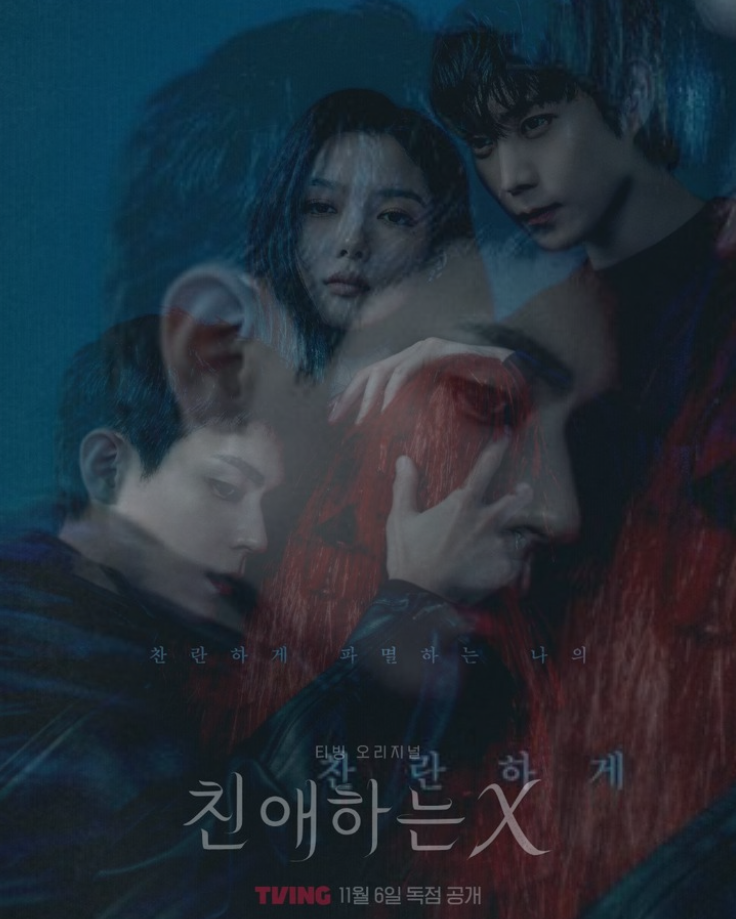
Inside the Mind of Dear X: A Psychological Breakdown of Kim Jae Oh
A detailed psychological deep dive into Kim Jae Oh, exploring how trauma, attachment, and emotional neglect shaped every major decision in Dear X.
Aya’s Introduction
When I first read Dear X, I thought I had it figured out. I had my opinions. I had my frustrations. I had my “why are you like this” moments. And honestly, I was ready to just write my review and move on. But before I did that, I started looking a little closer at the characters—trying to understand why they acted the way they did, why certain choices kept repeating, and why everything felt so emotionally messy. And… yeah. That opened up a whole new world.
The more I looked into Baek Ah Jin (played by Kim You Jung), Yun Jun Seo (played by Kim Young Dae), and Kim Jae Oh (played by Kim Do Hoon), the more I realised that none of them are “just toxic” or “just bad” or “just frustrating.” They’re all products of their environments, their trauma, their relationships, and the emotional tools they never learned how to use. So I decided to put all of that research, thinking, overanalysing, and emotional spiraling into these extended character breakdowns. This is for anyone who was just as curious as I was, but didn’t feel like going down a ten-tab research rabbit hole (because honestly… I get it).
One important thing before we dive in: I’m not a psychologist, therapist, or mental health professional. Everything in this analysis is based on personal research, reading, and my own interpretation of the story. I use psychological terms to help explain patterns and behaviours—not to diagnose these characters or present anything as medical fact. This is just me trying to understand them more deeply, make sense of their choices, and share that process with you. I’d also like to mention that I am in no way justifying their actions. Understanding the reason behind certain actions doesn’t justify the actions. People were killed. Lives were ruined. Those facts won’t ever be erased no matter how deep we dive.
We’ve successfully finished Baek Ah Jin’s Analysis (read here!). We completed Yun Jun Seo’s Analysis (read here!). Now, last but not least, let’s get into Kim Jae Oh.

*Table of Contents will be in the bottom right corner (because it’s a lot 🤭)*
Introduction: Usefulness as Identity
Some characters don’t chase love.
They wait to be used.
Kim Jae Oh is one of those characters.
On the surface, his story looks like loyalty. It looks like quiet devotion, unwavering presence, and a kind of reliability that never asks for anything in return. He doesn’t demand attention. He doesn’t compete. He doesn’t complicate things. He shows up, does what’s needed, and disappears back into the background without question.
And because of that, it’s easy to watch him and think: this is what selfless love looks like.
But the closer you look, the more that image starts to shift.
Because Jae Oh’s story isn’t about love in the way we’re used to understanding it. It’s about what happens when a person never learns how to exist outside of being useful. It’s about what happens when worth is measured through function, when presence is earned through service, and when being needed becomes the only proof that you’re allowed to be there at all.
What looks like calm on the outside is actually absence.
What looks like devotion is actually dependency without awareness.
And what looks like strength is, underneath, a survival pattern built on erasing the self before it ever has the chance to form.
This analysis isn’t here to romanticize him or reduce him to a victim.
It’s here to understand him.
To break down the psychology behind his obedience, the structure behind his silence, and the internal logic that makes even his most extreme choices feel consistent from his perspective. Because Jae Oh isn’t unpredictable once you really look at him.
He’s precise.
Terrifyingly so.
And once you see that pattern—once you understand how usefulness, identity, and survival fused into one system—you start to realize something even more unsettling:
Jae Oh didn’t lose himself at the end.
He was never taught how to have a self in the first place.
Part I – Jae Oh’s Psychology
When Love is Unstable, Usefulness Becomes Survival
Kim Jae Oh is often praised for his loyalty and love, but that interpretation misses what’s actually driving him. At his core, Jae Oh is not a character built on love—he’s built on usefulness. And underneath that usefulness is something much harder to look at: an almost complete absence of self.
To understand that, you have to start with his childhood.
Jae Oh grew up in chronic instability—abuse, an unpredictable father with potentially delusional thinking, and a home that never offered consistent safety or affirmation. In environments like that, children don’t develop a stable sense of being loved. Instead, something shifts early. The question stops being “Am I loved?” and becomes “What do I need to be in order to stay?”
And the safest answer is almost always the same: be useful.
Love can be withdrawn. It’s inconsistent, emotional, and dependent on someone else’s state. But usefulness feels measurable. It can be proven, maintained, and controlled. For a child in chaos, that distinction matters. It becomes the difference between feeling disposable and feeling necessary.
That’s the psychological framework Jae Oh grows up with.
So when Baek Ah Jin tells him she has use for him, she means it in a purely instrumental way. But for Jae Oh, it doesn’t land as something small or transactional. It lands as recognition. As validation. As purpose. As permission to exist.
That moment isn’t romantic. It’s foundational.
She doesn’t say, “I care about you.” She says, “You matter because you serve a function.” And to someone raised the way Jae Oh was, that doesn’t feel cold—it feels like stability. It feels like being seen in the only way that has ever made sense.
From that point on, Jae Oh isn’t looking for closeness. He’s looking for function.
That’s why throughout the story, he never demands affection, never questions her motives, and never asks for reassurance. Those aren’t needs he was taught to have. They don’t even register as something he’s entitled to.
Jae Oh doesn’t expect love.
He expects to be used.
And that’s what changes everything.
When Ah Jin manipulates him, it doesn’t register as cruelty. It registers as clarity. A defined role. A continued confirmation that he still has value within her world.
This is also where the gap between him and Yun Jun Seo becomes critical.
Jun Seo still operates with an internal line. His identity is tied to devotion, but it’s also tied to a moral boundary he can’t fully erase. Jae Oh doesn’t have that structure. His identity isn’t built on being good or even being loyal.
It’s built on being necessary.
Because of that, there isn’t a line that “can’t be crossed.” There’s only a question of whether the action fulfills a function.
Jun Seo would do almost anything—but not everything.
Jae Oh would do anything. Period.
Not because he’s more devoted, but because his sense of self isn’t anchored to morality at all. It’s anchored to usefulness. To being chosen. To completing a role.
And when that role exists, he exists.
When it doesn’t, he doesn’t.
Killing and The Line He Would Cross
This difference becomes even clearer when you look at the way Jae Oh responds to killing.
The important question isn’t “Did he kill someone?” It’s “What did that act mean to him?”
When Jae Oh kills his father, the situation checks none of the boxes his identity depends on. It isn’t planned. It isn’t controlled. It isn’t done in service of someone who explicitly needs him. It happens in chaos, not intention.
So instead of experiencing it as protection or sacrifice, he experiences it as loss of control.
Even if, logically, the act could be framed as saving his brother, that’s not how it registers psychologically. There’s no clear narrative of “I chose this for a reason.” No external validation of “you did the right thing.” No structure that turns the act into something meaningful.
It just exists as: I killed someone.
And for Jae Oh, that’s destabilizing.
Because without meaning, without function, the act doesn’t reinforce his identity—it strips it.
Jae Oh can tolerate extreme behavior, even violence, as long as it feels controlled and purposeful. If he can say, “I chose this,” “this serves someone,” or “this has a role,” then the action becomes something he can psychologically hold onto. It becomes proof of usefulness.
But this moment offers none of that.
It’s chaos. And for Jae Oh, chaos doesn’t just feel dangerous—it feels like erasure.
That’s why he spirals.
Not because he crossed a moral line, but because the act gave him nothing in return. No role. No validation. No structure to justify his existence within it.
And that’s where everything shifts when it comes to Ah Jin.
If Jae Oh were to cross that same line for her, the internal narrative changes completely. The act is no longer something that happened to him—it becomes something he chose.
Instead of “I lost control,” it becomes “I did this for someone.”
And that difference is everything.
Because now the action provides direction. Purpose. A reason to exist within it. It feeds the exact system his identity is built on.
This is also where the contrast with Jun Seo sharpens again.
Jun Seo collapses when his actions lose moral meaning.
Jae Oh collapses when his actions lose functional meaning.
He doesn’t need to be good.
He needs to be necessary.
Jae Oh didn’t break down because he killed someone.
He broke down because that act gave him nothing to hold onto.
No meaning. No role. No proof that he mattered.
Just emptiness.
And emptiness is the one thing he cannot survive.
What Happens When Usefulness Isn’t Rewarded?
If Ah Jin didn’t validate Jae Oh after he crossed a line for her, the damage wouldn’t just be emotional—it would be structural. He wouldn’t feel justified for long, and the fallout would be worse than if he had never done it at all.
Because for Jae Oh, the act itself is never the reward. What matters is what comes after.
When people say “he could kill for her,” it sounds like the action is the point. But psychologically, it isn’t. The real payoff is her reaction—her acknowledgement, her dependence, her choosing him because of what he did, and ultimately, her recognition of him as essential. That’s the part that gives the action meaning.
Internally, his thinking follows a simple but dangerous equation: I crossed the line, therefore I matter more to you now.
If that second half never materializes—if Ah Jin responds with indifference, distance, discomfort, or rejection—then the entire structure collapses. What he’s left with isn’t just regret, but a much more destabilizing realization: I did something irreversible… for nothing.
And that “for nothing” is what breaks him.
At that point, he’s forced to confront two realities at once. The first is that he crossed a moral line. The second, and far more damaging one, is that it didn’t make him necessary. Without that reinforcement, the identity he depends on starts to invert. What could have been framed as “I’m useful, even if it’s dark” becomes “I’m dangerous and still unnecessary.”
That is his worst-case identity.
But Jae Oh isn’t someone who can sit with that kind of internal collapse. His instinct wouldn’t be reflection—it would be correction. He would try to fix the meaning of what he did, and that effort can move in a few different directions, all of them unstable.
In one direction, he escalates. If the act didn’t secure his place, then maybe it wasn’t enough. He pushes further, does more, and tries to force a reaction that confirms his importance. The goal isn’t violence itself—it’s validation. But the methods become increasingly extreme because the original action failed to produce the outcome he needed.
In another direction, he distorts reality. Instead of accepting that the act didn’t matter, he convinces himself that it did—that Ah Jin does need him, she just won’t admit it. This allows him to preserve his identity without requiring her actual validation. The belief becomes self-sustaining, even if it disconnects him further from reality.
And then there’s the third possibility, which is the most internally destructive. He collapses inward. The conclusion becomes unavoidable: I went too far, and it still didn’t make me needed. From there, guilt and self-hatred don’t just exist—they take over. Not because he believes what he did was wrong in a moral sense, but because it failed in a functional one.
This is where the contrast with Jun Seo matters again. Jun Seo, at his lowest, still has a framework that allows him to say, “This was wrong.” That moral anchor gives his collapse a kind of structure.
Jae Oh doesn’t have that.
He doesn’t organize his identity around right and wrong. He organizes it around being needed. So when usefulness disappears, there’s nothing left to stabilize him. If he fully processes the idea that “I crossed a line and it didn’t make me matter,” then both of the systems that could have contained him—morality and function—fail at the same time.
And that’s when he becomes the most unpredictable.
Because now nothing stopped him, and nothing rewarded him. There’s no boundary, and there’s no purpose. What’s left is either self-destruction or a colder, more detached kind of danger where actions no longer need to mean anything at all.
The irony is that the very thing he believes will secure his place—crossing the line—is also the thing most capable of proving he never had one.
Jae Oh isn’t loyal in the way Jun Seo is. His attachment operates on a psychological transaction, even if he’s not consciously aware of it. At a structural level, the belief is simple: If I give everything, I become indispensable.
If that transaction fails, he doesn’t just lose Ah Jin.
He loses the logic that allows him to exist.
Did Jae Oh Love Ah Jin Romantically?
Not in the way romantic love is usually understood, but it’s not accurate to say he didn’t love her at all.
Jae Oh’s feelings are real, but they aren’t driven by desire—they’re driven by meaning. What can look like longing on the surface is actually something closer to reverence, attachment, and a kind of existential gratitude. His focus isn’t on possessing her or being chosen in a romantic sense, but on what she represents within his internal world.
He doesn’t look at Ah Jin and think, “I want her.” He looks at her and thinks, “I exist because of her.”
That distinction shapes everything.
Romantic love typically asks, “Do you choose me?” It assumes a baseline sense of self, where the relationship is something added onto an already existing identity. Jae Oh’s attachment asks a different question entirely: “Am I allowed to be here?”
That’s why he never competes with Jun Seo, never confesses, and never tries to redefine their relationship. He doesn’t need to be loved in a traditional sense. He just needs to remain within her orbit, in a role that confirms his existence.
So while his feelings can resemble love from the outside, they’re filtered through usefulness rather than intimacy.
He doesn’t want closeness.
He wants permission to continue being necessary.
Prison, Drawings, and The Preservation of Purpose
When Jae Oh is first sent to prison, we see him constantly drawing Ah Jin. The people around him notice it too—he draws her over and over, to the point where it becomes a defining habit. On the surface, it reads like romantic longing. But psychologically, it’s doing something much more specific.
Those drawings aren’t about imagining a future with her. They’re about maintaining continuity.
In an environment where everything is stripped away—freedom, autonomy, identity—Jae Oh holds onto the one thing that has consistently defined his worth. The drawings become a way to preserve purpose, to keep his internal structure intact, and to stay aligned with the person who gave his existence meaning in the first place.
He isn’t fantasizing.
He’s stabilizing.
That’s why his attachment can look distant on the outside but remain completely intact underneath. There’s no urgency in the way he holds onto her, because urgency would imply fear of losing something. Jae Oh isn’t trying to keep Ah Jin, he’s trying to maintain the version of himself that exists because of her.
And that version doesn’t require proximity.
Why He Doesn’t Go to Her
When Jae Oh is released from prison, the expectation would be that he immediately seeks Ah Jin out. If this were driven by love in a traditional sense, that’s exactly what he would do.
But he doesn’t. And that absence of movement is where his psychology becomes the clearest.
Jae Oh’s sense of usefulness was never situational, it was foundational. Ah Jin already gave him the core belief years ago: you matter because you’re useful. That idea doesn’t expire with time or distance. It embeds itself into his identity and continues to operate whether she’s physically present or not.
Because of that, he doesn’t need reassurance. He doesn’t need to check if he still matters. And he doesn’t chase her the way someone chasing love would.
He waits.
Not passively, but deliberately—the way someone waits for a signal.
To Jae Oh, seeking her out without being needed would feel like a violation of the role he’s built himself around. It would mean acting outside of function, inserting himself where he hasn’t been called. That doesn’t feel like connection to him, it feels like overstepping.
He doesn’t want to intrude.
He wants to be summoned.
That’s why it matters that Jun Seo is the one who brings Ah Jin back into his orbit. It reframes Jae Oh’s return not as desire, but as relevance. He isn’t reentering her life because he missed her, he’s reentering because there is now a reason for him to exist within it again. And if that moment never came, he wouldn’t go looking for it.
As long as he can hold onto the belief, “If she ever needs me, I’ll be there,” he has enough meaning to continue. That possibility alone sustains him. It keeps his identity intact without requiring confirmation.
Waiting, for Jae Oh, isn’t inaction. It’s survival.
When Function Meets Morality
Once Jun Seo pulls Ah Jin back into Jae Oh’s orbit, we immediately see both of them move into action for her sake. But even within that shared goal, their psychologies operate very differently.
Jun Seo approaches the situation trying to contain damage. He wants to prevent collapse, manage consequences, and preserve some version of moral balance—even if that balance is already compromised. His actions are still filtered through a need for things to make sense ethically.
Jae Oh doesn’t operate that way.
His focus is on execution. Remove the threat. Complete the task. Be effective.
Where Jun Seo is negotiating with morality, Jae Oh is aligning with function.
And the reason Jae Oh can move so cleanly in that space is because he doesn’t fear emptiness in the same way. Jun Seo fears losing himself to love. Jae Oh starts from the assumption that there is no “self” unless he’s being used. So instead of resisting that emptiness, he organizes himself around it.
Function doesn’t threaten him.
It defines him.
If She Never Needed Him Again?
The most tragic part of Jae Oh’s character isn’t what he does, it’s what he wouldn’t do.
If Ah Jin never needed him again, he wouldn’t chase her. He wouldn’t try to reinsert himself into her life or force a connection that no longer exists. Instead, he would continue living quietly, structuring his choices around the version of himself she created, and holding space for her without ever demanding her presence.
His attachment doesn’t require constant reinforcement the way Jun Seo’s does.
It requires possibility.
As long as he believes, “If she ever needs me, I’ll be there,” that belief is enough to sustain him. It gives him direction, even in her absence. It allows him to exist without needing proof.
What makes this worse is that nothing—loneliness, time, or even distance—would be enough to push him toward her. The breaking point wouldn’t come from missing her.
It would come from irrelevance.
If he ever reached a point where he truly believed, “She no longer exists in a world where I could matter,” that’s when the structure collapses. Because at that point, it’s not just that she’s gone, it’s that the role he built his identity around no longer has a place to exist.
Until then, he can wait. And for Jae Oh, waiting isn’t empty. It’s the only thing keeping him intact.
Jun Seo’s Warning and Why It Never Lands
This is where Jun Seo’s warning becomes important, not because it changes Jae Oh, but because it reveals just how different they actually are.
When Jun Seo says, “You’ll end up lost and empty like me,” the warning is meant to land as a consequence. It comes from someone who understands what it feels like to lose yourself completely to another person, to reach a point where there’s nothing left underneath that devotion.
But it fails on Jae Oh.
Not because he doesn’t understand it, but because it’s not something he fears.
Jun Seo fears emptiness because he remembers what it felt like to exist outside of it. His identity was built on love, loyalty, and moral tension, so losing those things feels like collapse. Jae Oh doesn’t have that same reference point. He isn’t trying to preserve a self that existed before Ah Jin. He’s trying to maintain the only version of himself that ever felt valid.
Where Jun Seo fears disloyalty, Jae Oh fears irrelevance. Where Jun Seo is afraid of becoming empty, Jae Oh starts from the assumption that he already is—unless he’s being used.
So the idea of ending up “lost and empty” doesn’t read as a warning to him. It reads as neutral. Familiar, even.
And that’s why he keeps moving toward Ah Jin without hesitation. From his perspective, there isn’t really a safer alternative. The path that leads to her is also the only path that allows him to exist with purpose. Anything outside of that isn’t stability, it’s absence.
Which is what makes his end feel less like a sudden tragedy and more like an inevitability. Not because he was reckless. But because, within his framework, this was the only way his life could logically resolve.
Pain, Secrecy, and The Cost of Staying
This same framework is what explains one of his quieter but most revealing behaviours: hiding his injuries after being beaten.
On the surface, it can be read as simple self-sacrifice or a desire not to worry Ah Jin. But the reasoning goes deeper than that. What Jae Oh is really protecting isn’t just her perception of him, it’s the structure of their relationship.
Their dynamic is built on something intentionally stripped of emotion. It’s functional, controlled, and clearly defined. If Ah Jin were to see the extent of his injuries, that structure would start to shift. She would be forced into a response—concern, guilt, or some form of emotional acknowledgment—and that would change the terms entirely.
His usefulness would no longer be clean. It would become a burden. And in that shift, he risks becoming someone she has to care about rather than someone she can rely on.
For Jae Oh, that is far more dangerous than the pain itself.
Because needing care introduces vulnerability. It requires acknowledgment. It creates the possibility of rejection in a space where he has only ever operated through function. Jae Oh doesn’t survive by being seen, he survives by making himself useful enough that being seen isn’t necessary.
So he hides it.
Not out of pride, but out of preservation.
Letting her know he was hurt would mean asking for something he was never taught to ask for. It would force her to see him not as a role, but as a person and that shift threatens everything he’s built his identity on.
At the same time, there’s a quieter, more unsettling layer beneath it. Jae Oh doesn’t just tolerate pain, he assigns meaning to it. Being beaten because of Ah Jin doesn’t fully register as injustice. Instead, it becomes proof of connection. Proof that he is still involved, still relevant, still within the space where he can matter. The suffering reinforces proximity in a way that feels almost stabilizing.
If he can endure it without complaint, then nothing has been disrupted and he still belongs.
So while part of his silence comes from fear of losing his role, another part of it comes from a belief that sits much deeper: if I suffer quietly, I get to stay. And for Jae Oh, staying—no matter the cost—is the closest thing he has to security.
Jae Oh’s Psychological Portrait
Jae Oh isn’t weak. He isn’t unintelligent. And he isn’t blindly romantic.
He’s someone who learned, very early on, that worth had to be earned through service. Someone who adapted to instability by becoming useful, and then built his entire identity around that adaptation. Over time, function replaced love, and usefulness replaced selfhood, until there was nothing left underneath it.
He survives by being needed. And without that, he doesn’t know how to exist.
That’s why his story doesn’t end with a dramatic internal conflict or a moment of realization. There’s no sudden awareness, no shift toward self-preservation, because there isn’t a stable self there to protect.
His trajectory stays consistent all the way through and that consistency is what makes it so difficult to watch. Because his tragedy isn’t just that he died for Ah Jin, it’s that he never believed he was allowed to live for himself.
Part II – The Sacrifice
Why It Made Sense and Why It Was Still Selfish
We finally reach the moment that defines Jae Oh completely: his sacrifice.
When he says, “My life was yours to use anyways,” it doesn’t come from exaggeration or emotion. It’s not a dramatic line, it’s a direct statement of how he understands himself. That belief has been quietly shaping every decision he’s made long before this moment.
At his core, Jae Oh operates on a simple internal logic: a life without purpose is wasted, being used is better than being nothing, and death is acceptable if it completes the function. This is instrumental self-worth pushed to its absolute limit, where existence only holds value if it serves something or someone else.
From his perspective, dying for Ah Jin isn’t tragic. It’s efficient.
And that’s what makes the scene so unsettling. Because while it looks like devotion, what’s actually happening is the final, complete alignment of his identity with a single outcome: to be useful in a way that cannot be undone.
But the part that makes it harder to sit with is how small the sacrifice actually is in terms of impact.
Jae Oh barely makes a dent in Moon Do Hyeok’s life. His death doesn’t dismantle power, doesn’t secure Ah Jin’s future, and doesn’t meaningfully shift the system working against her. It isn’t heroic, and it isn’t cinematic.
It’s just a man making sure his life means something before it ends. And that’s where the quiet selfishness comes in.
Not selfish in the sense of intention—he isn’t trying to hurt anyone—but in the way the act ultimately resolves his need more than it protects her future. The sacrifice closes his loop. It gives him certainty, purpose, and completion. Whether it truly helps Ah Jin long-term becomes secondary to the fact that it allows him to finally feel like he mattered.
Why He Didn’t Just Kill Do Hyeok
On the surface, killing Moon Do Hyeok feels like the more impactful choice. It’s the action that could have changed the outcome in a larger, more concrete way. But psychologically, Jae Oh was never built for that kind of agency.
That path would have required initiative, long-term planning, and a belief that he has the right—or the ability—to shape outcomes. It also would have required him to act not just for Ah Jin, but partially from himself.
Jae Oh doesn’t operate like that. He doesn’t think, “I will fix this.” He thinks, “Tell me how to be used.”
So when Ah Jin calls him, he isn’t analyzing options or constructing a strategy. He’s asking one question: what version of me is needed right now? And the answer he arrives at isn’t the one that creates the biggest impact, it’s the one that creates the clearest function. The version of him that sacrifices himself. Recording his own death isn’t about justice. It’s about certainty.
Every alternative carries instability. Killing Do Hyeok leads to unpredictable consequences. Fighting back introduces variables. Escaping leaves things unresolved. All of those options require him to live within uncertainty, to exist in a space where the outcome—and his value within it—can’t be guaranteed.
But dying is different. It’s final. Controlled. Unchangeable.
No one can undo it, ignore it, or reinterpret it in a way that strips it of meaning. For someone whose entire identity depends on being useful, that level of certainty matters more than scale, more than impact, and more than long-term consequences.
Even if the result is small, the meaning is absolute.
So while, from the outside, his choice can feel trivial or ineffective, that isn’t the metric he’s using. He isn’t measuring success by how much changes. He’s measuring it by how clear the equation is.
My death → helps her, even slightly → therefore my life had purpose.
And for Jae Oh, that is enough.
The Peace That Isn’t Really Peace
If you look at the moment before he dies (the picture at the top), there’s a kind of calm on his face that can easily be mistaken for peace. But it isn’t relief from life itself, it’s relief from uncertainty.
For the first time, everything aligns. He knows what he’s doing, why he’s doing it, who it’s for, and most importantly, that it will count. There’s no ambiguity left, no question about whether he matters, no instability in how his actions will be understood.
That clarity is what he’s been chasing his entire life. So what we’re seeing isn’t joy in death, it’s satisfaction in purpose. He isn’t thinking, “I want to die.” He’s thinking, “This is a good way to end.” And that distinction matters, because it reframes the act entirely. This isn’t someone choosing death out of despair. It’s someone choosing the only option that guarantees meaning.
If Jae Oh could have found that same level of certainty while living—if he could have existed in a role that consistently validated his usefulness—he would have taken it. But he never did.
So death becomes the only place where that certainty is finally, and completely, guaranteed.
Did He Always Know He’d Die for Her?
Not consciously, but structurally, yes.
From the moment Jae Oh’s identity formed around the belief “I exist by being useful,” and Ah Jin became the centre of that system, the trajectory was already in place. It wasn’t something he planned, but it was something he was always moving toward.
Because in that mindset, usefulness doesn’t have a natural limit. It escalates.
What starts as helping gradually becomes sacrifice. Sacrifice deepens into self-erasure. And self-erasure, if left unchecked, eventually reaches a point where the only thing left to give is your life. The progression doesn’t feel extreme from the inside, it feels consistent. Each step simply becomes the next logical extension of the last. That’s why his end doesn’t come out of nowhere.
He may not have been consciously preparing for it, but nothing about it contradicts who he’s been all along. In that sense, his arc mirrors Jun Seo’s. Both of them were always heading toward where they ended, just through different internal systems. Jun Seo’s unraveling becomes more visibly unstable toward the end, while Jae Oh remains steady. But that steadiness is exactly what makes his outcome feel inevitable.
The Call That Set Everything In Motion
If there’s a single moment that activates that trajectory fully, it’s Ah Jin’s call.
When she reaches out to him for help, two things happen at once: she needs him, and she chooses him specifically. That combination is enough to immediately reactivate his entire sense of identity. It pulls him back into alignment without hesitation.
But this time, something is different.
Jae Oh isn’t operating from the same level of belief in outcomes anymore. He’s seen too much, failed too many times, and understands—at least on some level—that he can’t fix her life in any lasting way. So the question shifts.
Instead of “How do I solve this?” it becomes “What is the most absolute way I can matter here?”
And that’s where his thinking narrows. He doesn’t look for the most effective option. He looks for the most certain one. The one that cannot be undone, ignored, or reduced. Something irreversible. Because irreversibility guarantees meaning in a way nothing else can. That’s where his mind lands.
What About His Brother?
This is where the tragedy sharpens, because Jae Oh’s capacity for care isn’t absent, it’s structured.
It’s not that he didn’t love his brother. It’s that his internal hierarchy doesn’t organise itself around love. It organises itself around purpose. And that hierarchy is brutally simple: the person who defines his purpose comes first, and everyone else exists after that.
So in his final moments, his mind doesn’t go to “Who do I love?” It goes to “Did I fulfill my role?” Those two questions have never been the same for him.
Allowing himself to fully think about his brother in that moment would introduce something his psyche can’t afford: conflict. It would bring in guilt, hesitation, and doubt, all of which disrupt the clarity he’s relying on to follow through.
So his mind narrows. It fixates. It simplifies everything down to one question he knows how to answer.
That narrowing is also why he feels no regret. From his perspective, this isn’t failure. It’s completion. Not in a moral or objective sense, but within the structure that has defined his entire life. He answers the only question that has ever mattered to him: was I useful enough to justify my existence?
And in his mind, the answer is yes.
Was Jae Oh’s Sacrifice Lowkey Selfish?
Yes.
As tragic as his death is, it’s still important to acknowledge that, at its core, it was selfish. Not in a cold or intentional way, but in a way that’s driven entirely by identity. The kind of selfishness that feels like devotion from the inside, because it aligns perfectly with what the person believes they’re supposed to be.
Jae Oh’s choice isn’t about pleasure, escape, or avoidance in a shallow sense. It’s selfish because he chooses the option that resolves his internal need for meaning, rather than the one that maximizes Ah Jin’s long-term survival.
That distinction matters.
In theory, there were other paths available to him. He could have gathered evidence more strategically, stayed alive to support her over time, or worked toward something that had a more lasting impact. All of those options are future-oriented. They require patience, the ability to tolerate uncertainty, and a belief that his continued existence has value.
Jae Oh doesn’t have that framework.
Instead, he chooses immediacy, certainty, and finality. Not because it’s the most effective path, but because it guarantees one thing: this mattered. That guarantee is more important to him than outcome, scale, or sustainability. So the selfishness comes from prioritizing emotional resolution in the present over practical impact in the future.
And when you look at the situation realistically, that gap becomes even clearer. Moon Do Hyeok holds significant power—enough that Jae Oh himself is aware his death won’t dismantle anything in a meaningful way. On top of that, he knows there are deeper layers to the situation, including the existence of Do Hyeok’s hidden ex-wife. None of that changes his decision.
Which is exactly the point. This isn’t about strategy. It’s about certainty.
Why He Doesn’t Choose the “Better” Option
The reason Jae Oh doesn’t take the more effective path comes down to how he defines “better.” For him, better doesn’t mean more impactful. It means more clear.
Long-term solutions are unstable. They require him to live in questions he doesn’t know how to hold: What if this doesn’t work? What if she doesn’t need me later? What if I fade out again? Those possibilities introduce a kind of uncertainty that directly threatens his sense of self. Because if his value can fluctuate, then it isn’t secure. So he avoids that entirely.
He chooses the path where the outcome is fixed, the meaning is guaranteed, and his role cannot be questioned or taken away. In that sense, his decision isn’t impulsive, it’s consistent with everything he’s been building toward internally.
A Different Kind of Selfishness
This is also where the contrast with Jun Seo becomes clearer again:
Jae Oh’s selfishness is self-validating: let me prove I mattered before I disappear.
Jun Seo’s selfishness is possessive: if I go down, you come with me.
Both are rooted in distorted forms of attachment, but they move in completely different directions. Jun Seo tries to take someone with him. Jae Oh tries to solidify himself before he’s gone. And that difference comes back to how each of them defines existence.
Jae Oh’s devotion isn’t pure, it’s conditional at a structural level. The internal equation has always been the same: I give everything, therefore I become necessary, therefore I exist. His final act doesn’t break that pattern. It completes it.
That’s why, from his perspective, the ending feels satisfying. Not because it changes anything externally, but because it resolves the only question that ever mattered internally.
Why He Didn’t Do More
This is also why Jae Oh never truly plans for Ah Jin’s future in a long-term sense. He doesn’t believe in a version of reality where he exists alongside her over time. That possibility was never something he built his identity around, so it never becomes something he works toward. Without that belief, there’s no reason to think in terms of sustainability or continued presence.
He isn’t asking, “How do I help her live better?”
He’s asking, “What can I do right now that proves I was worth something to her?”
Those are two completely different goals. And once that distinction is clear, his choice stops looking irrational. It becomes inevitable.
The Real Meaning of His Death
Jae Oh didn’t die a hero. He died believing he finally became one. And those two things are not the same.
He didn’t sacrifice his life because it would meaningfully change the outcome or secure Ah Jin’s future. He sacrificed it because it was the only way he could prove—to himself—that his life had already meant something.
That distinction is what makes his ending so unsettling.
Because it isn’t driven by hope, or even by desperation. It’s driven by resolution. A quiet, internal conclusion that this is the one action that finally aligns everything—his past, his purpose, and his worth—into something undeniable.
And the worst part isn’t just that he dies. It’s that, in that moment, he feels at peace.
Part III – Why His Story Feels So Seductive
The Fantasy of Being Chosen at Any Cost
Jae Oh’s story works because it taps into a very specific, very human fantasy: what if I mattered so much to someone that they would give up everything for me?
On the surface, that kind of devotion feels rare, intense, and almost romantic. It reads as proof of importance. Proof that, in a world where people leave, hesitate, and prioritise themselves, there is someone who wouldn’t.
But what makes that fantasy so dangerous is what it quietly removes.
Because the version of devotion Jae Oh represents doesn’t come from mutual choice. It doesn’t come from two people independently deciding to love each other, to stay, to sacrifice when necessary. Instead, it comes from a system where one person’s identity is entirely built around the other.
And that changes everything.
A partner like Jae Oh doesn’t choose you in the way we typically understand choice. He doesn’t weigh options, consider himself, and then decide to stay. He disappears into you. His devotion isn’t an action, it’s his entire structure. Which means there’s no real equality in it.
There’s no space for negotiation, no room for disagreement, and no ability to step back without collapsing the entire relationship. What looks like unconditional love is actually the absence of a self strong enough to exist outside of it. And without that, even devotion loses its meaning. Because sacrifice only holds value when it’s a choice.
Why It Feels Like Love—Even When It Isn’t
Part of what makes Jae Oh’s dynamic so compelling is how easily it can be mistaken for something pure.
He doesn’t ask for much. He doesn’t demand attention. He doesn’t compete, control, or try to possess Ah Jin in an obvious way. Compared to more aggressive or emotionally volatile forms of attachment, his presence feels steady, quiet, almost safe.
But that quietness isn’t stability. It’s absence.
Jae Oh isn’t choosing restraint, he simply doesn’t operate from a place where his own needs are centered enough to be expressed. What looks like selflessness is actually the result of a person who doesn’t believe he has the right to want anything. So the relationship never becomes mutual.
It becomes one-directional, where one person defines meaning and the other exists to fulfill it. And because that system runs so smoothly on the surface—no conflict, no demands, no resistance—it can easily be misread as ideal. But it isn’t sustainable.
Because the very thing that makes it feel appealing is also what makes it dangerous.
Devotion without choice
This is where both Jae Oh and Jun Seo intersect, even though their expressions look different.
Neither of them is truly choosing Ah Jin from a place of stable identity.
Jun Seo’s devotion comes from fusion—he loses himself through love, replacing his moral framework with loyalty. Jae Oh’s devotion comes from function—he never develops a self outside of being useful in the first place.
But the result is similar. Neither of them has the ability to step back and ask, “Is this something I want?” because their sense of self is already tied to the answer. And that’s what makes their devotion feel so intense, but also so unsettling.
Because it isn’t grounded in freedom. It’s grounded in necessity. Which means their endings aren’t just tragic, they’re accurate. Both of them follow the only paths their identities allow.
Part IV – What If?
If Jae Oh Never Met Ah Jin
It’s easy to assume that Jae Oh’s life would have been better if he had never met Ah Jin. On the surface, she looks like the catalyst that pushed him toward his end.
But that only holds up if you ignore what was already there.
Jae Oh doesn’t start as a stable person who is later broken by her. He starts as someone already shaped by instability—an abusive father, no consistent sense of worth, and a belief system built around survival through usefulness. That foundation exists long before Ah Jin enters the picture.
So removing her doesn’t remove the core problem.
It just removes the direction it took.
Without Ah Jin, Jae Oh is still left with the same internal equation: I only matter if I am useful to someone. And a system like that doesn’t stay inactive. It looks for something—or someone—to attach itself to.
Which leads to two likely outcomes.
In one version, he finds someone else who gives him purpose, and the cycle repeats in a different form. The details change, but the structure stays the same. He attaches, adapts, and erases himself in order to maintain that connection.
In the other version, he doesn’t find that anchor at all.
And without it, there’s nothing to organize his identity around. That doesn’t lead to freedom—it leads to collapse. Without usefulness, he isn’t left with a hidden, healthier self waiting to emerge. He’s left with emptiness, and no framework to survive it.
So instead of a slower, directed unraveling, his trajectory likely becomes shorter and more chaotic.
Which is why, in a difficult way, Ah Jin doesn’t create his damage.
She contains it.
She gives it structure, direction, and something to hold onto. Not in a way that heals him, but in a way that allows him to function longer than he otherwise might have.
It’s not better.
But it’s not necessarily worse either.
It’s just more defined.
Does It Depend On Who They Meet?
This is where the story becomes less about individual choices and more about timing and alignment.
Because the answer isn’t simply yes or no.
Trauma builds the foundation.
Relationships decide the architecture.
Who they meet doesn’t create their core wounds, but it determines how those wounds take shape, how they express themselves, and how far they’re allowed to go. The same underlying psychology can lead to very different outcomes depending on what—or who—it attaches to.
Ah Jin didn’t invent Jun Seo’s devotion.
She gave it a target.
Jun Seo didn’t create Jae Oh’s self-erasure.
He revealed what that path looks like when it’s fully realized.
None of them entered the relationship as blank slates. They came in already shaped by their own survival mechanisms, already leaning in certain directions. What happened between them wasn’t random—it was a kind of psychological alignment that locked those patterns into place.
They didn’t ruin each other by accident.
They met at exactly the wrong angles.
A Closed System With No Exit
Once those dynamics connect, they stop being separate.
They become a system.
A closed one.
Within that system, love turns into leverage, loyalty replaces identity, and meaning becomes something that has to be earned through suffering. Each person reinforces the others’ worst patterns, not out of intention, but because those patterns fit together too well.
And the more they interact, the harder it becomes to step outside of it.
Because stepping outside would require a version of themselves that none of them have developed yet—one that exists beyond survival mode, beyond control, beyond usefulness.
If even one of them had encountered something different at the right time—a healthier attachment, a stable environment, a moment of interruption—the trajectory could have shifted. Not erased, but redirected.
But that’s not the story being told.
They meet too early.
Before any of them understand who they are without the systems that kept them alive.
Why The Ending Feels Inevitable
This is why the ending doesn’t feel shocking.
It feels inevitable.
Nothing that happens at the end contradicts who they’ve been from the beginning. There’s no sudden transformation, no last-minute shift into a healthier version of themselves. Each character follows through on the logic they’ve been operating under the entire time.
Jun Seo doesn’t suddenly develop a stable sense of self.
Jae Oh doesn’t suddenly choose to live for himself.
Ah Jin doesn’t suddenly become emotionally accountable.
They all arrive exactly where their psychology has been leading them.
And that’s what makes it feel so bleak.
Not because it’s unexpected, but because it’s consistent.
Because at no point were they moving in a different direction.
Part V – Their Endings, Explained
Ah Jin’s Ending
Ah Jin survives, but her ending is a collapse of a different kind.
Not emotional, but structural.
Characters like her don’t break because they suddenly feel overwhelming guilt or develop self-awareness. They break when the systems they rely on stop working—when control slips, when narratives turn against them, and when the leverage they’ve carefully maintained disappears.
Her downfall isn’t about punishment.
It’s about exposure.
Once the image she built can no longer hold, everything underneath it becomes visible. And without control, she loses the one thing that allowed her to function the way she did.
That outcome isn’t dramatic—it’s accurate.
Jun Seo’s Ending
Jun Seo’s death isn’t a twist.
It’s completion.
From a psychological standpoint, his identity is fused to Ah Jin. His sense of self doesn’t exist independently—it exists in relation to her. At the same time, his morality remains rigid. He cannot cross certain lines, even for her, and that creates a constant internal conflict between what he feels and what he can allow himself to do.
As everything collapses, that conflict becomes unsustainable.
His guilt outweighs his desire to keep living, and once his role in Ah Jin’s life begins to break down, so does the only structure holding his identity together. There’s no version of the future where he can both preserve his moral boundaries and maintain the connection that defines him.
So the options narrow.
Living without her would require something he isn’t capable of—choosing himself. It would mean building a life that exists outside of her, or accepting that his life has no inherent meaning without that attachment. Neither of those are psychologically accessible to him.
Driving off the road with her isn’t impulsive.
It’s the only resolution that preserves his loyalty, avoids moral transgression, and ends the conflict he can no longer sustain.
Death, for Jun Seo, becomes coherence.
And there’s nothing romantic about that.
Jae Oh’s Ending
Jae Oh’s death operates on a completely different system, but it’s just as consistent.
His sacrifice isn’t driven by love in the way it’s often framed. It’s driven by the need to confirm that his life had value. Everything about his identity is built on one belief: if I am useful, then I deserve to exist.
Dying for Ah Jin becomes the ultimate proof of that.
It’s not an emotional exaggeration or a dramatic gesture—it’s the most complete version of the equation he’s been living by. In that moment, there’s no ambiguity left. His purpose is clear, his role is fulfilled, and his existence finally feels justified.
That’s why his ending feels so unsettling.
Because from the outside, it looks tragic and unnecessary.
From the inside, it feels correct.
Why It Works
This is where the writing stands out.
Whether or not the writers were thinking in clinical terms, they understood the emotional mechanics behind these characters. The patterns are too consistent to feel accidental: identity fusion in Jun Seo, instrumental attachment in Jae Oh, selective empathy and control in Ah Jin, and guilt functioning as both a motivator and a restraint.
These aren’t random traits.
They’re systems.
And the story allows those systems to play out without forcing resolution. There’s no sudden redemption, no artificial moral balance, and no last-minute healing that contradicts everything we’ve seen. Instead, each character follows through on the logic that has been guiding them from the beginning.
That’s what makes it feel different.
Some stories get the terminology right but fail to reflect it in behavior. This one does the opposite. It may simplify labels or lean into buzzwords at times, but it gets the behavior right—and that’s what carries the weight.
Food For Thought
This isn’t a tragedy because of what happens.
It’s a tragedy because of what never had the chance to happen.
None of them learned how to exist without attaching their worth to something external. Not to control, not to love, and not to usefulness. Every choice they make is consistent with that limitation, which is why the ending doesn’t feel forced—it feels inevitable.
They don’t fall apart at the end.
They arrive exactly where they were always going.
And that’s what makes it hurt.
Final Thoughts
Some characters spend their lives trying to be loved. Jae Oh spent his trying to be needed.
And in the end, he got exactly what he was built to want. Not a future. Not a relationship. Not even a life that was his own. Just one moment where everything aligned—where he knew what he was doing, who it was for, and that it would finally mean something.
From the outside, it looks like loss. From the inside, it felt like completion. And that’s what makes his story so hard to sit with. Because nothing about his ending is accidental. It isn’t a sudden collapse or a tragic misstep. It’s the cleanest, most consistent outcome of a life built on usefulness as identity. Every choice, every silence, every act of obedience was moving toward that exact point.
He didn’t fall apart. He followed through. The same is true, in different ways, for all of them.
Jun Seo didn’t suddenly lose himself at the end—he reached the limit of a life built on loyalty without selfhood. When that structure broke, there was nothing left to hold him up.
Ah Jin didn’t suddenly face consequences—she ran out of control. Once the systems she relied on stopped working, there was nothing left to protect her from exposure.
And Jae Oh didn’t choose death in a moment of desperation. He chose the only ending that made his existence feel undeniable.
None of them changed direction. They arrived. That’s why Dear X doesn’t feel like a story about twists or shocks. It feels like something unfolding exactly as it was always going to. Not because the characters were doomed in a dramatic sense, but because they were never given the tools to become anything else.
They didn’t know how to love without losing themselves. They didn’t know how to exist without attaching their worth to something external. And they never learned how to stop.
So in the end, Jae Oh doesn’t leave behind a legacy, or a future, or even a version of himself that continues on. He leaves behind a question.
If your entire life is built on being useful to someone else…
what’s left when you finally prove yourself?
For Jae Oh, the answer was simple.
Nothing.
And for the first time, that felt like enough.
And now we give a sad wave and goodbye to Dear X and it’s characters because that’s a wrap! In all honesty this has been sitting in my google docs for weeks, so it feels a little weird that it’s finally being posted. I’m gonna miss that nagging feeling to finally post Kim Jae Oh’s analysis. I don’t know if I can blame my busyness or my hesitation to say a final goodbye to Dear X as a whole.
I was so obsessed with Dear X and it’s psychology that I’m a little sad to say goodbye. Nevertheless, it’s time to move on to other things. I have so many dramas and movies that I’m ready to review so I have to say goodbye.
On the other hand, I really hope you enjoyed this little series and are as ready to move on as I am. We’ve got an exciting couple of dramas and movies coming up so get ready for that. Things are still hectic and busy so I can’t promise it’ll be next week but I haven’t forgotten you! (and I just renewed the website so I can’t abandon you or the money that went into this.)
I’ll see you soon and I can’t wait for the reviews that will be coming out soon! I meant to post this on Friday but didn’t get a chance so ignore the fact that it’s posted on a Sunday. My posts will continue to be posted on Fridays!
If you want to watch Dear X, you can find it on Viki and Disney+!
See you next time! 💕


Find Your Next Watch!


