
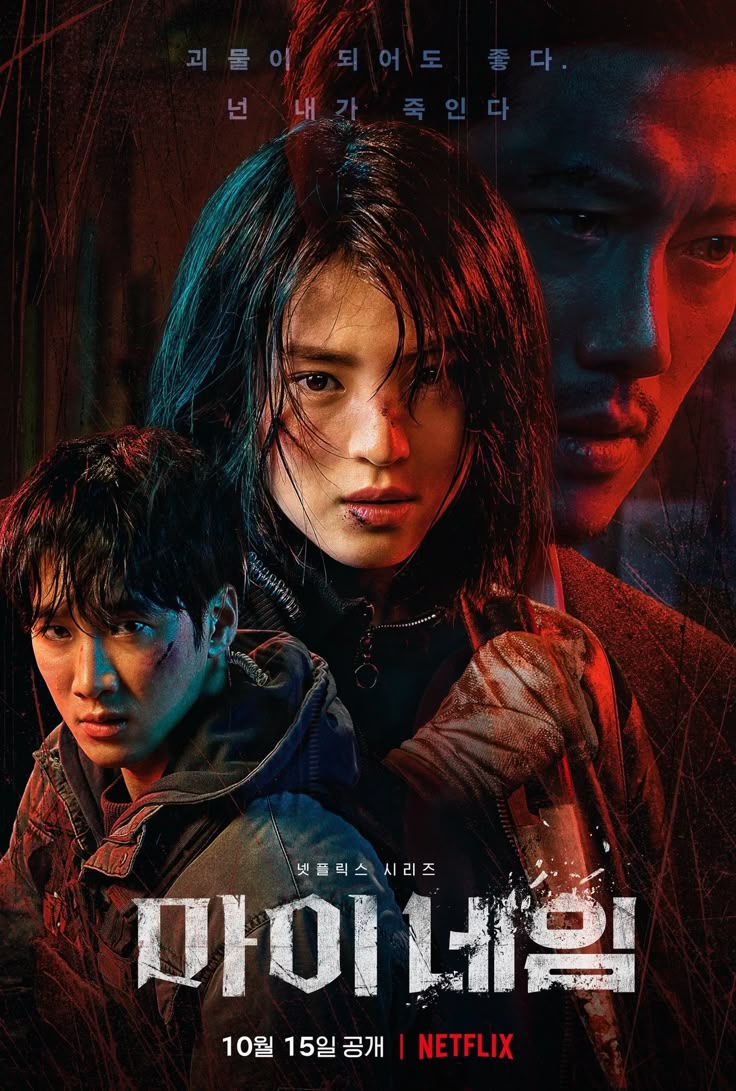
‘My Name’ Review: Revenge, Betrayal, and the K-Drama That Started It All
A near masterpiece that opened a new world for me, even if I had to rewrite the ending in my head.
Korean Drama Name: 마이 네임 (My Name)
Where To Watch: Netflix ← *Click for direct link*
Average Rating: 8.7/10 (Mydramalist)
My Rating: 9.5/10
One Sentence Description: A drama that starts with fire and ends in heartbreak, with a lead who deserved more than pain and betrayal.
Trailer:
Disclaimer: This review is 100% my opinion — I’m not here to hate, just to share my thoughts! Also, SPOILERS AHEAD, so proceed with caution if you haven’t watched yet. Watch it, come back and let’s see if you agree. Let’s keep the discussion respectful and fun! 💕
CONTENT WARNING:I hope you’ve already seen this show and know what the deal is. But in case you don’t, I felt like I should add in a little warning. This show has slight mentions of Sexual Assault. And since this is a review, I do also talk about this (in relation to the show only). Please be aware of that before you continue and be mindful of it. Stay safe ❤️
Simple Description
My Name follows a fierce young woman determined to hunt down her father’s killer.
⚠️Length Note: This post includes a detailed (and long) story breakdown. Want to skip straight to the review? Jump to the Review
We first meet Yoon Ji Woo heading to school, trailed by police and bullied by classmates because of who her dad is. To top it all off, it’s her birthday. What a way to celebrate.
That night, her father calls to say he won’t make it home, and Ji Woo—hurt and fed up—tells him not to bother coming back. But he does come back… just not in the way she expected. He’s gunned down right at her doorstep, collapsing in front of the door as Ji Woo desperately tries to reach him. He dies, and at his funeral we meet Mu Jin, the leader of the gang her father belonged to.
When detectives drop the case (he was most wanted, so they’re not exactly rushing to solve it), Ji Woo turns to Mu Jin for help. At first he rejects her, but after she gets kidnapped and he swoops in to save her, he finally takes her in. He sends her to a gym by the docks, where she’s stuck scrubbing dishes and folding laundry… but Ji Woo is determined. She trains after hours, pushing herself until she can take down a whole group of men in a brutal fight and still be the last one standing. Absolute queen moment.
Bitter from losing, Gang Jae and his friend spike her drink and try to assault her. Even half-conscious, Ji Woo fights back and stabs Gang Jae in the gut. Mu Jin punishes him by slicing his cheek and kicking him out of the gang (but trust me—he’ll be back).
From there, Ji Woo takes on a new identity, Hye Jin, and becomes fully immersed in Mu Jin’s world. Years later, she’s even embedded in the police force as his spy, working in narcotics while secretly keeping her eye on Captain Cha, the man she suspects killed her father.
Enter Pil Do, who gets stuck partnering with Ji Woo on a drug operation. Together they plan to capture Mu Jin, but the mission falls apart when a gunshot “accidentally” lets him escape. Behind the chaos, Ji Woo secretly plants the gun that killed her father (given to her by Mu Jin) to trigger a new investigation. But when Captain Cha checks everyone’s weapon, Ji Woo’s gun is still fully loaded. So if she didn’t fire the shot… who did? (it was her.)
Meanwhile, Gang Jae returns for revenge. After years of hiding, he storms the gym, massacres everyone but one, and smears blood across the walls as a warning: I’m back. Mu Jin scrambles to contain the fallout, ordering his people to stay quiet—which leaves the task force, and Ji Woo, with nothing but dead ends.
While Mu Jin and Captain Cha clash behind the scenes, Ji Woo waits for the forensic results on her father’s gun. The task force confirms Gang Jae was behind the gym massacre and sees this as a chance to bait Mu Jin, knowing he won’t let the attack go unanswered. Ji Woo, still loyal to the organization, secretly tips Mu Jin off about the trap being set for him.
Meanwhile, Captain Cha believes someone inside the gang will flip and arranges a meeting. Ji Woo tails him, but she runs into Pil Do along the way, and the two clash before chaos breaks out. In the confusion, Ji Woo slips away and spots Tae Ju (the lone massacre survivor) meeting with Cha. She immediately warns Mu Jin, but when Cha’s plan with Tae Ju turns out to be a decoy, his suspicions about Ji Woo deepen.
Cha then has Pil Do investigate Ji Woo’s background, while Ji Woo herself learns that the murder weapon once belonged to a narcotics recruit who died years ago. Later, Ji Woo and Pil Do stake out Gang Jae only to realize they’ve walked into a trap. Both are captured, while Mu Jin himself is also ambushed by Gang Jae’s men. Turns out, Gang Jae has been pulling the strings this whole time.
Gang Jae stabs Ji Woo in the leg and lures Mu Jin to his location. Meanwhile, Ji Woo and Pil Do are trapped in a car being crushed by machinery. Just when it seems like it’s over, Mu Jin crashes into the control panel and stops the machine. Ji Woo escapes and rescues Pil Do. Mu Jin vanishes again, but Captain Cha’s suspicions deepen. Why would Mu Jin risk his life to save them?
Cha begins bugging Ji Woo’s phone, monitoring every call. Around this time, Sergeant Cho, the cop who followed her back in high school, reappears and instantly recognizes her. Strangely, he covers for her. In a secret meeting, he reveals that Cha buried the case involving her father’s murder.
Soon after, Mu Jin kills Sergeant Cho, who had been accepting bribes to stay silent. Ji Woo, still loyal, tips Mu Jin off that Gang Jae plans to flee the country by boat. But Gang Jae flips the script; he makes a deal with the cops and lures everyone to the same location.
Mu Jin and the police arrive, but Cha holds them back while Gang Jae and Mu Jin fight. Ji Woo, unaware of the operation, rushes toward the chaos. Pil Do watches as Gang Jae stabs Mu Jin repeatedly. Ji Woo pulls a gun on Gang Jae. Knowing her cover will be blown if he’s arrested, she shoots him — with Pil Do witnessing everything. Mu Jin escapes yet again.
Days later, Ji Woo receives a package from Gang Jae containing a photo of her father in a police uniform. The name on it? Song Joon Su. The very same recruit who supposedly died years ago. With that, Ji Woo realizes Sergeant Cho’s death wasn’t random. The deeper she digs, the clearer it becomes: the police may have been involved in her father’s murder all along.
Ji Woo eventually tracks Mu Jin down in the mountains while he’s recovering and demands the truth. Mu Jin spins a story: her father used to be a cop, but he betrayed them after saving his life. According to Mu Jin, Captain Cha killed him for switching sides.
Doubtful that Ji Woo has the guts to kill Cha, Mu Jin orders Tae Ju to do it instead. That night, Tae Ju ambushes Captain Cha in his apartment, stabbing him repeatedly. Ji Woo arrives moments later, finds Cha bleeding out, and finally reveals who she is. With his last strength, Cha gives her an envelope before she escapes out the window—right as Pil Do arrives.
Inside the envelope lies the devastating truth. Ji Woo’s father had never betrayed the police—he had been loyal to them the whole time. He was working as a mole inside Mu Jin’s operation, secretly feeding reports back through a typewriter and even hiding a tracker in a lighter he gifted Mu Jin. When Mu Jin discovered this, he realized Ji Woo’s father had been playing him all along. The envelope contains a letter her father wrote to Cha confirming everything. The betrayal shatters Ji Woo, and in anguish, she burns the organization’s brand off her chest.
From there, Mu Jin marks Ji Woo for death. She’s kidnapped and submerged in a bath of water, but she fights back fiercely. In the chaos, she discovers that it was actually Tae Ju who killed her father. Fueled by rage, Ji Woo battles through Mu Jin’s men and ultimately kills Tae Ju herself. Period.
The police prepare to take down Mu Jin, but he strikes first—showing up on his own to frame Ji Woo. Though she’s arrested, Mu Jin shockingly arranges for her release, wanting her to come after him directly. Pil Do learns the truth about her past and chooses to trust her completely. The two spend the night together, and the next morning, they head back to the station. But just as they’re about to turn in, Mu Jin ambushes them on a motorcycle and shoots Pil Do in the head.
Heartbroken and fueled by revenge, Ji Woo storms Mu Jin’s club. She guns her way through his men until she comes face to face with him. After a tense exchange, they drop the guns and agree to settle things with knives. The fight is brutal, bloody, and personal. Just when it looks like Ji Woo is finished, she turns the blade on Mu Jin and slashes his throat. She watches him die, finally ending the nightmare.
In the final scenes, Ji Woo visits the graves of both her father—the man she now understands was loyal to the end—and Pil Do, the man she loved and lost.
The End.

The Review
The Good
I Love Fierce Main Leads
If you’ve read my other reviews, you already know that I love when female characters take control and get revenge for themselves. Ji Woo didn’t just survive, she dominated. She stood her ground, trained relentlessly, and became one of the strongest fighters in the entire show. That scene where the men tried to assault her and she said, “Not today”? Iconic. I’m always here for unapologetic female power, and My Name delivered.
Short And Sweet
One thing I’ll forever appreciate is how short this drama was. So many K-dramas drag in the middle just to fill 16 episodes, and it kills the momentum. My Name kept it tight with 8 episodes, and it was perfect. Barely any filler, and even when it slowed down, it was necessary for the story. They didn’t waste time, they didn’t overstuff it, they just delivered a killer plot with killer pacing. Honestly, other shows should take notes: short can absolutely hit just as hard (if not harder).
My First Drama Ever!
This one’s personal, but it matters. My Name was the very first K-drama I ever watched, so it’ll always have a special place in my heart. For most of my life, I thought live-action shows were boring (I was all about Bob’s Burgers, Rick and Morty, anime, etc.), but then I realised it was just Hollywood that wasn’t doing it for me. Same formulas, same clichés, same everything. My Name cracked the door wide open and pulled me into a whole new world of storytelling. Since then, I’ve never looked back. That’s why, no matter what flaws it has, I could never rate it below a 9. It gave me a new hobby, a new obsession, and a new appreciation for storytelling. It helped me gain something real and I’ll always be grateful for that.
The Bad
I’m sorry My Name, but I must. We’re still besties though 🫶
This Could’ve All Lowkey Been Avoided
Honestly, this whole mess feels like it didn’t even need to happen. Her dad was out here dealing with dangerous thugs every day, and yet nobody thought to protect his daughter? Rival gangs could’ve easily grabbed her, used her as leverage, or worse. And still, no one—not even the police chief—kept her under watch. When her father died, Captain Cha should’ve told her the truth from the start and taken her under his wing instead of letting her run straight into Mu Jin’s arms. They didn’t have to expose the undercover mission, but at the very least, someone should’ve cared enough about his family to keep her safe. Instead, they basically left her wide open to the exact tragedy that unfolded. All that extra trauma? It could’ve been avoided if someone cared about her father’s family the way they cared about him.
What Was Mu Jin’s Deal?
And don’t even get me started on Mu Jin. One minute, she’s like a daughter to him, the next he’s killing everyone she loves and practically begging her to come after him. But why though? She already had a mountain of reasons to hate him—he lied to her for years, used her in the police force, and, oh yeah, killed her dad. She didn’t need another push. She had trauma stacked on trauma. His obsession made no sense.
And the logic? Even worse. I also saw a comment asking why Mu Jin didn’t just fabricate evidence against the chief instead of sending Ji Woo into the police station and risking exposure. And honestly? Same. He had the power, resources, and smarts to pull it off. But no, let’s send her, the one person most likely to uncover the truth. Genius move. Then to top it off, he breaks her out of jail, kills her man, and practically dares her to kill him. Like—what even is this relationship? Twisted father figure? Obsessive frenemy? Toxic life coach? Whatever it was supposed to be, it ended up feeling messy and inconsistent, which is wild because the show had such strong potential everywhere else.
The Romance Came Out of Nowhere
I noticed this in a lot of other people’s comments and I 100% agree. The romance felt random, forced, and completely out of place. Ji Woo and Pil Do had little, if any, romantic chemistry the whole show. Then suddenly, they’re spending the night together? It felt like a Hollywood move — toss in a sex scene for the sake of it, not because it adds anything.
There was no tension, no buildup, no emotional groundwork. It didn’t feel like two people who’d been slowly falling for each other. It felt tacked on. They acted like co-workers at best and not even the kind who hang out after work. It felt like the writers wanted us to see Ji Woo care about someone so that when he died, we’d understand her pain. As if we didn’t already understand her pain. She’s been through hell. We didn’t need a rushed romance to validate her grief.
Pil Do’s Unnecessary Death
Can we talk about Pil Do’s death? Because wow—what a waste. It was so unnecessary. Why couldn’t he have just gotten into a car crash and lived, or literally anything that didn’t rip away her last shot at happiness? The timing made it even worse. She just started caring about him—basically the night before—and then he’s gone? It didn’t even feel natural, it felt like plot convenience at the expense of her healing. The writers clearly decided she wasn’t allowed one ounce of peace, and it just left me frustrated instead of emotional.
Unrealistic Fighting
I love a girl boss moment as much as anyone, but some of these fight scenes had me side-eyeing. How exactly was she taking down dozens of fully trained, grown men by herself? I can suspend disbelief for two or three — maybe even five if she’s lucky — but entire mobs? Come on. I’ll give credit where it’s due: they didn’t pretend she walked away without a scratch. But still. This is a brutal, honest review, and we’re not skipping anything.

What I Would Do
Ji Woo Would Get Breadcrumbs Along the Way
The gun was supposed to be a major clue but it barely led anywhere. Ji Woo didn’t fully understand the truth until she read the letter from Captain Cha, and by then, it felt like the story had skipped over all the buildup. In my version, she’d get breadcrumbs along the way.
Mu Jin could slip up and say something oddly specific that sticks in her mind, something that doesn’t add up. Captain Cha, instead of keeping her father’s honour locked in a vault, would casually defend him whenever someone called him a thug. Maybe Cha mentions how her father always carried a knife with a very distinct design. Ji Woo files it away, half-remembering, not quite sure. Then, a few episodes later, she spots Mu Jin with that exact knife. Suddenly the cogs start turning, the deja vu hits hard. She wants to deny it—but when she finally reads her father’s letter, the truth slams down and she can’t escape it anymore.
That would’ve been so much more satisfying than relying on a random gun clue that raises more questions than it answers. Like seriously—how did Mu Jin even get her father’s gun in the first place?
Mu Jin’s Feelings Would Actually Make Sense
Now let’s talk Mu Jin, because his “I raised you like a daughter but also want to destroy you” switch-up was confusing at best. In my rewrite, his feelings would actually be clear. He genuinely comes to see Ji Woo as his daughter, and his lies about her father’s death aren’t to manipulate her for fun—they’re because he’s terrified she’ll turn on him (which she eventually does).
If we decide to keep Mu Jin cold and distant, it’s not because he doesn’t care — it’s because he’s scared. Scared of losing her. Scared of being killed by the only person he ever saw as family.
We’d also get subtle moments showing how much he cares. Maybe a flashback as he’s dying or being arrested — Tae Ju asks who he trusts to take over if he’s gone, and Mu Jin says, “Ji Woo.” It’s a shock. Especially since, early on, he said he’d burn everything before giving a cent to anyone. Or instead, during the flashback, when he almost died during the fight with Gang Jae and he’s laying in the mountains with the monk, he’s determined to live. And for the first time it’s not for him. It’s because he has to make sure Ji Woo is alright. He’d also joke (during the flashback) how he’d only want to be killed by someone worthy of killing him. Maybe he lets her kill him or arrest him to prove it. It’s not about pitying him. It’s about understanding him. Giving him just enough character development to make his downfall hit harder.
No Romance, No Whiplash
Look, I get it. It was only eight episodes, and romance was never supposed to be the main focus. But if you don’t have the time to make it work, the best option is obvious: don’t do it at all. DUHHH.
There was clearly no time for romance with all the action and emotional trauma going on. I’d take it out completely. Pil Do’s desire to help her wouldn’t come from love — it would come from respect. He’d understand what she’s been through and support her as a partner, not a lover.
Just because you have a male and female lead working together doesn’t mean they’re attracted to each other — and it definitely doesn’t mean they need to sleep together. Removing the romance would’ve made the show feel tighter, more focused, and less like it was trying to check boxes.
A Real Happy Ending, Please
Let’s be honest—Ji Woo didn’t get a happy ending at all. She’s a fugitive. Her potential love interest is dead. Her “father” figure played her for years. And now she’s alone, traumatized, and still carrying the weight of everyone she’s lost. There’s no healing, no closure, no peace. And that’s a problem. So in my version? She finally gets her peace.
Option one: she gets pardoned through her father’s history or Captain Cha’s pull, or even proves her own innocence. She kills Mu Jin, wakes up in the hospital with Pil Do by her side, and there’s a detective badge waiting for her on the nightstand. Her father gets honoured with a proper ceremony, and she continues his legacy in the police force. Healing, closure, and a future—boom.
Option two: she doesn’t kill Mu Jin but takes him down the right way. Picture this: she has the chance to kill him, but Pil Do stops her, reminding her she’s not just a girl seeking revenge, she’s an officer of the law— like her father. And no, Mu Jin doesn’t just “find a way out.”He’s sent to a prison run by his rival gang, and they’re told he ratted. If you’ve seen Vincenzo, you know exactly how that ends. He still dies, but this time it makes sense.
Either way, Ji Woo walks away with some kind of peace. Not as Hye Jin, the alias forced on her, but as Ji Woo—the woman who fought, survived, and gets to start over on her own terms.
An Optional Plot Twist
Now this one’s more of a fun “what if” than a fix, but hear me out. Imagine if Ji Woo knew everything from the start. After her father’s death, she receives a flash drive, email, or letter explaining everything. She knows Mu Jin is the killer. She knows she has to start from the bottom and work her way up. And the whole time, she’s playing him.
Captain Cha may or may not be in on it — doesn’t matter. Ji Woo’s mission is clear. Everything she does for Mu Jin, everything he does to her — she records it, collects proof, builds her case. And at the very end, when she’s about to kill him (like he weirdly wants), she reveals everything. To him and to us. She recognized him at the funeral. She let herself get kidnapped. She climbed the ranks. All for this moment.
But instead of killing him, she honours her father’s legacy and gets justice. With all the evidence, she clears her name and puts Mu Jin behind bars. She still gets her happy ending — and finally finds peace.

Final Thoughts
In the end, I could never not like this show. I won’t get sentimental (because I already did), but I’m so glad this was the first drama I watched. The issues I found only really showed up once I started nitpicking for a professional review, and even then they never erased how much I loved the ride.
Years later, it’s wild to spot so many actors from other shows and realise how well this cast was. The pacing, the fights, and Ji Woo’s sheer ferocity stayed with me, even if the romance and Pil Do’s death rubbed me the wrong way. All that said, this was a near masterpiece for me. Thank you, My Name, for opening the door to a whole new world. I think — no, I know — I love you. 🫶
That’s a wrap on My Name! I don’t know why I feel so sentimental over this show! I mean it only changed my entire life, gave it interest, and opened a door to a whole new world…
Anyways, this is the first review that I’m actually kind of sad to finish. It was nice to take a trip down memory lane and see how far I’ve come but life must go on. What was your first ever drama that opened the doors to the Korean Drama world?
My next review is going to be on another drama that I watched quite early on in my journey. It’s quite popular and has one of my favourite male actors in it, so get ready for that next week!
I hope you enjoyed this review and I’ll see you next week! 💕


Find Your Next Watch!


Main Cast
Han So Hee as Yoon Ji Woo/ Oh Hye Jin
Park Hee Seon as Choi Mu Jin
Ahn Bo Hyun as Jeon Pil Do
Lee Hak Joo as Jung Tae Ju
Kim Sang Ho as Cha Gi Ho
Chang Ryul as Do Kang Jae
Yoon Kyung Ho as Ji Woo’s Father
Themes/ Genres
Revenge and Justice, Identity and duality, Loyalty vs. betrayal, manipulation, Trauma, Power, corruption, and survival
Crime Thriller, Action, Noir, Psychological drama
Comments (1)
Edgar Rowell
November 24, 2025 at 7:17 pm
My spouse and I stumbled over here coming from a different page and thought I might as well check things out. I like what I see so i am just following you. Look forward to looking into your web page for a second time.