
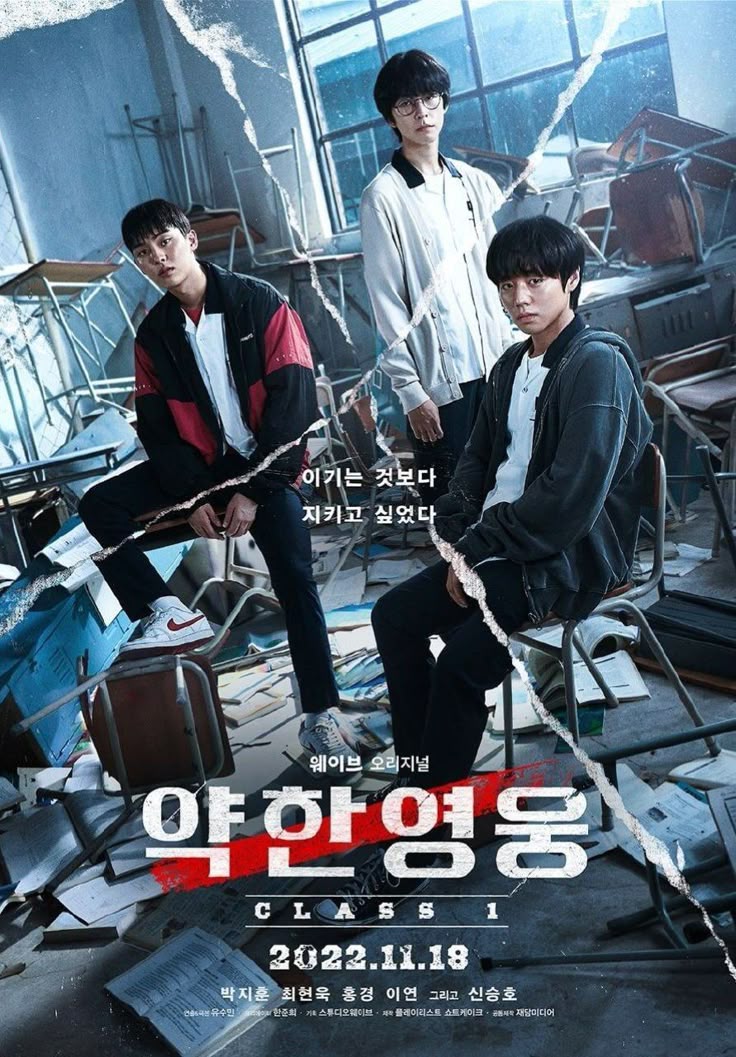
Weak Hero Class 1 Review: A Story That Hits Hard but Says Very Little
What starts with complex characters and promise, slowly trades development for shock value and nonstop fights.
Korean Drama Name: 약한영웅 Class 1 (Weak Hero Class 1)
Where To Watch: Netflix, Viki ← *Click for direct link*
Average Rating: 9.1/10 (Mydramalist)
My Rating: 8.5/10
One Sentence Description: Weak Hero Class 1 delivers incredible acting and intense moments, but sacrifices story and character depth in favor of relentless, exhausting violence.
Trailer:
Disclaimer: This review is 100% my opinion — I’m not here to hate, just to share my thoughts! Also, SPOILERS AHEAD, so proceed with caution if you haven’t watched yet. Watch it, come back and let’s see if you agree. Let’s keep the discussion respectful and fun! 💕
CONTENT WARNING:I hope you’ve already seen this show and know what the deal is. But in case you don’t, I felt like I should add in a little warning. This show is EXTREMELY Violent and Brutal. And since this is a review, I do also talk about this (in relation to the show only). Please be aware of that before you continue and be mindful of it. Stay safe ❤️
Simple Description
Weak Hero Class 1 is about a guy who just wants to study, get good grades, and be left alone—but keeps getting dragged into violence by bullies who refuse to let that happen. The problem for them? He’s smarter than they are, and when pushed far enough, far more dangerous.
⚠️Length Note: This post includes a detailed (and long) story breakdown. Want to skip straight to the review? Jump to the Review
The drama opens with a student loudly announcing all the correct answers on a recent exam. Out of nowhere, our male lead Yeon Si Eun slams his fist on the desk, calmly stands up, walks to the back of the classroom, grabs a book, and smashes it over another student’s head. What a way to start.
We then cut back thirteen days earlier, where we learn Si Eun is obsessed with studying and excelling academically. He and Jeon Yeong Bin — the same student he later attacked — both win mathematics awards, though Si Eun takes first place. Yeong Bin, a bully, begins targeting him out of jealousy. Their tension escalates until the baseball team storms in, looking for another lead: Ahn Su Ho. One of the players accuses Su Ho of hitting on his girlfriend, which he completely shrugs off. A fight breaks out, and Su Ho effortlessly dodges baseball bats like it’s nothing, clearly playing around. Si Eun watches silently until Su Ho finally strikes back, knocking the main guy out with a single punch.
From there, Si Eun becomes a constant target. His quiet, detached attitude only seems to irritate the bullies more. The next day, we meet another key character, Oh Beom Seok, a transfer student. Meanwhile, the bullying against Si Eun continues to escalate.
That night, Yeong Bin is revealed to be part of a shady group that drinks, does drugs, and hangs out in clubs. He talks to their dealer and gets his hands on a drug patch. Later, he forces Beom Seok — himself a victim of past bullying — to stick the patch on Si Eun’s neck right before an exam.
The drug takes effect, and Si Eun slaps himself continuously to snap out of it. The following day, they go over the answers and Si Eun misses a question — the very mistake we saw in the opening scene. Out of all the torment he’s endured, this single wrong answer is what finally pushes him over the edge. Using his knowledge of science, he brutally beats Yeong Bin with a book and stabs another bully in the hand with a pen. He’s ready to finish Yeong Bin off before Su Ho steps in and stops him.
Yeong Bin is left with a broken nose and a bruised ego, and immediately starts plotting revenge. His drug dealer agrees to help him, for a price. Later that night, Si Eun apologises to Su Ho, and we get a glimpse into Su Ho’s life—working food delivery all night, sleeping in classrooms between classes and breaks. Over lunch the next day, the two reconcile, and a small friendship forms. We also learn that Su Ho’s fighting skills come from his background as an MMA prodigy who almost went pro.
Later on, Beom Seok tries to befriend Si Eun, and it fails. Almost immediately after, Yeong Bin sends his drug-dealer friend, Jeon Seok Dae, to rough Si Eun up a bit. Beom Seok, still desperate to make things right, pays Su Ho to step in and help. While they’re on their way, Si Eun manages to hold his own again, using physics and his surroundings to fight back and take down several guys. Seok Dae eventually gets him to the ground, though, and Yeong Bin joins in, kicking him while he’s down. Just before Si Eun’s hand is smashed, Su Ho arrives and saves him.
Another long fight breaks out, and this time Beom Seok lands the final, winning blow. To celebrate surviving yet again, the three of them help out at Su Ho’s part-time job before sitting down to eat together. It’s the closest thing to peace this show allows.
A few days later, Si Eun becomes acquainted with Yeong Ki, the only major female character, who casually tells him she likes him. He doesn’t care. At the same time, the drug ring’s leader decides to retaliate for his men getting beaten. Yeong Bin lures the group out, where they’re confronted and demanded to pay 15 million won (about $15,000) for Seok Dae’s injuries. After this meeting, they’re essentially stalked nonstop by the gang’s men.
Fed up, Beom Seok steals his father’s watch to get the money. Yeong Ki explains that the gang’s leader, Gil Su, traps kids in gambling debt and forces them to either work for him or find a way to pay him back— with interest. Si Eun and the others decide to gather proof and take it to the police. That plan fails miserably. Su Ho is knocked unconscious, and both he and Beom Seok are kidnapped. Si Eun arrives with the police too late, finding no one there.
Later, Si Eun tracks Yeong Ki’s phone to a remote location and finds his friends tied up. Seok Dae, clearly tired of being Gil Su’s punching bag, turns on him. Another brutal fight breaks out before the police finally arrive. Gil Su tries to escape, Si Eun chases him, and yet another long, violent fight erupts involving Gil Su, Su Ho, and Si Eun. Eventually, the night ends with Gil Su, Seok Dae, and their entire gang arrested.
At the police station, Beom Seok’s father uses his influence to get the boys out. Seok Dae makes peace with them, and Si Eun and Yeong Ki visit Su Ho in the hospital, where we see Si Eun smile for the first time. It’s a rare soft moment that doesn’t last long. Shortly after, Beom Seok is beaten by his father with a golf club because of everything that happened. This show truly does not let up on the violence.
Once things finally seem calm, Beom Seok realises that Si Eun, Su Ho, and Yeong Ki have been hanging out without him, and he starts to spiral. On the weekend, the four of them go to a karaoke bar, but everything shifts when Yeong Ki answers Beom Seok’s phone and hears his former bullies on the other end. We also learn that Beom Seok was adopted purely to improve his father’s political image.
Eventually, Beom Seok opens up to Si Eun and Su Ho about his bullying, and Su Ho agrees to confront the bullies with him. The bullies apologise, but that’s not enough for Beom Seok. He wants to hurt them. When Su Ho stops him, it becomes the breaking point. Feeling humiliated and pushed aside, Beom Seok turns away from them and aligns himself with the bullies from the beginning.
This marks the second half of the show—and yes, it only gets worse from here.
From here on, Beom Seok essentially cuts off both Su Ho and Si Eun and fully joins his new friend group. He eventually admits that his real resentment isn’t toward Si Eun but toward Su Ho, who he never felt truly liked him. Yes, it technically started with Su Ho not following him back on Instagram, but it clearly goes much deeper than that.
Su Ho and Si Eun talk about Beom Seok’s sudden shift, each interpreting it differently. Si Eun believes Beom Seok is being used by his new friends for his money, while Su Ho thinks it’s the opposite. He believes Beom Seok is using them for protection and popularity, choosing safety and status over genuine friendship. The tension between Su Ho and Beom Seok continues to grow, until Beom Seok decides to get his own revenge. He hires a notorious fighter from another school, Kang U Yeong.
One night, while Su Ho is out delivering food, Beom Seok and his new friends tamper with his bike brakes. Su Ho gets into an accident and suffers a leg injury. Su Ho’s birthday arrives, which also happens to be the day Beom Seok plans to have U Yeong fight him. Beom Seok lures Yeong Ki out and forces Su Ho to meet them. Si Eun arrives instead. U Yeong shows up and brutally beats Si Eun. Despite everything, Si Eun ends up covering for Beom Seok in the back of the ambulance.
Si Eun and Yeong Ki avoid Su Ho, while Su Ho starts digging for answers on his own. He eventually uncovers the truth. Meanwhile, Beom Seok is beaten again by his father over the incident. Su Ho meets Si Eun one last time before confronting Beom Seok, who is waiting with U Yeong. Su Ho initially wins the fight, but when one of the guys cheats and trips him, everything spirals. U Yeong knocks Su Ho out, and Beom Seok’s group begins stomping on him. Everyone eventually stops except Beom Seok, who has to be physically pulled away. Moments later, they realize Su Ho isn’t breathing. Panicked, they scatter, leaving him behind. Si Eun goes looking for Su Ho, while Beom Seok, wracked with regret, is dragged away by his father’s employees.
The next day, Si Eun performs poorly on his exam, completely consumed by worry. Afterward, Yeong Ki finds out what happened and immediately calls him. Si Eun rushes to the hospital, where Su Ho lies in a coma. Beom Seok’s father prepares to send him to the Philippines, while Beom Seok spends his final days drifting through school.
This time, when Si Eun returns to school, he’s not focused on exams. He’s focused on revenge. First, he goes after Yeong Bin and U Yeong. Then he moves on to Beom Seok and his friends. Everyone gets beaten except Beom Seok, who accepts it without resistance. Si Eun smashes a few windows before returning to the hospital, where he sits beside Su Ho and falls asleep. When he wakes up, Su Ho is awake. They talk, joke, and apologise to each other. Su Ho smiles. Si Eun stares at him and cries. And then the illusion shatters. Su Ho is still in a coma. Nothing has changed. Everything is still ruined.
The show ends with Beom Seok being sent to the Philippines, Yeong Ki blaming herself and leaving, and Si Eun transferring to a delinquent-heavy school in Yeongdeungpo. Almost immediately, he becomes a target again. The final shot: a troublemaker stirs up conflict, and Si Eun clicks his pen. The cycle begins anew.
The End.

The Review
The Good
A Friendship Worth Rooting For (While It Lasted)
Even though we only got to enjoy it for a few episodes, I genuinely loved the friendship between Si Eun, Su Ho, and Beom Seok. They understood Si Eun’s personality and respected his boundaries, and Si Eun clearly cared about them in his own quiet way, even if he didn’t always know how to show it. That’s what made it hurt more. The show gave us such a soft, wholesome dynamic only to rip it away almost immediately, and honestly, that betrayal worked.
A Smooth Shift Between Storylines
Normally when a drama introduces a new plot halfway through, it feels messy — like the writers realised the first arc couldn’t stretch to the end and scrambled to fill time. That wasn’t the case here. The transition from Yeong Bin and Seok Dae’s storyline into Gil Su’s arc felt natural. Gil Su’s presence planted the seed for the next conflict, and Yeong I’s arrival tied it all together. It never felt like the writers panicked and scrambled to fill runtime, and I applaud the show for pulling off such a seamless shift.
Next-Level Acting
No matter how low a rating was, one thing every comment section agreed on was the acting. It was genuinely outstanding across the board. Even characters who only appeared briefly left an impression. Park Ji Hoon’s performance as Si Eun, especially in the final moments, completely explains why that scene shows up in nearly every “best K-drama acting performance” edit. The emotional control, the restraint, the breakdown… It was all devastating in the best way.
Beom Seok: Before the Fall
I was so fascinated with Beom Seok’s character so while I’m not a psychologist, I just have to include his complexity into ‘The Good’ section.
Oh Beom Seok is the kind of character who wears his trauma like a second skin, and you can see how every choice he makes is stitched together from fear, insecurity, and a desperate need to belong. From the start, his life has taught him that safety is conditional and affection is transactional. He was adopted to serve an image, not because he was wanted, and his father made sure he never forgot that. When you grow up being beaten into obedience and reminded that you’re a burden, you don’t develop a stable sense of self. You learn to attach yourself to people who feel strong, reliable, and untouchable. That’s why Beom Seok gravitates toward Si Eun after witnessing his quiet brutality, and why he pulls Su Ho into the group too. It’s not just admiration. It’s fear management. Protection has always come from proximity to power, so he sticks close to it and mistakes that closeness for security.
What makes Beom Seok complicated is that his neediness slowly curdles into resentment the moment he feels replaceable. Yeong Ki entering the group doesn’t just make him jealous, it confirms his worst fear: that he can be replaced. Small things spiral because his mind is already primed for rejection. That’s why the smallest cracks in friendship don’t feel small to him at all. An unanswered Instagram follow, side conversations he’s not part of, a comment from Gil Su calling him a lackey — all of it stacks until his brain fills in the gaps with the version of reality he knows best. It’s like a confirmation of the script he’s been handed since childhood: you’re unwanted, you’re replaceable, you’re nothing without someone stronger to shield you.
And once that script takes over, resentment becomes his oxygen. He doesn’t just envy Su Ho’s strength, he rewrites their entire friendship as a lie, convincing himself he was never truly liked. In his world, people don’t quietly drift, they abandon. They don’t misunderstand, they tolerate. So when he starts believing Su Ho never genuinely liked him, that belief becomes unshakable— not because it’s true, but because it fits the story he’s been told his whole life.
Psychologically, it makes sense: when you’ve been beaten down long enough, you stop waiting for betrayal and start assuming it’s already happened. Turning to the bullies and using money as glue isn’t about dominance as much as it is control. He can’t risk being unwanted again, so he chooses relationships where he knows exactly what he’s offering and exactly why they’re staying. Beom Seok isn’t driven by cruelty as much as he is by loneliness, fear, and a mind that keeps convincing him he’s already lost — even when he hasn’t.
He’s not just a coward hiding behind stronger friends—he’s a boy who never learned how to exist without someone else’s shadow to crawl into, and that shadow eventually became his prison.

The Bad
Beom Seok’s Point of No Return
If the first half of Beom Seok’s story is about insecurity and loneliness, the second half is about how those fractures quickly turn into violence.
Where Beom Seok crosses an irreversible line is in how his fear and resentment finally turn outward. The way he almost kills Su Ho isn’t just impulsive rage. It’s patterned. He waits until someone else has done the hard part, until Su Ho is already down, and only then does he step in. That detail matters because it’s the same way he released his anger with his old bullies. Beom Seok doesn’t attack strength head-on. He attacks once the threat is neutralised. It’s not just cowardice, it’s learned helplessness. His entire life has taught him that he can’t win fights on his own, so the only way he feels powerful is by stomping on someone who can no longer fight back. Violence, for him, isn’t about domination. It’s about finally not being the weakest person in the room.
What makes his actions even darker is where his anger is actually coming from. When Beom Seok beats his old bullies, he’s thinking about Su Ho. He isn’t reacting to the person in front of him as much as he’s unloading years of humiliation, rejection, and self-hatred onto a safer target. He can’t confront the people he feels abandoned by directly, so he redirects that fury onto people he knows won’t hit back. That’s why the violence escalates so quickly. Once Beom Seok convinces himself that Su Ho is the source of his pain, the line between past and present collapses. Every memory of being powerless floods in at once, and instead of stopping himself, he lets it justify what he’s doing.
But here’s the line that can’t be blurred: trauma explains his choices, it doesn’t excuse them. The regret he shows afterward—shaken by the sight of Su Ho limp and broken—rings true, but it’s the regret of someone who realises too late that he’s crossed a line he never actually wanted to cross. His shock, guilt, and panic feel real. He’s not calculating consequences or trying to protect himself. He’s horrified because the person on the ground is someone he genuinely cared about. That doesn’t clear him though. Regret after the fact doesn’t undo attempted murder. It only underscores how dangerous it is when self‑hatred and paranoia are left unchecked.
What seals his tragedy is what comes next. Even in his guilt, he sabotages any chance of redemption by shifting blame onto Yeong Ki, as if his violence were forced upon him. That final deflection is telling: Beom Seok is broken, yes, but he’s also unwilling to own the damage he caused. It’s the final proof of how broken his thinking has become. His arc is a brutal reminder that pain can warp into cruelty, and that loneliness, if left to fester, can turn a victim into a perpetrator.
Beom Seok is both deeply damaged and fully responsible, and the show never lets us forget that those two things can exist at the same time. Understanding him doesn’t mean forgiving him—it means recognising how easily insecurity can curdle into destruction when someone refuses to confront their own shadow.
So Much Depth, So Little Exploration
One of the biggest disappointments was how the show introduced genuinely complex characters and then barely scratched the surface. There was so much there, and almost none of it was explored. Let’s break it down.
Si Eun: A Walking Time Bomb
Si Eun is a character who could snap at any moment, yet we’re never told why. He’s obsessed with studying, but why? He doesn’t care about being bullied, but one wrong test question sends him into a violent spiral. Why does he feel like a blank slate emotionally, yet explode with rage when pushed too far? Why does he seem distant from his parents, and why is extreme violence his immediate response once talking fails?
He doesn’t just fight. He loses control. He gets blinded by rage to the point where he would seriously hurt anyone in his way. That kind of behaviour doesn’t come from nowhere, yet the show never slows down long enough to ask what’s actually going on inside his head.
Su Ho: The Calm Fighter Everyone Fears
Then there’s Su Ho. Everyone is terrified of him, but we’re never really told why. People mention that he almost became a professional fighter, but was that actually true? And if it was, why did he stop? He’s calm, measured, and only fights when necessary, yet everyone treats him like a ticking bomb they’re scared to wake up.
We also get almost nothing about his personal life. Where are his parents? Why is he working so much? Why did he decide to take Yeong I in so easily? He clearly heard Beom Seok say he felt uncomfortable, yet he consistently ignored those boundaries. When Beom Seok started pulling away, Su Ho barely reacted. Why? For someone portrayed as emotionally intelligent, those blind spots felt strange and unexplored.
Yeong I and Seok Dae: Missed Opportunities
Yeong I was the only girl in the group, which immediately raised questions. How did she get involved with Gil Su? Why was she running away? What was her relationship with Seok Dae? They clearly had history and emotional closeness, yet instead of exploring that, Seok Dae exits almost as quickly as he arrives.
Even his sudden shift from loyalty to rebellion against Gil Su felt underdeveloped. What made him snap? What pushed him over the edge? These weren’t minor side characters. They had stories worth telling, but the show chose speed over depth.
(Beom Seok’s issues were already covered — and trust me, there were plenty.)
Violence Overload
My biggest issue overall was the sheer amount of violence. It was constant, brutal, and exhausting. Why did we need someone getting beaten to near death in almost every episode? Why was violence always the first response and conversation never even an option?
It made the show exhausting to watch. I found myself covering my eyes or skipping ahead because the brutality never let up. A comment I read said this was “clearly written by men for men,” and honestly, I couldn’t help but laugh. It felt like we weren’t given time to recover from one fight before another started. The violence added shock value but little substance.
Si Eun Was Cool… Until He Wasn’t
At first, Si Eun’s fighting style was one of the most interesting parts of the show. It seemed like he was going to use his intelligence to calculate angles, physics, and timing in every fight, and early on, that’s exactly what we got.
But that slowly disappeared. His fights turned into frantic scrambling, grabbing whatever was nearby and swinging wildly. Instead of calculated wins, it became luck-based survival. He went from being strategic to sloppy, and that took away what made his character stand out in the first place.
I won’t spoil Weak Hero Class 2, but I will say this issue doesn’t really improve, and that made the violence feel even less justified.
Where Were the Adults?
Where were the adults? How did baseball players swing metal bats in broad daylight without anyone stepping in? How did Si Eun nearly smash Yeong Bin’s head in a classroom without consequences? Where was humanity? Where was the line?
The school seemed prestigious, yet the teachers were conveniently absent every time chaos erupted. Chairs flying in classrooms, boys brawling in cafeterias — and not a single adult intervened. Were the teachers just sipping coffee in the lounge, shrugging it off as “boys will be boys” while students fought for their lives? The lack of authority made the violence feel absurd and unrealistic.

What I Would Do
Turn Down the Violence, Turn Up the Story
This is obvious, but I’d tone down the violence and turn up the story and character development. We honestly needed more slow scenes. I mentioned this in my A Killer Paradox (Check out that review here!) review how important slower moments are for building and pacing a story. Without them, you end up with violence for the sake of violence, characters begging to be explored, and a story that’s constantly being pushed into the background.
Those slower moments could have been used to actually explain why these characters are the way they are. We could have learned how Su Ho became such a skilled fighter, or even had background characters talk about the moment everyone started fearing him. We could have gotten flashbacks at the beginning of episodes that explored Si Eun more deeply—his lack of emotional expression, his obsession with grades, and the tension with his parents. Beom Seok did get more focus than the others, but even then, there was still room for more. This show introduced too many interesting characters and then refused to slow down long enough to let them breathe.
Yeong I especially felt underused. She easily could have had a quieter moment with Su Ho where she explained her past. She clearly had a close relationship with Seok Dae, yet once he lets her get away, she never mentions him again. If they were that close, it would have made sense for her to be desperate to get him out of prison, to visit him, or at least to acknowledge what happened to him.
We just needed more of this. Like I’ve said in previous reviews, not every moment has to be thrilling, but it does need to make sense. It needs to move the story forward in a meaningful way. Violence for the sake of violence gets exhausting when it doesn’t actually lead anywhere. By the end, it genuinely felt like the writers created the violent scenes first and then tried to patch together a story afterward. And honestly, even the storylines themselves felt a little lazy because of that.
Si Eun, the Mastermind Fighter
If the show insisted on constant fight scenes, then those scenes needed to be more than just fights. In my version, Si Eun would be a true mastermind fighter—someone who wins because he thinks faster, not because he gets lucky.
Watching him calculate angles, predict movements, and use his academic knowledge in combat would have made the violence far more tolerable. The Pavlovian conditioning with the pen was brilliant, and it showed exactly what this character could have been. We needed far more moments like that instead of him wildly swinging, grabbing whatever was nearby, and surviving by chance.
If Si Eun is going to be obsessed with studying, then make his intelligence the reason he wins. What makes him dangerous should be his mind, not sheer luck.
Beom Seok’s Redemption arc
If Beom Seok were ever to claw his way toward redemption, it wouldn’t be clean or heroic—it would be clumsy, misguided, and painfully on‑brand. The first step might be him walking into a police station and turning himself in, not because he suddenly grasps the full weight of his violence, but because guilt gnaws at him until he can’t breathe. It’s less about justice and more about trying to quiet the chaos in his own head. Or maybe it’s accountability as self-punishment, which is honestly the only framework he knows.
Where his redemption stays painfully incomplete is in how he tries to make amends. Beom Seok would give Su Ho money — his own and some of his father’s — to cover medical bills, lost time, everything. Not because he thinks money fixes what he broke, but because money has always been his substitute for sincerity. It’s how he’s kept people close, how he’s apologised without saying the words, how he’s tried to prove his worth. And that’s what makes it believable. Beom Seok doesn’t suddenly become enlightened; he stumbles forward with the tools he’s always had—fear, guilt, and money—and hopes they’ll be enough. In doing so, he’d reveal that he still doesn’t fully understand friendship or forgiveness, only that he owes a debt he can never repay. And maybe that’s the point. Beom Seok’s redemption wouldn’t come from being forgiven or welcomed back. It would come from finally acting without expecting protection, acceptance, or love in return. And for a character who’s spent his entire life hiding behind others, that small, imperfect step would be the closest thing to redemption he could ever manage.
Side note:
Honestly, as much as I’d want more for Beom Seok, his ending does make sense. His quiet departure, following his father’s orders and disappearing to the Philippines, fits the pattern he’s never broken out of. When things collapse, Beom Seok doesn’t confront the damage. He withdraws. He lets someone stronger decide for him. His father stepping in to clean up yet another mess isn’t a twist, it’s the most consistent part of his life. Every failure has been managed, relocated, or buried before Beom Seok ever had to face it himself— and this time is no different. He’s been taught that obedience is safer than responsibility, and escape is easier than accountability. His exit isn’t a twist, it’s the inevitable conclusion of a boy who never learned how to stand on his own, even when the weight of his guilt demanded it.
Leaving the country is just another way of outsourcing accountability, proving that he lacks the courage to confront the wreckage he created. His ending wasn’t redemption or punishment, it was stagnation — a reminder that without choosing to act on his own, Beom Seok remains exactly where he started, just in a different place.

Final Thoughts
At the end of the day, this show is honestly very overrated. When you strip it down, it’s mostly a group of kids who don’t know when to stop, one kid who will absolutely kill you if pushed far enough, one guy who’s somehow both terrifying and goofy, and one walking trauma essay (which, yes, I basically wrote). I still don’t fully understand why I gave this show such a high rating, but if I’m being honest, it probably had something to do with the fact that so many of my celebrity crushes were in it. Leave me alone, I’m just a girl.
Outside of that, the storylines themselves are surprisingly thin. They exist mostly to justify the next fight scene. Characters are introduced with layers and complexity, only to fade into the background or disappear entirely. Yeong Ki and Seok Dae are the most obvious examples, but they’re not the only ones. Even the main characters feel like they’re carrying entire histories we’re never allowed to see. It genuinely feels like the show expects viewers to have already read the webtoon or to simply accept that these characters are “like this” without ever being told why.
By the end, the show starts to feel less like a narrative and more like an excuse to showcase brutal violence without consequences. No one ever gets a break, and the story never pauses long enough to recover from one beating before launching into the next.
The ending only confirms this. It hints at nothing new. Si Eun still just wants to study, people still won’t leave him alone, and he’s still winning fights with a pen and a lot of luck. The open ending feels less intriguing and more exhausting — like a promise of more violence with little story to justify it. I won’t spoil the second season, but I will say this: a drama written for men will always remain a drama for men, no matter how many seasons it gets.
And what sucks the most is that this show had all the pieces for something powerful, it just cared far more about how hard its characters could hit than why they were hurting in the first place.
And we’re done! I was actually really excited to review this drama because I love dissecting complex characters. Beom Seok was a delight to dissect and I hope you enjoyed it. I hope you enjoyed the entire review!
Did you love this drama as much as everyone else seemed to? If so, did you at least agree with some of the things I had to say? What were your thoughts on Beom Seok?
I might review the second drama in the future but for now, I think I’ve had enough violence for the sake of violence for a while. Next week we are reviewing a drama that recently came out and one that didn’t really hit the way I was hoping. No spoilers today but get ready for a long review next week!
See you then! 💕💕


Main Cast
Park Ji Hoon as Yeon Si Eun
Choi Hyun Wook as An Su Ho
Hong Kyung as O Beom Seok
Kim Su Gyeon as Jeon Yeong Bim
Lee Yeon as Yeong Ki
Shin Seung Ho as Jeon Seok Dae
Cha Woo Min as Kang U Yeong
Na Chul as Kim Gil Su
Themes/ Genres
Bullying and Systematic violence; Survival through intellect and resilience; Friendship, loyalty, and betrayal; Trauma and emotional scars; Power dynamics and social hierarchy; Justice vs. revenge
Action Drama; Youth/teen drama; Psychological thriller; School drama