
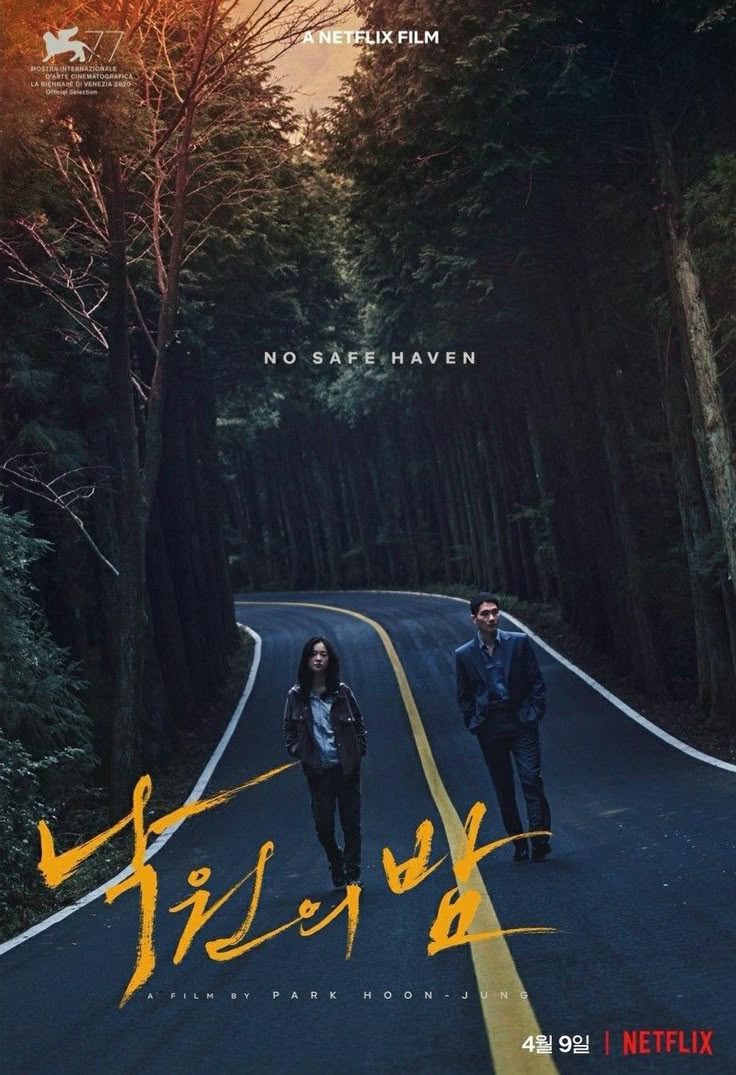
Night in Paradise Breakdown: A Mobster Film That Refuses Redemption and Embraces the Inevitable
A story where loyalty is punished, endings are earned in blood, and peace is just a cigarette and a wave.
Korean Drama Name: 낙원의 밤 (Night in Paradise)
Where To Watch: Netflix ← *Click for direct link*
Average Rating: 8.0/10 (Mydramalist)
My Rating: 7.5/10
One Sentence Description: A brutal, blue-tinted descent into gang life, grief, and the kind of loyalty that kills you.
Trailer:
Disclaimer: This review is 100% my opinion — I’m not here to hate, just to share my thoughts! Also, SPOILERS AHEAD, so proceed with caution if you haven’t watched yet. Watch it, come back and let’s see if you agree. Let’s keep the discussion respectful and fun! 💕
CONTENT WARNING:I hope you’ve already seen this show and know what the deal is. But in case you don’t, I felt like I should add in a little warning. This show has mentions of Suicide, Implied Drug-Use, and is EXTREMELY Violent and Gruesome. And since this is a review, I do also talk about this (in relation to the show only). Please be aware of that before you continue and be mindful of it. Stay safe ❤️
Simple Description
Night in Paradise follows Park Tae Gu, a high-ranking gang member who escapes to Jeju Island after seeking revenge on the people responsible for the deaths of his sister and niece. What unfolds is a brutal look into gang life, grief, and the quiet truth that the only way out is death.
⚠️Length Note: This post includes a detailed (and long) story breakdown. Want to skip straight to the review? Jump to the Review
The movie opens with our lead, Tae Gu, a high-ranking gang member confronting an older man about betrayal. Within minutes, we’re thrown into the kind of world this film lives in — one where three men are tied up, nearly naked, and bloodied. Tae Gu, we learn, was offered a position in a rival gang and turned it down (this becomes important later). He’s loyal. He’s lethal. And he’s the backbone of his current crew.
Not long after, Tae Gu rushes to help his sister and niece out of the hospital. They drive ahead of him while he finishes up, agreeing to meet later for his niece’s birthday. But they never make it. A car accident kills them both. It’s sudden. It’s brutal. And it sets everything in motion.
At the funeral, Boss Yang, Tae Gu’s gang leader, comforts him. But when Tae Gu learns that rival gang members may have been involved, he doesn’t hesitate. He brutally stabs them to death. It’s not just revenge. It’s a declaration.
Because of the fallout, Boss Yang sends Tae Gu to Jeju Island to lay low before relocating to Russia. There, we meet Kim Jae Yeon, the female lead, who picks him up instead of her uncle, Kuto. While they drive, we cut to Kuto selling guns to a group of men. Back in Seoul, Boss Yang learns that the man Tae Gu stabbed, Chairman Doh, actually survived and is in surgery. To make matters worse, Director Ma, another target who also survived, calls Boss Yang directly, promising to gut him like a fish before hanging up. This man clearly means business.
The next morning, Jae Yeon shoots bottles while Tae Gu watches, cigarette in hand. Then she puts the gun to her head and pulls the trigger. It’s empty. But the moment is chilling.
Later, Tae Gu finds Jae Yeon passed out in her car with a needle in her arm. Her uncle injects the drug and rushes her to the hospital. There, we learn Jae Yeon is dying. She has a 10% chance of survival in Korea — maybe 20% in the U.S. That’s why she and her uncle plan to leave.
Back in Seoul, Boss Yang meets with Director Ma to beg for his life. Ma agrees to spare him but only if Boss Yang hands over the man who tried to kill the chairman: Park Tae Gu.
Back in Jeju, the same men from before visit Kuto looking for more guns. Believing he’s still hiding some, they stab him, but Kuto quickly turns the tables, grabs a gun, and starts shooting. Tae Gu and Jae Yeon return just in time to help, but another Russian man shows up and kills Kuto instead. Jae Yeon, upon finding her uncle dead, kills the remaining men.
That night, she reveals the truth: her family died because of her uncle’s ties to the Russian gangs. The next day, Tae Gu is summoned to the airport by Boss Yang. Jae Yeon warns him not to go as she has a bad feeling. He ignores her, and she’s right. He’s been betrayed. Boss Yang is working with Director Ma. We already know this, but Tae Gu’s just catching up. He makes it out of the hospital and barely escapes a brutal car chase.
When he returns, he learns that Jae Yeon went back for her uncle’s body but Tae Gu knows that’s exactly where Boss Yang will go. He races over, while Jae Yeon discovers the body is gone. Director Ma and Boss Yang arrive first and take her hostage. Tae Gu, fully aware of what’s waiting, takes a final smoke, looks out at some cows, and heads to Kuto’s farm.
He’s greeted with a savage beating. Inside, the truth finally comes out — the Chairman had nothing to do with his sister and niece’s deaths. It was all Boss Yang. Why? Because, like we learned early on, Tae Gu was in high demand. Other gangs wanted him, and Boss Yang feared he’d leave and take his men with him. Tae Gu was Boss Yang’s muscle and shield; without him, he’d be weak and alone. Director Ma cuts Tae Gu loose and lets him get a few hits in before handing a knife to Boss Yang. As agreed, Director Ma and his men take turns stabbing Tae Gu in the stomach. It’s brutal, drawn-out, and hard to watch. They let Jae Yeon live and burn the farmhouse with Tae Gu inside. She watches it all.
The next morning, Jae Yeon walks into the restaurant where the gang members are eating. She locks the door. Opens fire. Kills them all — Boss Yang, Director Ma, and the men who murdered her uncle. Then she walks to the beach. The police arrive. But she has her own ending. She watches the waves, listens to music, and shoots herself.
A brutal ending to a brutal movie.
The End.

The Review
The Good
The (Real) Life of a Gangster
If there’s one thing I can genuinely appreciate about this movie, it’s how it refused to romanticise the mobster life. It was brutal. It was raw. And it never tried to dress it up. So many stories lean into the fantasy of the “top mafia boss falls for a soft girl and suddenly he’s never killed anyone, got there through threats alone, and underneath it all, he’s gentle, kind, and just wants love (but would also burn the world for her).” Don’t get me wrong, we all eat up those stories, but somewhere along the way people forgot what being in a gang is actually like.
Just to clarify, I know this is a movie. But it managed to show the reality of that world without glorifying it or going overboard. Tae Gu wasn’t out here taking down twelve guys armed with knives using just his fists. The movie didn’t shy away from showing that it’s a dog-eat-dog world — every man for himself. I appreciated that realness.
Tae Gu was a gang member and he acted like one. He killed people. He got betrayed. He bled. And he made hard choices. What made it even better was that the female lead didn’t soften him. He didn’t hide who he was. And she didn’t need saving. Jae Yeon held her own, and that dynamic was refreshing. Despite the over-gruesomeness, I can applaud the realness this film delivered.
Respect, Not Love (And I Respect That)
I touched on this above, but it deserves its own spotlight. I’m so glad this wasn’t a romance. Tae Gu and Jae Yeon never felt like a couple. Even if they somehow got a happy ending, I couldn’t imagine them married with kids as that’s not what their relationship was. What they had was respect. Understanding. They were all each other had, and they leaned on that — not love, not longing, just survival and a quiet connection they knew wouldn’t last.
And yes, this could’ve easily turned into a romance if it were a series. They could’ve thrown in a kiss or a confession just because they were the male and female leads. But they didn’t. The writers knew what they wanted, and they stuck to it. That restraint made the story hit harder. It wasn’t the vibe and they didn’t force it.
Top-Notch Acting
I feel like I say this in almost every “Good” section, but it’s always true: the acting was phenomenal. With two of my favourite actors Jeon Yeo Been and Cha Seung Won in the cast, I already knew I was in for something solid. But they didn’t just deliver, they immersed me. Every scene felt like it was being recorded on hidden cameras. It wasn’t just believable, it was haunting. Acting might seem like a small thing, but when it’s the reason you’re emotionally invested, it changes everything.
Cold Vibe, Perfect Tone
I didn’t even notice this until I rewatched it for the review, but the entire movie had this cold, blue filter. It was such a subtle touch, but it really set the tone. That blue hue gave everything a sense of sadness and heaviness before anything even happened. From the very beginning, you could tell it was going to be intense — not from the trailer or the synopsis, but from the color palette alone. It’s crazy how something so small can say so much.

The Bad
Violence for the Sake of Violence
Even though I praised this movie for its realism, there were times when it felt like violence just for the sake of violence or more accurately, brutality for the sake of brutality. Kuto’s death, for example, felt lowkey forced. It was like the movie thought, “We haven’t had a fight scene in five minutes… better throw one in!”
He worked with gang leaders and had a history with the Russian mob, so why was he so trusting? Why was he so cocky if he couldn’t hold his own from the jump? Sure, he eventually grabbed a gun and shot a few of them, but he should’ve had a weapon on him from the start. The whole thing felt sloppy. And honestly, did we really need to see men tied up in their underwear, bloodied, with bags over their heads? I get it, mob life is violent. But at times, it felt like the movie was made for a very specific kind of viewer who enjoys gore for gore’s sake. Maybe that’s on me, but still…
Mixed Feelings on the Ending
I’m still torn on the ending. On one hand, it was poetic — Jae Yeon taking revenge, then ending her own story on her own terms (and no, we’re not romanticising suicide here, so don’t even start). I liked the emotional callbacks, like her not wanting to be alone and Tae Gu remembering that in his final moments. But on the other hand… Tae Gu was robbed.
He was loyal. He was betrayed. And he never got the revenge he deserved. Watching someone so devoted get stabbed in the back by the very person he protected? That’s pain. I kept hoping he’d at least get a sliver of peace — maybe kill Boss Yang, maybe die in Jae Yeon’s arms. But instead, he died knowing everything he fought for was a lie. And while I get that this movie leans into realism, I can’t help but feel a little disappointed in how it all played out. Jae Yeon got her closure. Tae Gu didn’t.
Who Is Tae Gu?
This is a one-and-done movie — no sequel, no spin-off — so I wish we got more of Tae Gu’s backstory. He was clearly respected, feared, and basically the shadow leader of his gang. But how did he get there? What made him so loyal to Boss Yang? What was his life like before all this?
There were so many quiet moments — scenes of him drinking, smoking, staring into space — that could’ve been used to show us something. A flashback. A memory. Anything. Instead, we got long stretches of silence that didn’t tell us much. And that’s a shame, because Tae Gu was layered. We just never got to peel those layers back. It’s not that I needed his entire life story, but a few glimpses into who he really was would’ve made his ending hit even harder.
Boring Bits That Could’ve Been Better
Let’s talk about the pacing. For a movie with such intense stakes, the Jeju Island scenes felt oddly slow and not in a reflective, character-building way. Tae Gu’s moments with Kuto and Jae Yeon were more boring than anything we got from Director Ma and Boss Yang. Which is ironic, considering Tae Gu and Jae Yeon were the leads.
Boss Yang and Director Ma’s storyline actually built tension and helped us understand what led to Tae Gu’s death. But Tae Gu driving around, eating at random places, and dealing with Jae Yeon’s hospital visits? It felt like filler. I get that we needed to understand their relationship and her eventual death, but the pacing dragged. And the worst part? The movie kept jumping from quiet, slow scenes to sudden bursts of violence. It didn’t have to be either soft conversations or brutal beatings— there was room for nuance.
This is exactly where some backstory could’ve filled the gaps— like Tae Gu’s life before the gang and what led him to be the gang’s backbone, or even more about Jae Yeon’s illness (which, by the way, we know nothing about). These little holes didn’t ruin the movie, but filling them in place of the slow scenes and random violence would’ve made everything tighter and more purposeful.
Boss Yang Was the WORST
I can’t get over how much of a coward Boss Yang was. How did this man become a leader when he was so pathetic? Tae Gu literally turned down the offers and Boss Yang still killed his sister and niece. Like… how insecure do you have to be?
He was weak, paranoid, and useless without Tae Gu. Once Tae Gu was gone, he had no protection, no backbone, no plan. And yet he clung to power like it meant something. I’m glad he got the ending he did. Good riddance.
A Happy Ending Was Never an Option
Another smaller point, but I was kind of sad knowing from the start that a happy ending was never in the cards. When Boss Yang said Tae Gu would go to Russia, I didn’t believe it for a second. And even if he did make it there, it wouldn’t be peace, it’d be isolation, regret, and endless reflection.
This movie was destined to leave you upset or shocked, but never happy. Maybe that’s the beauty of it. Maybe that’s the point. But either way, it made me sad so it goes on “The Bad” side.

What I Would Do
Less Violence, More Storytelling
As mentioned in nearly every point above, the flow of this movie needed a serious shift. Tae Gu and Jae Yeon’s storyline should’ve been just as compelling as Boss Yang and Director Ma’s, and that starts with giving us more story, less filler, and way less violence-for-violence’s-sake.
I’d add flashbacks during Tae Gu’s quiet moments when he zones out, smokes, or sleeps. I’d probably start with the death of his parents — maybe they grew up in a dangerous neighbourhood, got caught in crossfire, and Tae Gu, driven by revenge, went after the killers only to almost die himself. Then Boss Yang steps in and saves him. That’s where their relationship begins.
As for Tae Gu’s loyalty, I’d explore it one of two ways (these flashbacks would be sprinkled throughout the movie):
Option 1:
Boss Yang gets revenge on the people who killed Tae Gu’s family and even keeps Tae Gu and his sister safe. But of course, nothing comes for free. In exchange for that protection, Tae Gu is forced to join the gang — securing his and his sister’s safety at the cost of his freedom. It’s a loyalty built out of debt, not devotion.
Option 2:
Take a page out of My Name (Check my review on that here!). Boss Yang offers Tae Gu a chance to get strong, make money, and eventually find his parents’ killers. He pretends to help, even giving Tae Gu updates over time, but secretly works with the very people responsible for their deaths. Tae Gu unknowingly does jobs for them — maybe it’s the captain who ate the noodles in that one scene. This version gives Boss Yang an even darker edge and makes Tae Gu’s loyalty feel tragic rather than naïve.
Either way, we’d get to actually see who Tae Gu was before all this — his first kill, his early fights, his motivations. His story would show a man, dealt with the worst cards, shaped by loss and survival, forced into a world he never truly belonged to.
A More Satisfying End
Even though I’m not entirely mad at the ending, I still wish Tae Gu had gotten some form of peace. Instead of dying knowing everything was a lie, I’d let him take Boss Yang down with him. Director Ma could still want Boss Yang dead and claim it was “an accident,” but Tae Gu would be the one to end him.
If that didn’t work, then at least give Tae Gu a quieter, more meaningful death. Maybe after being left to bleed out, he uses the last of his strength to make it to the cliff by the farm. He’d sit beside Jae Yeon and watch the waves one last time.
For his final moments, we’d get a vision of him with his family, alive and laughing as they celebrate his niece’s birthday. A glimpse of an alternate world where things went right. Where his parents never died, his sister and niece are safe, and he finally gets to rest. A full-circle ending that’s both tragic and peaceful — a life that could’ve been if even one card had been different, playing in his mind as everything fades.

Final Thoughts
In the end this movie wasn’t bad. I liked the realness it had and the storyline was a pretty good one. I can’t really complain too much about the violence when this was literally a movie about mobsters so I’ll just complain a bit about its other bits.
Thinking back, I think the reason it was just “fine” was simply because to me, the good and the bad points kind of cancel each other out. Like the fact that this was a realistic mobster movie cancels out the fact that it was too violent, I didn’t mention this in the good but the poetic-ness of the ending canceled out the disappointment, the acting canceled out my Boss Yang problem because it was due to the good acting that the character came across so cowardly, and the way they handled the male and female lead canceled out the boring bits. I don’t know why but it’s because of those cancellations that I feel like I’m in limbo, not sure if I liked it or I didn’t.
Maybe that’s what makes this movie stick— it lives in the in-between. Maybe it wasn’t made to be liked or disliked. Maybe it was made to be felt. To sit with you in silence. To remind you that sometimes, the most honest stories don’t offer closure — just a cigarette, a wave, and the weight of everything that could’ve been.
Another movie review complete! I’ve really enjoyed reviewing movies recently that I’m debating whether next weeks review should be on a movie or a series? I think I might take a little break from movies and get back to series’ since I have one I’m dying to review!
Also, what did you think of this movie? It got pretty high ratings and people had lots of good things to say about it (which I get) but there were a few negative reviews sprinkled here and there. Where do you stand?
Next weeks review will most likely be on a series but I like to keep you guessing so it might be another movie. Stay tuned and I’ll see you next week! 💕


Main Cast
Uhm Tae Goo as Park Tae Gu
Jeon Yeo Been as Kim Jae Yeon
Cha Seung Won as Director Ma
Lee Gi Young as Kuto
Park Ho San as Gang Boss Yang
Themes/ Genres
Revenge and it’s consequences; Grief and emotional isolation; Redemption and moral ambiguity; Power, loyalty, and betrayal; The illusion of escape; Violence as a cycle; Death as both threat and release
Neo-Noir; Crime thriller; Drama; Action
Comments (1)
Night in Paradise Breakdown-Only: A Mobster Film That Refuses Redemption and Embraces the Inevitable – Aya's K-drama Corner
November 21, 2025 at 3:28 pm
[…] *Want a more detailed description? Click here!* […]