
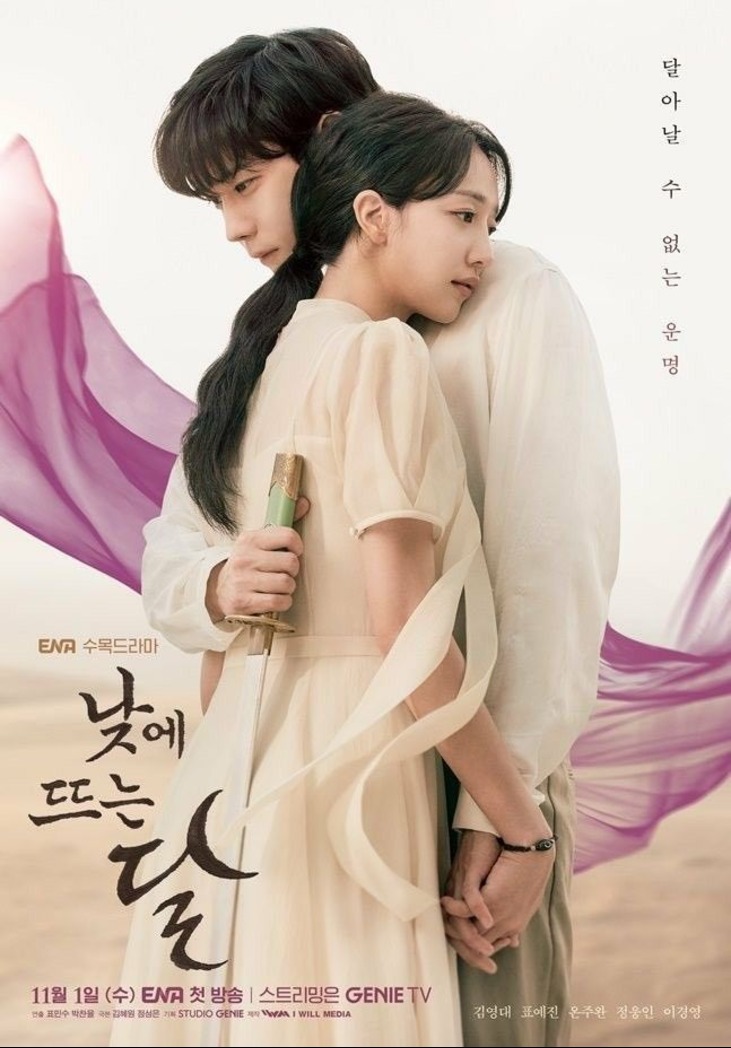
Moon in the Day Review: A Tragic Love That Transcends Lifetimes
A tale of the sun who keeps moving forward, and the moon who never lets go.
Korean Drama Name: 낮에 뜨는 달 (The Moon That Rises in The Day)
Where To Watch: Viki← *Click for direct link*
Average Rating: 7.7/10 (Mydramalist)
My Rating: 7.5/10
One Sentence Description: A cursed warrior, a reincarnated lover, and a story that’s tragic, beautiful, and occasionally boring
Trailer:
Disclaimer: This review is 100% my opinion — I’m not here to hate, just to share my thoughts! Also, SPOILERS AHEAD, so proceed with caution if you haven’t watched yet. Watch it, come back and let’s see if you agree. Let’s keep the discussion respectful and fun! 💕
WARNING: I hope you’ve already seen this show and know what the deal is. But in case you don’t or whatever the case may be, I felt like I should add in a little warning. This show has mentions of suicide. And since this is a review, I do also talk about this (in relation to the show only). Please be aware of that before you continue and be mindful of it. Stay safe ❤️
Simple Description
Moon in the Day is about a 1500-year-old warrior whose soul has been stuck in limbo, watching his first love reincarnate over and over while plotting her murder. Oh! And she killed him. True love at its finest.
⚠️Length Note: This post includes a detailed (and long) story breakdown. Want to skip straight to the review? Jump to the Review
We start with a flashback: 1500 years ago, the Great Gaya betrays Silla, and war breaks out. Do Ha, our male lead, is tasked with killing the Gaya General to end the conflict. He succeeds and then executes the general’s family, accidentally killing the wrong person. Han Ri Ta, the general’s daughter, escapes but witnesses the massacre. She vows revenge and, after several failed attempts, finally kills Do Ha. But in doing so, she unknowingly curses herself: Do Ha’s vengeful spirit becomes tethered to her soul. Moments later, Ri Ta drowns herself in a river. What a start.
Cut to the present. Ri Ta has reincarnated as Kang Young Hwa, a firefighter, with Do Ha watching from limbo. She saves a man named Mr. Seok (he’ll matter later), and we meet Do Ha’s reincarnated form: Joon Oh, a bratty actor playing a firefighter in an ad. He throws tantrums, storms off set, and goes on a date with his girlfriend, Jung Yi Seul.
When Yi Seul lands a role in a historical drama with Joon Oh’s rival, he throws another fit and forces his way to the male lead. The next day, Joon Oh and Young Hwa have a tense encounter — he belittles her job, she twists his arm and steals his phone. End Scene.
But Joon Oh’s got bigger problems than bruised pride, he’s dying from a rare blood cancer with only months left to live. And then fate steps in. He passes out in his van, which plunges into the ocean. Young Hwa, of course, dives in and saves him. While he’s rushed to the hospital, she collapses from exhaustion and ends up there too. Joon Oh dies but Do Ha’s spirit takes over his body. He immediately heads to Young Hwa’s room, knife in hand, ready to end the curse.
Before we see how that plays out, we get a flashback: Ri Ta didn’t kill Do Ha right after the massacre. They actually fell in love and got married. But eventually, she did kill him; because of this his spirit is cursed to follow her through 17 reincarnations. He’s tired. He wants peace. And now, in Joon Oh’s body, he’s ready to end it once and for all.
From this point on, to avoid confusion, I’ll call him Do Ha when he’s in Joon Oh’s body, and Joon Oh when we’re talking about…well, actual Joon Oh.
In the present, Do Ha tries to stab Young Hwa but a mysterious force protects her, flinging him backward. He tries again, but Young Hwa, completely unaware of the danger, checks his forehead for a fever. Do Ha flashes back to Ri Ta doing the same thing and promptly passes out on her bed. Young Hwa gets discharged, and Do Ha tries to follow her, only to be mobbed by reporters and hospital patients.
That night, Do Ha finds Young Hwa’s home and waits outside. That leads to another failed murder attempt thanks to the forcefield. He lands the role in the drama alongside Joon Oh’s girlfriend and attends the press conference. Upon seeing Young Hwa, he insists she stay close to him at all times. She declines and heads to work. Meanwhile, Do Ha confesses his true identity to his manager. Because why not?
Eventually, Young Hwa agrees to be his bodyguard. It goes terribly. Day 1: both are knocked unconscious and dragged to an abandoned warehouse. While that’s going on, we discover that Joon Oh’s drowning wasn’t an accident; he was drugged. Young Hwa wakes up first and takes down most of the kidnappers, but the leader knocks her out. The mastermind? Mr. Seok, aka Seok Chul Hwan. Turns out Chul Hwan is actually possessed by another ghost that’s after Young Hwa. He orders their deaths, but Do Ha wakes up and wipes the floor with everyone. Young Hwa gets blamed, and Do Ha makes her his official bodyguard.
The next day, Do Ha brings Young Hwa to a script reading. She goes to his car to grab a shirt and finds his bloody clothes from the kidnapping. Since the blame fell on her and got her suspended from work, she’s not happy. While they argue, Joon Oh’s rival, Tae Joo, gets put into a trance by the evil spirit that inhabits Chul Hwan and hits Young Hwa with his car. She’s left unconscious and bleeding.
Before we deal with that, we flash back again. After Ri Ta fails to kill Do Ha, she’s forced to work for him. She agrees, but only to find the right moment to strike. Joke’s on her, though — he wants her to kill him.
In the present, as doctors try to revive Young Hwa, Do Ha collapses too. Her survival is clearly linked to his. She pulls through but stays in a coma, bringing Do Ha back too. Do Ha’s determined to use this opportunity and sneaks into her hospital room and tries to strangle her. She wakes up mid-choke, calls him “my lord” (just like Ri Ta), and he hesitates.
Later, after Young Hwa is discharged, Do Ha starts noticing how eerily similar she is to Ri Ta and begins to fall for her. Time passes, and Young Hwa moves into Do Ha’s home to care for him. In a callback to the past, Do Ha and Ri Ta once made a bet about whether some lotus seeds would sprout in a thousand years. When Young Hwa admits she lost the bet, Do Ha grows more confused. Who is she really?
Young Hwa begins sharing her dreams of her past with Do Ha, and he becomes obsessed with using them to uncover the truth behind his death. Cue another flashback because this show loves a time jump (and so do I).
Back in the past, Do Ha’s father grows suspicious of Ri Ta and her relationship with his son. He hates Do Ha and wants to control him, so he accuses Ri Ta of theft, locks her in a shed, and beats her. Do Ha rescues her and even kills a guard in the process. Romantic? Traumatic? Both?
In the present, Do Ha tells Young Hwa they were once married. How? Because his father (the general (I think)) erased Ri Ta’s identity and used her as leverage to control his son. He killed everyone who knew who she really was, effectively putting a leash on Do Ha.
Meanwhile, Chul Hwan (a.k.a Do Ha’s dad still hanging around in spirit form) meets with Joon Oh’s brother and tells him about Do Ha’s possession. After testing Do Ha, the brother starts to believe it. Chul Hwan explains that when a spirit possesses someone, it leaves a dark mark; a symbol of how the spirit died.
Do Ha, torn between vengeance and emotion, continues to hesitate. He wants freedom, but he can’t bring himself to kill Young Hwa. Days pass, and the group — Do Ha, Young Hwa, her roommate, and the manager — go to an amusement park. Do Ha and Young Hwa continue to bond.
Joon Oh’s ticking cancer clock complicates things. His brother suggests one last trip together back to the campsite they used to visit. Except this “final outing” is actually a setup. Chul Hwan has convinced him that the only way to remove Do Ha from Joon Oh’s body and get Joon Oh back, is by pushing Young Hwa off a cliff. So, that’s exactly what he does. The brother drugs Do Ha and pushes Young Hwa off a cliff. Luckily, she manages to hang on, and Do Ha snaps out of his stupor just enough to save her.
Realizing he’s been manipulated, the brother confronts Chul Hwan at his hideout. They fight, and the brother ends up unconscious and in the hospital. Meanwhile, Do Ha opens up about the pain of watching Young Hwa die over and over again across lifetimes.
Young Hwa, seeking answers, runs into Chul Hwan who casually drops the bombshell that he knows Ri Ta and Do Ha, and blames her for everything. Later that night, Do Ha reveals another layer of the curse: Young Hwa is destined to die before she turns 30. While discussing this, Young Hwa sees Do Ha’s scar, finally realizing Chul Hwan wasn’t lying about any of it.
We return to the past, again, and finally learn the real reason Ri Ta killed Do Ha. And no, it wasn’t revenge. Before their wedding, Do Ha’s father gives Ri Ta an ultimatum: poison Do Ha in secret, or he’ll send Do Ha into battle where his own men will turn on him. Desperate, she initially agrees to the poisoning plan. But in a last-minute twist, she poisons Do Ha’s father instead and stabs him in the chest. He swears revenge with his dying breath. She’s arrested and handed over to Do Ha to be executed.
Ri Ta explains that killing his father was the only way to free Do Ha from his control. Do Ha, torn between duty and love, chooses her and they run away together.
That night, while Ri Ta sleeps, Do Ha’s father’s guards attempt to kill her. Do Ha murders them all. The next morning, Ri Ta sees the cost of their love: families mourning dead sons, brothers, husbands, and the wreckage of what they’ve done. Do Ha shows zero remorse for slaughtering to protect her to the point he’s willing to kill anyone, even a child, if it keeps her safe. It’s intense and morally messy.
That night, Ri Ta realises that as long as they’re together, they’ll never escape the sins they’ve committed or the ones they’ll commit for each other. So she kills him. Then walks to a cliff and jumps. And now we know.
Back in the present, Yi Seul, under Chul Hwan’s influence, pushes Young Hwa in front of a truck, blaming her for everything. But her friend intervenes, taking the hit instead.
While her friend recovers in the hospital, Do Ha finally confirms that Chul Hwan is his father. Meanwhile, realizing that everyone around her keeps getting hurt, Young Hwa decides to end her life. Do Ha rushes to stop her, using a game they once played in the past to reach her. It works. They kiss.
Chul Hwan keeps escalating. He lures Young Hwa out again; Do Ha protects her and explains Chul Hwan’s obsession: Chul Hwan must kill Young Hwa before she turns 30 or he’ll be extinguished. But then we get the cruel catch: if Young Hwa does make it past 30, Do Ha will vanish. His whole purpose as a spirit was to protect her from Chul Hwan. Defeat the villain and Do Ha loses his reason to exist. Tragic timing, right?
As Young Hwa’s birthday approaches, she, Do Ha, her roommate, and the manager retreat to a cabin in the woods. Do Ha, knowing the end is near, spends the night looking at their photos and crying. He wants to live, but he wants her to live more. It’s a quiet, heartbreaking setup for everything that follows.
The day before Young Hwa’s birthday arrives, and she spends it with the people who matter most. As night falls, tension builds. At 11 p.m., the lights go out. Chul Hwan has found them. He’s desperate to live, and the final showdown begins.
Do Ha urges everyone to flee while he faces his father. The manager is badly injured, and Do Ha is knocked out. Young Hwa runs while the others hide. As Do Ha regains consciousness, Chul Hwan closes in on Young Hwa. She keeps running, and Do Ha arrives just in time to protect her.
In the final minutes before midnight, Chul Hwan tries to convince Do Ha to let him kill Young Hwa so they can all survive. But Do Ha is done. Done watching her die. Done being tethered to a curse. Done letting Chul Hwan win. He impales his father, who still believes he’ll return. But Do Ha reminds him: only the protector can end him for good. Chul Hwan dies, and with him, Do Ha’s 1,500 years of torment finally come to a close.
For the first time in 1,500 years, Do Ha finally rests.
Time passes. Joon Oh is alive! but this time, he’s just Joon Oh. Young Hwa returns to her firefighter job. Joon Oh prepares for his historical role. He reaches out to Young Hwa, hoping to move forward. They part ways. Joon Oh keeps on acting. Young Hwa heads to Antarctica, fulfilling the dream she had at the start. Life goes on. They never meet again.
Until… reincarnation rolls around.
In the final scene, Young Hwa is now a university student snapping photos of old historical sites (possibly the same places tied to Ri Ta and Do Ha, though that’s purely my guess). She almost tumbles off a ledge but is caught just in time by — who else? — Do Ha’s reincarnate.
They look at the moon, then at each other, a quiet reminder that even when unseen, the moon still lingers in the daylight. Just as Do Ha had always lingered beside her. Young Hwa was the sun. Do Ha was the moon. And some loves, no matter how cursed or quiet, never truly fade.
The End.

The Review
The Good
Perfect Name, Perfect Metaphor
I love when a show’s title actually means something and Moon in the Day nailed it. Just like Youth of May (review here!), the metaphor wasn’t just poetic, it was the emotional backbone of the entire story. Do Ha, the moon, always lingering quietly beside Young Hwa, the sun. Even when unseen, he was always there. That final scene: “They look at the moon, then at each other…”, was the perfect echo of everything the show had been building toward. And yes, the writers spelled it out in the show, but the way they wove it into the narrative made it feel earned. You could tell they cared deeply about this story, and that care showed in every detail.
Fated Love Tropes Done Right
Let me just say it louder for the people in the back: I LOVE fated love tropes!!! There’s nothing more satisfying than two leads who are destined for each other, no matter what century, what curse, or what tragedy tries to tear them apart. I especially love when the male lead remembers first (or in this case, never forgets) and falls in love with the female lead all over again.
This drama nailed it. On one side, Do Ha is ready to kill her just to finally find peace. On the other side, he’s realising that his love for her never died and he doesn’t know if he’s capable of harming the very woman he’s always loved. His line: “I can’t go back into that fiery pit, because I’m obsessed with you.” — yeah, that one lives rent-free in my head.
Tragic, But Beautiful Ending
I didn’t know what kind of ending I wanted but I’m not mad at what we got. In fact, I kind of loved it. Fantasy or not, I respect when a drama gives us an ending that feels realistic instead of force-feeding us the “perfect happy ending.” And in its own way, this was a happy ending. Joon Oh lived, Young Hwa got to chase her Antarctica dream, Do Ha finally rested, and everyone got a piece of peace.
And that final scene? Them meeting again in a new life? It was quiet, subtle, and full of promise. It gave closure without tying everything up too neatly. The love between them isn’t over — it’s just beginning again.
We Got the Full Story
One of my biggest pet peeves with historical dramas is when they give you crumbs and expect you to fill in the rest. Not here. Moon in the Day gave us full, rich flashbacks that made the past feel just as important as the present. I could write an entire essay on Do Ha and Ri Ta’s history and not because I’m guessing, but because the show laid it all out. Even the lotus seeds had meaning. The writers didn’t treat the past like filler, they treated it like foundation. And I applaud them for that.
The Bad
Would’ve Been Nice to See Him Act Like Joon Oh
This isn’t a dealbreaker, but it was a missed opportunity. Do Ha pretending to be Joon Oh, even just once, was fun to watch. It added tension, humour, and a glimpse into how out-of-place he was in the modern world. But then… nothing. No more pretending. No more awkward moments of him trying to act like a spoiled celebrity. Imagine the show stretching that: Do Ha awkwardly Googling “how to be a spoiled actor,” dodging Joon Oh’s brother who’s always suspicious, faking PDA on command, and pretending to care about his girlfriend. It would’ve added depth to his character and given the actor a chance to show range. Instead, we got 90% blank stares and emotionless delivery. No shade, but it got a little dull.
Should’ve Used His Celebrity Status More
Joon Oh being an actor felt like a setup with no payoff. Young Hwa’s job as a firefighter had clear relevance — she saved his life, it tied into her character, it mattered. But Joon Oh’s stardom? Barely touched. If you’re going to make him a public figure, use it. Let him leverage his fame to track down Mr. Seok. Let the media complicate things. Let his fans get in the way. Something. Anything. Instead, it just felt random — like a character trait that got left behind.
Her Reasons Didn’t Work… At All
This was the biggest letdown. The grand reveal of why Ri Ta killed Do Ha was supposed to be emotional, tragic, and layered. Instead, it was weak, thin, and frankly, selfish. She said they were never meant to be together and that staying together meant they’d never escape their sins. Choosing death for both of them because you decide the relationship is doomed? That’s not your choice alone to make. That’s not tragic, that’s convenient writing.
He was clearly willing to fight for life and for her, so her decision to end everything for the two of them robbed Do Ha of agency and made the drama’s moral centre wobble. If you’re going to double down on tragic sacrifice, give the audience a reason they can feel. Not a line that reads like a plot shortcut.
Some Unnecessary Middle Fluff
If you’ve only read my description, you probably think this show sounds amazing and it is— in parts. But that’s because I cut out all the fluff. The reason this drama only got 7.5 stars from me, despite how much I love the core story, is because there were long stretches where I was just… bored.
The girlfriend had way too much screentime. The bodyguard subplot didn’t make sense and dragged. Chul Hwan spent most of the show playing stalker in a never-ending cat-and-mouse game. Those scenes didn’t build tension, they diluted it. The core moments were incredible, but the slow ones (a.k.a the present day scenes) made me forget why I cared. And that’s never a good sign.
Irrelevant side characters
This one’s a structural issue. None of the side characters really brought anything to the story. I saw a comment that said, “If none of the side characters were in the show, the plot would still move forward just fine.” They were right and that was the problem. Tae Joo, the attorney, the roommate, the brother, the manager — the whole lot of them felt like filler.
Every time one of them showed up, the energy dropped. The historical scenes were so much stronger because they got straight to the point. No fluff, no distractions. But in the present timeline, each irrelevant character got a scene or two that didn’t add much, and it slowed everything down.
Her Being His Bodyguard? Be Serious.
Let’s talk about the bodyguard thing. Young Hwa, who’s shorter and physically weaker than Joon Oh, is hired to protect him? Really? That was such a flimsy excuse to force proximity between them. And then when they both got kidnapped, everyone just assumed Young Hwa beat a group of grown men into unconsciousness while Joon Oh laid there like a decorative pillow. Be serious.
I’m not trying to start a “men vs. women” debate. Biology is biology. Most of the time, he was protecting her. So why did she even entertain the bodyguard role for a second? It didn’t make sense, and it didn’t add anything meaningful to the story.
Damsel in Distress/ lack of power use
I didn’t even clock this until I saw a couple of comments point it out, and then it hit me “oh yeah!” The female lead went from being a super cool firefighter to suddenly forgetting every ounce of self-defense she ever knew. It was odd watching her constantly run from danger when her actual job is literally to run into it. At first, I excused it because, well, she’s being chased by a psycho ghost who wants her dead. Fair. But then again… she’s a firefighter who deals with life-or-death situations every day. It just didn’t add up. Honestly, this might’ve made more sense if she’d been written as an ordinary civilian, someone without survival training.
And while we’re on the subject of power inconsistencies, what happened to Do Ha’s powers? He had them in the beginning, then poof — gone. No explanation, no payoff, nothing. Why couldn’t he use them against the villain? It felt like a whole subplot that the writers set up and then completely forgot existed.
Not Enough “Falling in Love” Scenes
This one hurt. I love “falling in love” scenes more than actual couple moments. I want the tension, the stolen glances, the emotional shift. And we got… basically none of that. She hated him and wanted to kill him. He killed her family and forced her to be his servant. And then suddenly, he’s ready to die for her by episode three? Where did that even come from?
If a man is so deeply in love that he’s ready to kill children to protect her, I need to see the moments that made him fall. I want denial. I want confusion. I want him questioning himself, resisting his own obsession, realising he’s too far gone. And with Ri Ta, I needed to see the cracks in her hatred — the moments she starts to care, hates herself for softening, and finally realises she’s in love. We got none of that. We skipped right past all of that to “welp, I guess he’s obsessed now.” and that’s not romance, that’s a disappointment wrapped in a rushed plot.

What I Would Do
Give Her a Genuine Reason
I was so invested in trying to come up with a better reason for Ri Ta killing Do Ha and I couldn’t. Because honestly, it was never her choice to make. So in my version, instead of her killing him and then herself, she just kills herself. And here’s how that could’ve played out:
He’d Never Truly Be Free Because of Her:
In this version, Ri Ta tries to assassinate Do Ha’s father anonymously. She thinks she succeeded — the doctors say it’s hopeless, and she’s relieved. Do Ha is finally free. Until the father wakes up.
She’s devastated. Not for herself, but for Do Ha, who’s now under an even tighter leash. The father finds out it was her and uses it to manipulate Do Ha further. Ri Ta realises it’ll never end. If they run, his father would hunt them down; If she runs, Do Ha would never let her go and would get her to come back; And if she stays, Do Ha would live in constant fear and servitude.
So she makes a choice— the only one that truly frees him. She disappears. Do Ha, of course, finds her. They meet at the same cliff from the original show. He pleads, but when the father’s guards appear, she remembers why she’s doing this. With tears in her eyes, she tells him she has no regrets and that she’d make this choice again and again if it meant freeing him. Then she lets go. He runs to stop her, but he’s too late.
She Turned Him Into an Even Worse Monster:
In this take, Ri Ta succeeds in killing the father, and they run like in the original version. But the cost? Do Ha is forced to kill dozens of men wherever they go, slowly becoming the very monster he once begged her to save him from becoming. She loves him, but she can’t ignore what’s happening — the man she wanted to free is just as enslaved, only now it’s to their love and their sins.
They stop at a cliff. She asks him what he thinks the water looks like from below, planting the seed. Cold? Rocky? He pulls her back, and they camp nearby. Later, she drugs him with a sedative (herbs). She messes it up so he’s not unconscious, but weak. She tells him she loves him and that she has to do what she has to do.
Do Ha recalls the weird questions about the water and pieces it together. By the time Do Ha stumbles toward the cliff, she’s already surrounded by guards. He begs to take her back, to spare her, but she shakes her head. She says goodbye (the same way she did in the version above), knowing the only way to fully break his chains is to take herself out of the equation. And she falls.
The Aftermath aka the Present Time:
Instead of Do Ha being obsessed with why she killed him, the obsession becomes why she killed herself. When he dies in the past, he swears to find her again and never leave her side. The curse binds him to her, either in her next life or immediately after. The love is still fated, but this time, the mystery isn’t about betrayal, it’s about sacrifice.
This way, the story still plays out with reincarnation, curses, and fated love, but the emotional core shifts into something much more heartbreaking: a man who’s desperate to understand why the woman he loved thought her death was the only way to free him.
I could go on and on… but I’ll stop here 🤭
Falling in Love Scenes Galore
If Do Ha’s love is strong enough to kill for, we need to see why. In my version, we’d get rich, layered parallels between the past and present. Not just vague dream sequences, but real moments that trigger memories. Maybe they’re at a festival and Young Hwa sees children dancing, and suddenly remembers the first time she felt something for Do Ha, when he danced with kids at a festival centuries ago. Or maybe she’s at a park and gets splashed by a fountain, and it reminds her of the time a drunk man tried to throw alcohol on her, and Do Ha stepped in to protect her. That night, he tended to her wound and that was the moment she fell.
And he doesn’t get a free pass either, because honestly, I prefer watching the guy fall in love more. Even though Ri Ta wants to kill him, she still has small moments of joy. Maybe he catches her sneaking around and thinks she’s plotting against him… only to find her feeding stray kittens. Or one night, drunk and unguarded, she forgets her mission entirely, walks with him, laughs, dances, and mumbles that she wishes she could live for herself and not have to hate him— right before she collapses on his shoulder.
Over time, we’d see him watching her more closely. Saving her when she stumbles. Laughing because of her. Wanting to live because of her. These are the beats we needed to understand how a love could survive curses, betrayal, and centuries.
Make the Side Characters Matter
One of the easiest ways to make the present timeline more engaging? Give the side characters actual relevance. In my version, most of them would’ve existed in the past life too— with relationships that shape who they are now. Yi Seul wasn’t just clingy in the present; she was an obstacle in the past. The roommate was Ri Ta’s cautious friend. The manager was Do Ha’s right hand. Tae Joo had a crush on Yi Seul centuries ago, and now they’re tangled again.
They don’t need to remember their past lives but their personalities and dynamics would reflect who they once were. Maybe Do Ha has the ability to restore the manager’s memories, and now he helps uncover the truth. Think See You In My 19th Life, where the present is shaped by the echoes of the past.
This approach would make the present timeline more dynamic, as side characters’ actions would feel purposeful rather than filler. For example, Yi Seul’s interference with Joon Oh and Young Hwa wouldn’t just be about jealousy, it would echo her past self as someone who naturally complicates their relationship.
To add a comedic angle, one character, like the brother or Tae Joo, could remain oblivious while everyone else subtly maneuvers, always lagging behind in understanding the unfolding situation. This would give the story more layers, humour, and cohesion, turning the side cast from irrelevant background figures into integral pieces of the narrative.
Do Ha as Joon Oh — Missed Potential
This one’s small, but still worth mentioning. It would’ve added so much if Do Ha had to fake being Joon Oh for most of the present times. Imagine him impressing directors with his acting, then immediately tanking a scene to avoid suspicion. Pretending to be in love with Yi Seul, but clearly not feeling it.
The present timeline felt a bit flat at times compared to the historical parts, and having Do Ha juggle his double life as Joon Oh would’ve added tension, humour, and depth. Honestly, it could’ve carried a lot of the “modern” episodes that dragged.

Final Thoughts
I’ll say it again and again: I LOVE fated love tropes. This drama had so much to love, and nearly all of it revolved around their love: the historical depth, the emotional weight, and Do Ha’s constant battle between choosing himself or choosing her… and always choosing her. Watching him go from “I need to kill her” to “I’ll be the reason she lives” was everything.
Honestly, part of why I loved this drama so much is because I had so much fun imagining alternate versions of their story. I’m not even going to lie, I got so deep into my own rewrite that I started getting bored watching the actual show because my version was just that good 😂. I even considered writing little stories based on the ideas I came up with… but I’m already busy writing these reviews, so we’ll see.
All in all, the story was genuinely good. If they’d just changed her flimsy reason for killing him, trimmed down some of the modern-day fluff, and avoided a few questionable choices (looking at you, bodyguard subplot), this would’ve been an easy 10/10.
I know the opinions on this one are mixed, and honestly, I get it. But me? I’m choosing to focus on the parts I loved. Otherwise, I’d have to rewrite the entire vibe of this review, and we don’t have that energy here.
So while it wasn’t perfect, when the fated love trope is done right, I’ll forgive just about anything.
Another review in the bag!! I took a two week break because I was overseas and it was difficult for me to get these out but I’m back and better than ever!
The next review I’m gonna do is one I kind of reviewed on another platform but I want to make it a bit more professional and written out. It’s a drama I didn’t like… sigh. I feel like I’m always writing reviews on dramas I don’t like but it’s not on purpose. I find that I have more so say with the bad ones and I don’t want to bore you with a short review less than 10 pages long (🤭).
Anyways, I’ll see you next week!💕


Main Cast
Pyo Ye Jin as Kang Young Hwa/ Han Ri Ta
Kim Young Dae as Do Ha/ Han Jun Oh
Ohn Joo Wan as Han Min Oh (brother)
Jung Woong In as Seok Chul Hwan
Jung Shin Hye as Jung Yi Seul
Choi Ye Won as Choi Na Yeon (roommate)
Kim Dong Young as Jang Yoon Je (manager)
Themes/ Genres
Betrayal and revenge; Fate vs. free will; Identity and duality; Time-trapped souls; Emotional redemption;
Fantasy, Romance, Historical Drama, Supernatural
Comments (1)
Moon in the Day Review-Only: A Tragic Love That Transcends Lifetimes – Aya's K-drama Corner
September 29, 2025 at 1:33 pm
[…] *Want a detailed description? Click here!* […]