
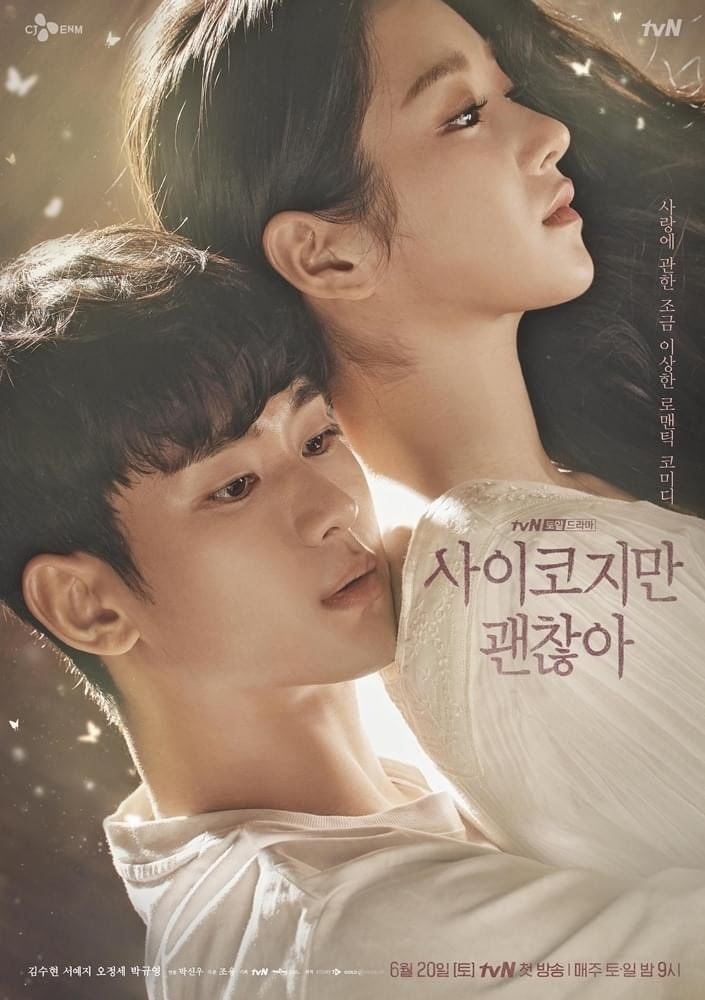
It’s Okay to Not Be Okay Review: When Mental Health Became a Side Plot and Toxic Love Took Centre Stage
A psychiatric hospital, unresolved trauma, and a love story that sometimes felt like a hostage situation.
Drama Name: 사이코지만 괜찮아 (Psycho But It’s Okay)
Where To Watch: Netflix ← *Click for direct link*
Average Rating: 8.9/10 (Mydramalist)
My Rating: 8.5/10
One Sentence Description: A beautiful mess of childhood trauma, questionable parenting, and outfits that slayed harder than the plot.
Trailer:
Disclaimer: This review is 100% my opinion — I’m not here to hate, just to share my thoughts! Also, SPOILERS AHEAD, so proceed with caution if you haven’t watched yet. Watch it, come back and let’s see if you agree. Let’s keep the discussion respectful and fun! 💕
Side note: This review has nothing to do with Kim Soo Hyun’s current situation. My focus here is strictly on the show itself — the characters, the story, and the performances as they appear in the drama. Any comments about the ongoing scandal, or hatred directed toward him, will be removed. The mentions I make of his acting skills and chemistry are solely in relation to his work in this series and are not connected to anything happening outside of it.🤍
Simple Description
It’s Okay to Not Be Okay is about a girl and a guy learning to face their traumas and, little by little, grow together.
⚠️Length Note: This post includes a detailed (and long) story breakdown. Want to skip straight to the review? Jump to the Review
The drama actually opens like a fairytale — a story about a young girl who was followed by a dark shadow, so everyone called her a monster. She had no friends and lived in constant loneliness. One day, she saved a boy from drowning, and in return he started following her everywhere… until she destroyed some butterflies and he ran away.
We then jump into the real world with our male lead, Moon Kang Tae, who pulls his brother out of work after an incident with some machines. His brother, Sang Tae, is autistic and struggles in overwhelming situations. Meanwhile, our female lead, Ko Mun Yeong, is introduced as a famous children’s book author who manages to terrify a little girl just for asking for a picture. Enter Lee Sang In, her long-suffering publisher CEO, who drags her to a children’s psychiatric hospital for a reading. Coincidentally, Kang Tae also works there — though in the adult ward. A new patient arrives after a horrifying case: he tried to make his daughter overdose, then attempted to kill himself. His daughter is admitted to the children’s ward with PTSD.
During Mun Yeong’s reading, chaos strikes. The father barges in looking for his daughter, dragging her backstage. Mun Yeong follows, watches the mess unfold, and — in the most blunt way possible — tells him to kill himself but leave his daughter out of it. He snaps, grabs her by the throat, and we see a chilling flashback of Mun Yeong experiencing something similar as a child. Just when it looks bad, Kang Tae jumps in to save her, but Mun Yeong isn’t done. She pulls out a knife, ready to stab the man, and Kang Tae blocks her, slicing his own hand in the process. He ends up taking the fall and losing his job. Mun Yeong signs hospital papers to save her father, and the man who attacked her dies later in solitary confinement.
That night, both Kang Tae and Mun Yeong realize they’ve crossed paths before. Kang Tae finds himself rereading her book, while his brother wakes from a nightmare insisting “the butterflies will kill me.” Ju Ri — Kang Tae’s friend, coworker, and Mun Yeong’s old classmate — mentions there’s a job opening at her psychiatric hospital back in their hometown. We also see a flashback of Kang Tae’s mother being murdered when he was younger. Sang Tae had witnessed it but could only say, “the butterfly did it.”
The next day brings us to Mun Yeong’s book signing, which… let’s just say doesn’t go smoothly. While Kang Tae steps away to take a call, Sang Tae gets distracted by a child’s dinosaur costume (dinosaurs are his favourite). Unfortunately, the child’s father doesn’t take it well and grabs Sang Tae by the neck, causing him to panic. Kang Tae rushes back to calm his brother, but Mun Yeong jumps in like a force of nature, yanking the father’s hair until he apologises. What a book signing.
Not long after, Mun Yeong shoves a book critic down the stairs for threatening to write that she has an anti-social personality. Subtle, right? We then find out the fairytale characters from the beginning — the lonely girl and the boy she saved — were actually Mun Yeong and Kang Tae all along. Soon after, Kang Tae accepts the job offer and they move back to their hometown.
Meanwhile, Mun Yeong’s reputation takes a nosedive. Footage of her fight with the parents — plus clips of her being rude to kids — gets leaked, and people start boycotting her books. To make things worse, a civic group files for an injunction against her latest release, claiming it’s too disturbing. Mun Yeong, blissfully unaware, heads back to her hometown, where Kang Tae moved to. Her obsession with Kang Tae deepens, and she even agrees to teach a literacy class at the same psychiatric hospital where he works.
Eventually, the injunction gets approved, which leaves her publisher Sang In in full panic mode. Meanwhile, Mun Yeong and Sang Tae finally meet and immediately bond, which only makes Kang Tae lash out in frustration. He says some cruel things to Mun Yeong before dragging his brother away. Later, when Mun Yeong agrees to take her father on a walk, he suddenly snaps, tells her to die, and strangles her. In true Mun Yeong fashion, she laughs through the tears after it happens. Kang Tae eventually hears about the incident, rushes out, and finds her wandering alone — barefoot, drenched, and broken. He takes her home, and after some back and forth, she convinces him to let her stay.
Back at the hospital, Sang Tae agrees to paint a mural on the wall while Sang In begs Mun Yeong to publish again because, thanks to her antics, he’s flat broke. Mun Yeong, however, has other ideas. She offers Sang Tae a job — live with her and be her illustrator. Meanwhile, we get more backstory on Kang Tae through a flashback: as a kid, he ran home excited about earning his red belt, but instead of praise, his mom slapped him for leaving Sang Tae to walk alone. Hurt, Kang Tae stormed out, only for Sang Tae to follow him onto a frozen lake. The ice cracked, Sang Tae fell in, and at first Kang Tae ran away. But guilt pulled him back, and he tried to save his brother while nearly drowning himself. Sang Tae managed to escape, but it was Mun Yeong — watching from a distance — who helped pull Kang Tae out.
In the present, Mun Yeong is haunted by nightmares of her mother, and Kang Tae slowly begins to care for her more openly. A few days pass with Mun Yeong teaching her literacy class, and Kang Tae finally admits (at least to himself) that he’s falling for her. Things take a sharp turn when one of the patient’s toxic exes shows up, furious that she’s moved on. He chases her down until she runs straight into Mun Yeong. Ever the chaotic queen, Mun Yeong hurls her can at him — only to get hit in the face herself. Kang Tae, arriving right on time, punches the guy square in the jaw. His suspension that follows? Totally worth it.
Afterward, Kang Tae casually asks Mun Yeong to go on a trip with him, and for a moment, it feels like we’re heading into rom-com territory. But of course, it doesn’t last. Mid-drive, Mun Yeong gets annoyed, kicks him out of her car, and speeds off. Later that night though, she and Sang Tae are laughing together over a TV show when Kang Tae comes home. Instead of holding a grudge, the two of them make plans to take that trip the next day. But before any of that, the hospital director makes a chilling discovery: Mun Yeong’s mother might still be alive.
Kang Tae and Mun Yeong finally set out on their long-awaited trip, and they go up a mountain to a suspension bridge. They snap pictures, laugh a little, and actually enjoy themselves. Later, they stay overnight at a guest house (just to sleep, relax 🤨), and we finally get the backstory of Ju Ri’s long-time grudge against Mun Yeong. Turns out, back in school Ju Ri was bullied, and Mun Yeong swooped in as her only friend. Things were good until Ju Ri made more friends, which triggered Mun Yeong’s jealousy. To keep Ju Ri all to herself, Mun Yeong drove those other friends away — and once Ju Ri found out, the friendship fell apart.
Back home, Sang Tae starts worrying when his brother doesn’t answer his phone and hasn’t returned. When Kang Tae finally shows up with Mun Yeong, Sang Tae is still upset. Things boil over when he overhears talk about the two possibly getting married. He confronts Kang Tae and demands to know who he loves more: him or Mun Yeong. Kang Tae swears it’s Sang Tae, but he doesn’t believe him. In a gut-wrenching scene, Sang Tae dunks his brother in water, screaming that Kang Tae wants him dead. He accuses Kang Tae of pushing him into the icy lake years ago and running away. Kang Tae collapses, sobbing, insisting it isn’t true. Easily one of the most emotionally brutal moments of the drama.
Meanwhile, one of the patients, Ms. Park, starts asking odd questions about Kang Tae and his brother, setting off alarms for the hospital staff. Kang Tae decides to break things off with Mun Yeong to focus on Sang Tae, though he eventually patches things up with his brother. Ms. Park keeps raising eyebrows. A nurse mentions she’s unstable and loves provoking others. Later, Kang Tae hears her humming a song and follows her straight to Mun Yeong’s father. She needles him with the question, “Why? Are you going to kill me again?” which sends him into a rage. He chokes her, insisting if he doesn’t kill her, she’ll kill him. The staff restrains him, but now both Kang Tae and the director start to wonder: is Ms. Park connected to Mun Yeong’s mother… or is she actually her?
Mun Yeong, meanwhile, is determined to be besties with Sang Tae, but he’s still hurt about being left behind during the trip. The next day, Kang Tae pieces things together and realizes Ms. Park really might be Mun Yeong’s mother. He rushes to her house, where Ms. Park has already arrived, wishing Mun Yeong a creepy “happy birthday” and talking about her father. By the time Kang Tae arrives, Ms. Park is gone, and he’s left shaken but relieved. The tension melts a little as Kang Tae and Mun Yeong reconcile, and she cares for him while he’s sick.
While lying together, Kang Tae finally opens up: Sang Tae had witnessed their mother being murdered by a woman wearing a butterfly brooch. Ever since, each spring when butterflies return, the brothers pack up and flee. It’s the one trauma they’ve never been able to escape.
Back at the hospital, Sang Tae is close to finishing his mural when the director requests butterflies. Naturally, Sang Tae refuses. Tensions at home rise too — Kang Tae and Sang Tae get into a heated argument, ending with Kang Tae finally snapping and fighting back.
A few days pass, and Sang Tae finally decides to face his fear of butterflies by telling the truth about his mother’s death. One night, while chasing a cat on their way home, his mom walked into a tunnel. There, a strange woman with a golden butterfly brooch appeared and stabbed her in the neck. She then grabbed the back of Sang Tae’s hair and threatened him — which explains why he panics whenever someone touches it. As Sang Tae describes the brooch, Kang Tae remembers an old family photo of Mun Yeong’s mother wearing the exact same one. The realization hits hard: did Mun Yeong’s mom kill his?
Kang Tae is shaken but resolves to keep this from Mun Yeong. Not long after, her father’s cancer worsens. Kang Tae and the director encourage her to say her goodbyes, but Mun Yeong refuses. In her eyes, parents don’t get automatic forgiveness just because they’re parents — or because they’re dying. Her father eventually passes away, but not before confessing that he killed his wife and threw her body into a lake.
After his death, Mun Yeong starts considering selling her “castle” and moving forward. But things unravel again when Sang Tae’s nearly finished mural is defaced with a white butterfly. The sight destroys him — it’s the same butterfly he saw on the woman who murdered his mother. Mun Yeong connects the dots too, remembering her mother’s identical brooch. The truth is undeniable: her mother killed Kang Tae’s mom and traumatized Sang Tae. She’s left shattered.
While Mun Yeong retreats to process everything, Kang Tae comforts his brother and digs deeper with the director. They check the CCTV footage to catch whoever drew the butterfly, expecting Ms. Park. But in a shocking twist, it’s not her at all — it’s Nurse Haeng Ja. Sweet, dependable head nurse Haeng Ja is actually Mun Yeong’s mother.
Kang Tae immediately sends Sang Tae to be with Mun Yeong while the director scrambles to handle Haeng Ja. Mun Yeong, on the other hand, continues to spiral. Kang Tae eventually tells her the truth — Haeng Ja is her mother — and the weight of it crushes her. After a few more days of mourning and guilt, Mun Yeong puts together a plan to catch her. Unfortunately, Haeng Ja is already ahead of them and kidnaps Sang Tae first.
Kang Tae and Sang In scramble to distract Mun Yeong while Kang Tae goes to confront her mother himself. Mun Yeong immediately finds out, almost crashes Sang In’s car, and runs back to her “castle” house. At the “castle,” he finds Sang Tae drugged and unconscious. Haeng Ja unloads years of twisted blame, accusing Mun Yeong of everything. She recalls how she snapped when Kang Tae’s mother suggested putting Mun Yeong in a psychiatric hospital after she showed disturbing behaviour, like suggesting they kill an injured bird. Kang Tae’s fury boils over, and he nearly strangles Haeng Ja — but stops himself. That hesitation gives her the chance to stab him with a needle.
Mun Yeong arrives just in time and tries to stab her mother in return, but Kang Tae intervenes, desperate not to let her carry the burden. Haeng Ja seizes the moment and stabs Mun Yeong instead. Just as it looks like she’ll win, Sang Tae regains consciousness, grabs a massive book, and slams it against her head — knocking her out cold. Hero move.
The police arrest Haeng Ja while Kang Tae sleeps off the drugs. When he wakes up, Mun Yeong—convinced he’ll only suffer if he stays with her—tells him and Sang Tae to move out. The next day, Kang Tae quits his job and learns the director is also leaving. Mun Yeong tells Sang In she’s retiring and won’t be publishing the book she was working on with Sang Tae. But after a lot of back and forth (and a whole lot of stubbornness), she finally agrees to be with Kang Tae again.
Eventually, Mun Yeong decides to publish the book with Sang Tae after all, and Sang In couldn’t be happier. She later visits her mom in prison, vowing not just to forget her, but to use the butterfly as a symbol of healing instead of fear. Meanwhile, Sang Tae paints over the old butterfly and replaces it with a new, brighter one—showing his growth and his ability to finally move past his fear of butterflies.
The book is published under the title Finding The Real Face. Sang Tae is excited to see his name and illustrations in print, while Sang In quietly panics that it won’t sell since it’s nothing like Mun Yeong’s usual work. After a failed reading event, Director Oh gifts them a camper van, which instantly lifts everyone’s spirits. That night, Mun Yeong and Sang Tae pretend they’re not interested in taking a trip — just to surprise Kang Tae. The next morning, they all head out together.
One night on the trip, outside the camper, Mun Yeong finally apologises to Kang Tae for hurting him and confesses her love—for real this time. The next day, Sang Tae decides he wants to head back and work on a new project he’s been offered. He tells Kang Tae to stay with Mun Yeong, pushing Kang Tae to finally understand that he can live his own life while letting Sang Tae live his.
The story closes with the ending of Finding The Real Face, where the trio in the book finally discover who they are.
The End.

The Review
The Good
Oscar Who? We Only Know Oh Jung Se
I think everyone can agree with me when I say Oh Jung Se’s (Sang Tae) performance was nothing short of fantastic. Even the subtle things—like the way he used his fingers—were so well done. I actually questioned whether or not this actor was autistic because of how convincing his performance was (I was new to K-dramas at the time, I didn’t know; cut me some slack 🙏).
And of course, I can’t leave out Kim Soo Hyun and Seo Ye Ji. Their chemistry? Next level. Their acting? Flawless. Even the extras in the hospital held their own. Nothing hits better than a show where every actor knows their role and nails it.
Tim Burton, But Make It Therapy
I genuinely enjoyed the little animated stories sprinkled throughout the drama. Some people compared them to Tim Burton and now I can’t unsee it—and I love it. It was such a smart touch to use these eerie fairytales to reflect real-life themes. Honestly, I still can’t believe they were supposed to be children’s books. If I had read those as a kid, I’d still be in therapy.
Mun Yeong’s Outfits = Slay
I’ve seen countless edits of Mun Yeong’s outfits and let me tell you, they live rent-free in my head. Every single look was a serve. I don’t think I’ve ever wanted a character’s wardrobe more than hers, and yes, I shamelessly gave the show an extra point just for the fits.

The Bad
She Wasn’t “That Girl,” She Was Just Toxic
Anybody else find Mun Yeong plain toxic? She basically forced Kang Tae into Stockholm Syndrome, it was always her way or the highway, she pushed herself on him multiple times, kidnapped his autistic brother—the list goes on. I don’t know why some people frame this as “bad b” behaviour when really, it’s just bad behaviour. I’m always on the women’s side, but what isn’t okay for men shouldn’t magically become okay for women. And this? Wasn’t okay.
The show tried to justify it by dangling the possibility of a disorder, but by the end, it’s clear she was just a woman with trauma. Trauma can explain some things, sure, but it doesn’t excuse toxic actions. And every time she was challenged or proven wrong, she’d flip defensive and get irritated. Honestly, in real life, I don’t know how long that relationship would’ve lasted. Towards the end, she said she didn’t want to walk on eggshells — which is ironic, because that’s exactly what Kang Tae would have to do around her.
And don’t even get me started on her poor publisher. Because of her “I don’t care” attitude, Sang In was constantly left to pick up the pieces, pay people off, and run damage control. She wasn’t grateful, she wasn’t apologetic—she didn’t even care. He went broke cleaning up after her, and at the end she even forced him to choose between saving his business or staying loyal to her. Why didn’t he ever make her pay for all that? Why was he still working with her? This woman literally had the office hiding sharp objects in case she lashed out—like are we serious?
This all made her hard to root for, or even relate to, because she didn’t really grow or change. Even when Sang In begged her to publish for the sake of his business, she was still only thinking about herself. If I were him? Lawsuit. Immediately.
So… Did She Have a Disorder or Not?
One thing I’ll never understand: did Mun Yeong actually have an antisocial personality disorder or not? A couple characters mentioned it in passing, but nobody confirmed it. And considering she literally worked in a psychiatric hospital surrounded by doctors—and dated a nurse—you’d think someone would’ve said something definitive.
By the end, she chalks it all up to trauma. Which, again, doesn’t make her trauma invalid, but it makes her actions less excusable. Trauma absolutely changes people. But if they had confirmed a diagnosis, we could’ve better understood her behaviour. Like with diagnosed narcissism, you don’t excuse it, but you understand the patterns.
I just wish they hadn’t used the “maybe she’s antisocial” angle as a plot device. It would’ve been more meaningful if she actually had it and we saw her work through it.
Childhood Connection? More Like Plot Convenience
I’m still not sure what the point was of Kang Tae and Mun Yeong knowing each other as kids. He still fell in love with her as an adult, and they didn’t even realise their “past connection” until after they’d already met again. Honestly, it felt like an excuse to draw some cute Tim Burton–style animations (which, fine, I’ll admit, I enjoyed).
But here’s the thing: if you’re going to give characters a shared childhood, use it. Let Kang Tae’s memory of her shape their story. Let it mean something. Instead, it barely came up, and the plot would’ve been exactly the same without it. K-dramas do this all the time, and it drives me crazy. If the characters don’t need a past, don’t force one.
Romance > Mental Health?
I love a romance as much as anyone, but I’m officially over heavy topics being shoved into rom-com packaging. After Doctor Slump (review here!), True Beauty (review here!), and now this—I’m officially tired. The issue is that the romance always overshadows the mental health storyline that the show pretends to prioritise. It starts to feel like bait: “Look, deep and emotional mental illness themes!” only to push them aside so the leads can flirt.
Struggling together? Love that. Pretending mental illness magically eases up because you meet the right person? Don’t love that. It’s Okay to Not Be Okay should’ve leaned into the fact that both leads had real childhood trauma. Mun Yeong needed to face her pain without pretending she wasn’t struggling. Kang Tae needed to learn to be more than just his brother’s caretaker. Healing together is powerful. Healing because of each other is shallow.
And the wild part? They literally worked in a psychiatric hospital surrounded by patients. The show had the perfect setup to weave genuine healing into the story and mostly skipped it.
Mun Yeong’s Mother: The Resurrection That Made No Sense
Now let’s talk about the biggest head-scratch of them all: Haeng Ja’s “survival.” She was left bleeding out at the bottom of the stairs and dumped into a lake. How did she escape? Swim her way out like a K-drama Michael Phelps? Then get secret plastic surgery and stroll back into town? Make it make sense.
Worse, she didn’t even do anything once she returned. Knowing how creepy and possessive she was, how was she okay just watching her daughter make friends and heal? They could’ve used her as a mirror — someone who tries to convince Mun Yeong she’s still broken, still dangerous, still unlovable. And Mun Yeong could’ve finally stood up to her and said, “No, I’m not that person anymore.” That would’ve been powerful. Instead, they wasted her on a half-baked “final villain” arc that felt rushed, random, and unnecessary.

What I Would Do
Make Trauma the Entrée, Romance the Side Salad
This one’s a no-brainer. The mental struggles and trauma should’ve been the main course of the show, with romance sprinkled in like garnish. Both Kang Tae and Mun Yeong had heavy pasts—so why not actually let them work through those? Imagine if he kept pretending everything was fine and she kept avoiding her problems, only to be forced to confront them together. That would’ve been so much more powerful than “toxic attraction, but make it cute.”
And since they worked in a psychiatric hospital, I’d use the patients as mirrors for the leads. Different patients could come and go, each leaving an emotional scar (or healing moment) that pushes Kang Tae and Mun Yeong closer to growth. Maybe one patient opens up to Mun Yeong about how ignoring her feelings led to burnout — how pain demands to be felt, and only by facing it can you be free. That moment could help Mun Yeong confront her fear of her mother and everything she internalized growing up.
For Kang Tae, I’d either use a patient or Sang Tae himself. Maybe Sang Tae calls him out one day: “No, everything’s not fine. You’re not fine.” (Iconic, right?) That wake-up call could allow Kang Tae to finally see he’s allowed to have his own life beyond caregiving. Then when he and Mun Yeong fall in love, it wouldn’t be through manipulation—it would be because they help each other heal.
Make Mun Yeong’s Mom the Villain She Deserved to Be
Haeng Ja lurking in the hospital the whole time, only to go down in the same episode she was revealed? Weak. That’s not the energy of a woman who traumatized her daughter for years and killed someone. If I rewrote it, she’d be a full-on psychological threat—stalking Mun Yeong, sending cryptic letters, sabotaging her life at every turn. The kind of villain who makes you check behind your door at night.
Then, at the climax, Mun Yeong could finally put her mother in her place. Not physically, but emotionally—proving she’s no longer controlled by her. Whether Mom goes to prison or takes her own life out of spite, it would feel like a natural, fitting end.
And for the record: no “bleeding out, tossed into a lake, surprise I survived” nonsense. If she’s gone, she’s gone. Or at least let her disappearance feel believable—car crash, cliff, something. Anything but magical K-drama resurrection powers.
Make the Childhood Connection Actually Matter
Their “we knew each other as kids” twist? Random. In my version, their past would directly impact the present. Maybe they used to sneak away from their toxic homes and rely on each other. Maybe they created little games or sayings that resurface in adulthood—flashbacks giving us that bittersweet déjà vu. Their past wouldn’t just be a plot twist — it would be the foundation of their relationship. Their romance would then feel like a continuation of something deep, not just coincidence.
Give Mun Yeong Real Growth
Mun Yeong started self-absorbed and ended… still self-absorbed. Sure, she had trauma, but by the finale I wanted to see real change. In my rewrite, she’d learn how to care for people outside of herself. She’d apologise to the publisher for ruining his life, actually help him rebuild his business, and show gratitude instead of indifference. She’d still keep her sharp tongue and bold personality (because that’s who she is), but with genuine character development layered in.

Final Thoughts
I genuinely liked this show when I first watched it years ago. I liked her outfits, I liked Kim Soo Hyun, and I liked the little animations. This was another one of the first shows I ever watched and another show that I’m glad was one of my firsts. Sometimes I don’t want to review the shows I love because I actively look for things to point out and it slightly changes the way I think about the show. I still really like this show and refuse to lower the rating but once a reviewer, always a reviewer.
All-in-All, I do get why a lot of people loved this show and why it’s some people’s favourites. It had chemistry, amazing acting, and cute little animations that remind me of Tim Burton. Had they fixed a few things like the mother, the mental issue focus, and a couple other things, I’d be right there with everyone who loved it. Maybe.
But hey, if healing from childhood trauma is as easy as falling in love with a guy who looks like Kim Soo Hyun, then sign me up and send me to the nearest psychiatric hospital.
And that’s a wrap! Was this one of your favourites too? Even though I enjoyed writing this, I can’t help but be glad it’s over lol! I’ve been putting off writing this review for weeks and I’m glad that I finally got around to it.
I’m so excited for next week’s review because I just finished it yesterday and I had A LOT to say about it. It just came out and I think it got quite a bit of hype. I won’t give too much away but the male lead has been added to my list of celebrity crushes and the name doesn’t really have anything to do with the actual show (🤭). Any guesses?
See you next week for another review! And trust me, it’s gonna be a long one!💕


Main Cast
Kim Soo Hyun as Moon Kang Tae
Seo Ye Ji as Ko Mun Yeong
Oh Jung Se as Moon Sang Tae
Kim Joo Heon as Lee Sang In
Park Gyu Young as Nam Ju Ri
Jang Young Nam as Park Haeng Ja
Themes/ Genres
Mental Health and Emotional Trauma, Abandonment, guilt, and forgiveness, Identity and self-acceptance, Family bonds and caregiving, Breaking emotional walls
Psychological Drama, Romance, Healing melodrama, Fantasy (fairy tale-inspired)
Comments (1)
It’s Okay to Not Be Okay Review-Only: When Mental Health Became a Side Plot and Toxic Love Took Centre Stage – Aya's K-drama Corner
October 17, 2025 at 2:41 pm
[…] *Want a more detailed description? Click here!* […]