
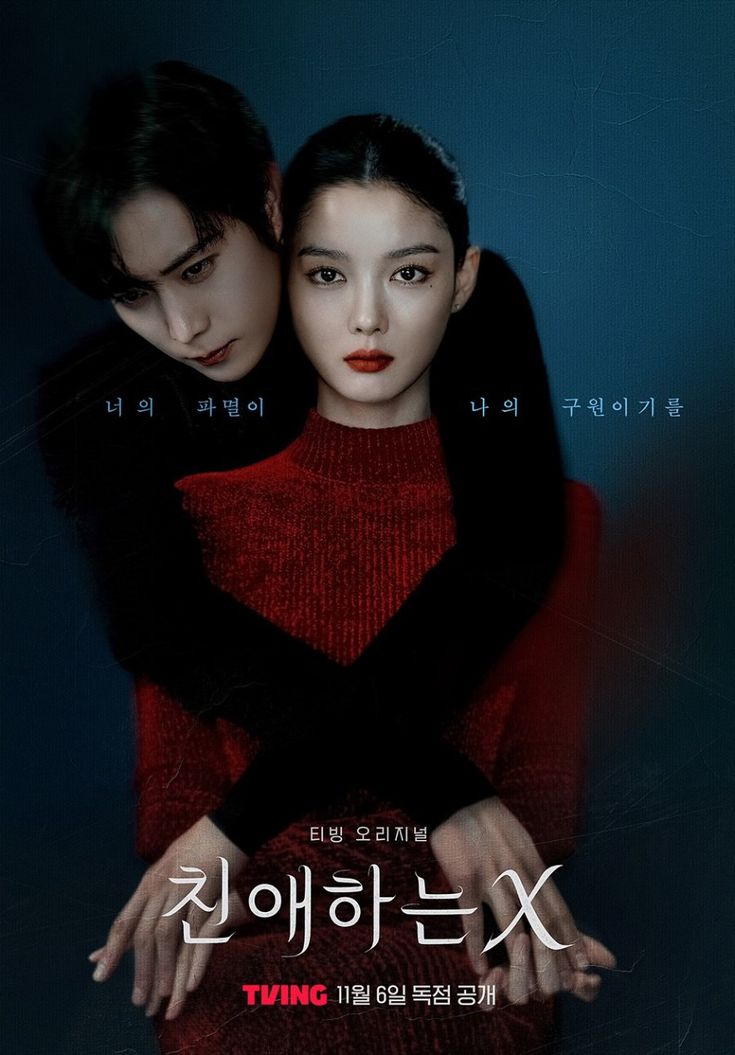
Dear X Review: A Psychological Tragedy About Survival, Control, and Obsession
A deep dive into Dear X, where loyalty, usefulness, and ambition collide in a story that feels less like a twist and more like a tragic inevitability.
Korean Drama Name: 친애하는 X (Dear X)
Where To Watch: Viki, Disney+ ← *Click for direct link*
Average Rating: 8.1/10 (Mydramalist)
My Rating:7.5/10
One Sentence Description: Dear X tells a haunting story of people who learned how to survive, but were never taught how to live — and paid the price for it.
Trailer:
Disclaimer: This review is 100% my opinion — I’m not here to hate, just to share my thoughts! Also, SPOILERS AHEAD, so proceed with caution if you haven’t watched yet. Watch it, come back and let’s see if you agree. Let’s keep the discussion respectful and fun! 💕
CONTENT WARNING:I hope you’ve already seen this show and know what the deal is. But in case you don’t, I felt like I should add in a little warning. This show is Violent and has heavy mentions of Domestic Abuse (Including toward a Child), Trauma, and Suicide. This is a psychological breakdown so there will also be a lot of psychological talk! And since this is a review, I do also talk about this (in relation to the show only). Please be aware of that before you continue and be mindful of it. Stay safe ❤️
Simple Description
Dear X is about a girl with antisocial personality disorder who’s willing to do just about anything to reach the top; even if it means a body or two gets left behind along the way.
⚠️Length Note: This post includes a detailed (and long) story breakdown. Want to skip straight to the review? Jump to the Review
The story opens with Baek Ah Jin as a child. She talks about a defining moment in her early life and explains that her mother was an alcoholic who abused her. Her father was mostly absent until one day he shows up, drags her mother outside, and throws her down a stone staircase. As her mother lies there begging her to call an ambulance, Ah Jin simply walks away. We then cut to the present, where adult Ah Jin is walking down a red carpet. On-screen text tells us she’s now a top actress with antisocial disorder who uses people purely for her own benefit. It notes that she’s never interacted with anyone who wasn’t useful to her, that she’s been partially responsible for two deaths, and that while she’s never directly killed anyone, it’s very likely she will in the future.
We jump back to 2016, where Ah Jin is a high school student. During a birthday celebration for their teacher, chaos breaks out when it’s revealed that Ms. Kwak was having an affair. Ms. Kwak runs away in shame, only to be stopped by Ah Jin, who calmly asks if she liked her birthday present. It’s pretty clear this was revenge for Ms. Kwak calling her an orphan. We then meet Sim Sung Hee, who’s furious that Ah Jin has taken first rank while she’s stuck in second. Sung Hee tries to dig into why Ah Jin was talking to the art teacher, and Ah Jin casually warns her that in movies, nosy people always die first.
One of the male leads, Yun Jun Seo, is introduced soon after, and he’s clearly obsessed with Ah Jin. He gives up his spot on the debate team for her, which only makes Sung Hee angrier. Sung Hee gets her mother involved and has Ah Jin removed from the team, then publicly announces that she’s an orphan. Around the same time, Ah Jin finds a note Sung Hee had written to Jun Seo. Not long after, the debate competition is canceled when it’s exposed that the judges were being bribed. Sung Hee immediately assumes Ah Jin is responsible and throws water on her.
After this, we learn that Ah Jin is secretly running a loan shark operation with Kim Jae Oh. Things spiral when Sung Hee gets her hands on Jae Oh’s phone and realises Ah Jin is the one pulling the strings. Ah Jin calls Jae Oh, puts on a sad act, and asks for his help. The next day, she figures out Sung Hee’s locker combination and passes it along to Jae Oh while Jun Seo convinces Sung Hee to skip PE so they can spend time together. Sung Hee pretends to be sick and goes looking for him, only to be led to the art room, where she finds Ah Jin holding hands with the art teacher. At the same time, Jae Oh takes the envelope of cash the students collected for their homeroom teacher’s wedding and hides it inside Sung Hee’s locker.
The students eventually return and quickly realise the envelope is missing. Once they figure out Sung Hee skipped PE, they check her locker and find both the cash and Jae Oh’s phone. Sung Hee panics and immediately blurts out that Ah Jin is dating the art teacher, which earns her a slap from their homeroom teacher, whose fiancé just happens to be that same art teacher. Ah Jin smoothly defends herself by claiming they were talking about a counseling centre called True Love. It’s sharp, it’s calculated, and it works. Sung Hee still thinks she has the upper hand until Ah Jin drops the bomb: Ms. Kwak, from the very beginning, was having an affair with Sung Hee’s father. As Sung Hee’s world crumbles, Ah Jin laughs, and ends it by reminding her of that earlier warning about being nosy.
Later, back in the past, we learn that Ah Jin’s father remarried a woman whose son is none other than Jun Seo. One night, Ah Jin overhears Jun Seo’s mother talking to her father about selling videos of Ah Jin, making money, and then dumping her at an orphanage. Back in the present, Jae Oh rushes home after a frantic call from his brother. Their abusive, delirious father is trying to stab him, and in the chaos that follows, Jae Oh accidentally kills his father. He sends his brother to live with their aunt, calls Ah Jin to say goodbye, and plans to turn himself in. Ah Jin advises him to act remorseful to get a lighter sentence. It works. He gets three to five years on the grounds of self-defense.
Another flashback shows Ah Jin caring for Jun Seo while he’s sick and quietly planting the idea that his mother doesn’t love him. Jun Seo eventually shows her a family photo that includes his parents and his father’s driver. From the photo, Ah Jin realises the driver is actually Jun Seo’s biological father. She uses this to stop Jun Seo’s mother from sending her away and even manages to get new clothes out of the deal. That night, Ah Jin continues feeding Jun Seo the idea that his mother doesn’t care about him. When Jun Seo’s mother overhears and confronts Ah Jin’s father, she tries to drown Ah Jin in a bathtub. Jun Seo walks in on this, and Ah Jin uses the moment to prove her point before telling him to call 9-1-1. Then she runs upstairs and jumps out of a second-floor window. Brutal, but effective. With her injuries, there’s no way they can sell her off or abandon her now.
Ah Jin remains hospitalised, where Jun Seo reads her diary and notices she refers to his mother only as “X.” Between the diary entries, the attempted drowning, and all the seeds Ah Jin planted, Jun Seo becomes fully convinced that his mother is a bad person and decides he’ll never leave Ah Jin’s side again. Am I saying child Ah Jin manipulated child Jun Seo into hating his own mother and trusting only her? No. But I’m also not not saying that.
By 2017, while out on the street, Ah Jin notices a man chasing down a thief, and something about it catches her attention. We eventually learn that the man Ah Jin noticed earlier is Choi Jung Ho, a retired baseball player. Ah Jin starts working at his café, and Jun Seo later suggests she move in with him to get away from her father. She refuses and says she’d rather just pay him, a detail that definitely matters later. While working at the café, people begin to notice how striking Ah Jin is, and she ends up going viral.
Not long after, a man begins stalking Ah Jin and even follows her home one night. Jun Seo, on his way to her apartment, finds her hitting the stalker with a rock after he tries to kidnap her. She yells at Jun Seo for being late and accuses him of not being willing to do everything for her. Ah Jin takes the stalker’s beanie while Jun Seo covers her tracks and calls an ambulance.
When Ah Jin finally gets home, she overhears her father on the phone talking about selling her. She tries to sneak up on him, but he threatens to kill her instead. Jung Ho notices the injury her father left on her neck and grows concerned, while Jun Seo records Ah Jin’s father selling spy cameras. A confrontation follows, and Jun Seo even picks up a brick, but he can’t bring himself to use it. Ah Jin watches this unfold and later lies at the police station, claiming Jun Seo is actually her stalker. While he’s in custody, she coldly tells him that he simply doesn’t have what it takes to get rid of her father.
The next day, Ah Jin shows up to work with yet another bandage and tells Jung Ho she’s being stalked. He starts driving her home, leaves a baseball bat outside her door for protection, and genuinely worries about her safety. A few nights later, Ah Jin completely trashes her own apartment. At this point, it’s clear she’s setting something in motion.
That night, she messages her father and tells him to come to her apartment at 8 p.m. to collect money. Jung Ho asks her to stay over at his place, so Ah Jin returns home to grab a few things and finds her father already there. She gives him a beanie, the same one she took from the stalker, but no money. When he starts beating her, she calls Jung Ho, who rushes over and fights her father before hitting him in the head with the baseball bat. Coming from a former baseball player, that hit is brutal. Jung Ho flees, Ah Jin strikes her father with the bat again, and Jun Seo, freshly released from jail, runs toward the scene as Ah Jin calls 9-1-1, sobbing and begging them to save her father. The moment the call ends, her tears dissolve into manic laughter.
Before the police arrive, Ah Jin cuts up the beanie and flushes it down the toilet. Later a detective finds fibres from the beanie floating in Ah Jin’s toilet. The police bring Ah Jin in and reveal that her father was actually struck two more times. A representative from Longstar Entertainment, agrees to help Ah Jin in exchange for her signing with them. At the same time, Jun Seo goes to the police station and tries to take the fall for everything, but his story has too many holes to hold up. It’s eventually revealed that Jun Seo was actually the one who hit Ah Jin’s father a third time, hoping to shoulder the blame. Before the police can dig any deeper, the detectives decide to charge Jung Ho and let both Jun Seo and Ah Jin walk free. It turns out the CEO orchestrated all of this after Ah Jin signed with her company. Time passes, Ah Jin becomes a successful actress, and we see Jung Ho watching her films from inside prison.
We’re then introduced to actor Heo In Gang, who wants his breakup with his co-star made public. Not long after, Jae Oh is released from prison, and Jun Seo has become a bestselling author with a book titled Co-Offender Y. It’s obvious the book is about Ah Jin. Jun Seo later spots her on set and makes it painfully clear he still hasn’t moved on.
Eventually Ah Jin meets with Jun Seo and asks him to help her fall in love with In Gang. Meanwhile, Jae Oh starts working with a man who specialises in background checks and is tasked with investigating Detective Park (the guy who was in charge of Ah Jin’s case). He clones Park’s phone and overhears him talking to a reporter about Ah Jin killing her father. Since Jae Oh was in prison and knows none of this, he calls Jun Seo for answers.
Jae Oh and Jun Seo start digging into In Gang’s past and uncover that he’s drowning in guilt over an incident involving his former bandmate. That guilt, combined with unresolved grief, seems to have spiraled into depression and alcoholism. Earlier, we learned that In Gang’s junior once ate a macaron containing nuts, had a severe allergic reaction, missed out on an MC role, and eventually quit the industry. In Gang took that MC spot instead, and it became the moment that launched his career. The part he can’t forgive himself for is that he knew the macarons contained nuts and still let his junior eat one. That decision haunts him.
We also learn that In Gang lost his parents and now only has his brother and grandmother. Ah Jin uses this and steals his grandmother’s diary, reading through their family history. It works. She deliberately grows close to the grandmother, which immediately upsets In Gang. He tells Ah Jin to stay away from him, while she plays concerned and understanding. When Jun Seo later asks why she’s even bothering with In Gang, Ah Jin is honest. She needs him to reach the top, and she plans to date him for exactly one year.
Jae Oh and Jun Seo corner Detective Park, threatening to expose his daughter’s drug use in the U.S. if he doesn’t back off. He quickly backs off. Eventually, In Gang apologises to Ah Jin and asks her to dinner to make things right. She agrees but asks Jae Oh to make sure that In Gang is as late as possible. Jae Oh handles it, and In Gang shows up extremely late, taking a taxi in a panic, only to find Ah Jin still waiting for him. She reassures him, says all the right things, and he kisses her.
Time passes and Ah Jin and In Gang are still together, still very publicly “in love.” Jun Seo grows uneasy, remembering Ah Jin’s promise to break things off after a year. In Gang, meanwhile, starts talking about marriage, kids, and settling down. On Ah Jin’s birthday, the two go out to dinner, but the night is interrupted by a call saying In Gang’s grandmother has found her missing diary. Clearly rattled, Ah Jin gets a ride from Jae Oh and heads to the apartment. Jun Seo arrives shortly after, and as he and Jae Oh talk outside, they hear a loud thud from upstairs. They rush in to find Ah Jin standing at the top of the stairs and In Gang’s grandmother lying motionless at the bottom. She doesn’t survive.
At the funeral, Ah Jin tells the police that In Gang’s grandmother was feeding stray cats when she suddenly got dizzy and fell down the stairs. Later that night, Ah Jin meets with a director who wants her in his next film, while Jun Seo starts questioning whether Ah Jin actually pushed In Gang’s grandmother. In Gang soon discovers that another resident on the same floor as his grandmother had a hidden camera that might have captured what happened. The footage is supposedly with the police, but it’s actually Jae Oh who has it and secretly hands it over to Jun Seo.
An article later comes out claiming In Gang bought Ah Jin a ring, and the director worries the relationship will distract from the film. Ah Jin goes to In Gang’s house and coldly breaks up with him, finally admitting she stole his grandmother’s diary and that everything had been carefully set up. That same night, the CEO tries to comfort In Gang by promising she won’t renew Ah Jin’s contract. He thanks her. The next day, when she returns to check on him, she finds him dead in a bathtub, having taken his own life.
Once news of In Gang’s death breaks, public opinion quickly turns against her, including the CEO, who now wants to see her fall. Eventually, the truth about that night with In Gang’s grandmother is revealed. Turns out everything Ah Jin said was true. The grandmother led Ah Jin outside to show her some cats, grew dizzy, and fell down the stairs.. At the same time, Jun Seo watches the footage and realises Ah Jin is telling the truth.
Longstar Entertainment terminates Ah Jin’s contract, with the CEO fully convinced Ah Jin murdered In Gang. Ah Jin, determined to fight back, vows that either she or the CEO will fall. Soon after, the CEO is arrested for embezzlement and bribery. Ah Jin then meets with Dio Entertainment, who reveal her new contract was made possible by Moon Do Hyuk, the CEO of Hadere and a shareholder in Dio. He’s also the one who’s been monitoring her and her circle, and the one who cleaned up her messy press.
Curious and wary, Ah Jin finally meets Do Hyuk and asks him what he wants. He admits he knows everything about her and claims he wants to help. He also reveals that he was behind the former CEO’s arrest. Soon after, he instructs his assistant to get rid of Jae Oh and to leave Jun Seo alone, at least for now.
That night, Jun Seo meets Jae Oh at his workplace to discuss the men who’ve been following him. As they’re talking, one of Do Hyuk’s men locks the office doors and rigs the place to explode. We then cut between the office blowing up and Do Hyuk proposing marriage to Ah Jin, promising her a clean slate and a new life. She accepts immediately and slips on the ring. Moments later, we see Jun Seo and Jae Oh barely escaping by jumping out of a window just before the building explodes.
Ah Jin marries Do Hyuk, and for a while, she seems to be living the life she always wanted. She continues to thrive under Do Hyuk’s influence and even lands a new movie role thanks to his connections. But cracks start to show. When Ah Jin greets Do Hyuk after work one evening, she notices a clock in the house has stopped at the exact time her father was beating her, just before his death. Around the same time, Jun Seo encourages Jae Oh to live his own life and not end up hollow and obsessed like he has. Jae Oh ignores him and meets Ah Jin instead. She looks exhausted and unwell and asks him to investigate Do Hyuk and his ex-wife. Unknown to her, Do Hyuk listens to the entire conversation through a bug he planted in her car. So yeah. That’s concerning.
Jun Seo moves back in with his mother and appears genuinely at peace for the first time in a while. While out shopping, he runs into a producer who notices how closely Ah Jin’s scandals mirror the events in Jun Seo’s book. The producer wants to expose it, but Jun Seo refuses, still choosing loyalty. Back at Ah Jin’s house, she asks the housekeeper for tea. When she picks up the cup, everything suddenly shifts, and she’s holding a glass of whiskey in a completely different room. When she steps back out, she finds the maids cleaning up broken furniture and shattered items. The housekeeper calmly tells her that Ah Jin was the one who destroyed everything.
Ah Jin later meets Jae Oh at work after apparently calling him, though she has no memory of doing so. She’s convinced Do Hyuk is doing something to her, but she doesn’t know how. The hallucinations continue, Do Hyuk watches from the sidelines, and when Jae Oh finally turns to Jun Seo for help, Jun Seo makes it clear he’s done getting involved.
Eventually, Ah Jin confronts him, and Do Hyuk tells her that he wants her to rely on him completely, but she keeps fighting back. He clearly has something to do with her hallucinations, especially when he tells Ah Jin that his ex-wife broke too easily, but he’s sure Ah Jin will hold on. Realising what he’s doing, Ah Jin decides she wants to ruin Do Hyuk and take his place. She uses a burner phone to call Jae Oh, who seems to already have a plan.
Later, Ah Jin wakes up with an IV and appears to be back to normal. She joins Do Hyuk for lunch and pretends not to care as he receives a call about Jae Oh, loudly telling his men to get rid of him. That night, Jae Oh lures Do Hyuk’s men to the rooftop where Ah Jin killed her father. He holds them off for as long as he can before being beaten and thrown off the building. It turns out Jae Oh had set up hidden cameras and spyware on his phone as part of his plan. Although Jae Oh dies, the plan works. Jun Seo and Ah Jin receive the audio and footage surrounding Jae Oh’s death. Jun Seo rushes to Jae Oh’s workplace, where his death is confirmed, while Ah Jin breaks down crying in the shower.
The following morning, Ah Jin shows Do Hyuk a video of his own goons admitting they were ordered to kill Jae Oh, and she even insists on being a witness. She’s trapped him. Jun Seo calls her, devastated, but Ah Jin brushes off Jae Oh’s death, insisting that he sacrificed himself for the greater good. Finally fed up, Jun Seo calls the producer and agrees to move forward with the show about Ah Jin.
Eventually, Ah Jin’s new film Amen to Nothing becomes a massive success and heads to the Blue Dragon Awards, bringing us back to the opening scene. At the ceremony, Ah Jin wins Best Actress just as Jun Seo and the producer release their documentary about her. The documentary goes viral, featuring everyone Ah Jin once knew. When she steps off stage, she sees the footage and hears Jun Seo explaining the night she killed her father. Ah Jin panics and runs off, eventually running into Jun Seo, who takes her for a drive. She tells him she wants to go home, while he explains that he’s finally realised she will never change and needs to be stopped. He tells her that they should die together, says he loves her, and then drives the car off a cliff.
Later, the news reports reveal that Jun Seo died on impact, while Ah Jin survived and is now missing. Upon hearing this, Jun Seo’s mother falls down the stairs in distress. The story ends with everyone believing Ah Jin is dead as a woman places a white rose in front of Ah Jin’s photo and walks away. In a final flashback, we see Ah Jin climb out of the wreck, stand on the rocks, look back at the car and laugh.
The End.

The Review
The Good
Acting That Said “Don’t Blink”
I think we can all agree the acting in this drama was top-tier. Kim You Jung completely disappeared into her role and delivered one of her strongest performances yet. She sold every moment, and honestly, I wouldn’t be surprised if she walked away with an award for it. Kim Young Dae also impressed me — he really embodied his character, and I’m glad we got to see him shine here. Same goes for Kim Do Hoon. Everyone pulled their weight, and it just proves my point: acting can make or break a show way more than people realise.
Somehow, This All Still Made Sense
This drama felt like it was split into three clear parts: Ah Jin, Jung Ho, and the father; Ah Jin in her actor era; and finally Ah Jin with her extremely unsettling husband. Despite how dramatic those shifts are on paper, the story mostly flowed from one phase to the next.
The final part does feel a little random, but not in a way that comes completely out of nowhere. A lot of that comes down to how the show planted small seeds before each major shift. The CEO trying to scout Ah Jin throughout high school and beyond, or her husband stepping in to get her out of trouble, were things that quietly set the stage. By the time the plot fully pivots, it feels earned. Pulling that off is harder than people think, so I appreciated how well it came together.
Okay Fine, The Writers Knew What They Were Doing
When I first finished this drama, I thought the writers were just being cruel for the sake of it. Every character felt deeply messed up, and not always in a way that was immediately satisfying. It wasn’t until I went down a full research rabbit hole that I realised just how intentional everything actually was.
Once you start breaking down the characters psychologically, it all clicks into place. I get into that more below, but fair warning: once you see it, you can’t unsee it. I originally rated this drama a 4.5/10, but that was before I fully understood how layered and deliberate the writing really was.
Beneath the Surface Pt.1: The Psychology That Shaped Them
When I first watched this drama, I thought Baek Ah Jin was selfish and cruel, and that Jun Seo and Jae Oh were confusing, obsessive, and impossible to root for. But after spending time researching trauma and mental disorders, my perspective has shifted completely. For anyone who might have had the same first impression as I did, I’ve broken down their inner worlds as simply as possible, so we can see not just what they did, but why their minds led them there. I broke this up into two groups: this one is mindset focused and the other one (in The Bad section) is action focused. Let’s begin:
**Quick heads-up: I want to make it clear that I’m not a psychologist and I’m not trying to force a diagnosis onto these characters. Everything I’ve written comes from my own interpretation, and I could very well be wrong. Understanding the brain is simply a hobby of mine, and I used ChatGPT to help me break things down and get a clearer perspective. So while ChatGPT did not write this for me, it did help me to get a better understanding. My goal isn’t to excuse their actions, but to explore the psychological roots behind them in a way that makes their stories easier to understand.**
Baek Ah Jin: Why “Selfishness” Was Survival
Baek Ah Jin is one of those characters who looks cruel on the surface but starts to make sense once you look at the world she grew up in. From the start, her life taught her that love was dangerous and trust was a trap. An alcoholic mother who beat her, a father who killed that mother in front of her eyes, and a stepmother who plotted to exploit her—none of the adults in her life ever offered safety. When you grow up in a house where affection is always conditional and betrayal is inevitable, you don’t learn how to be vulnerable. You learn how to survive.
When she later manipulated Jun Seo as a child, it wasn’t because she enjoyed hurting him. It was because she understood that being needed, believed, and protected was the only way she wouldn’t be discarded. After his mother’s attempt to drown her, that belief hardened into something permanent. From that point on, Ah Jin didn’t see manipulation as immoral. She saw it as necessary.
What made Ah Jin unsettling was that she carried this survival logic into every stage of her life, even when it no longer protected her. She grew up viewing people less as emotional connections and more as variables: who is safe, who is useful, who is a threat. She avoided attachment not because she felt nothing, but because feeling something always ended badly. Ah Jin wasn’t driven by ambition or malice as much as she was by a deep belief that closeness led to harm and that the only way to stay standing was to stay ahead.
Yun Jun Seo: Devotion Without a Self
Jun Seo’s devotion felt extreme until you realise his entire sense of self was built around guilt and moral splitting. From childhood, he learned that love meant responsibility and that protection meant sacrifice. His home wasn’t safe, but it was rigidly structured around power, silence, and image. When Ah Jin entered his life, she didn’t just need help, she gave him clarity. By framing herself as the only one who cared and his mother as the threat, she offered a simple moral map to a child who desperately needed one. Watching his mother try to drown her didn’t just traumatise him, it locked that map in place.
That’s why her manipulation worked so well: his childhood had already primed him to believe that his mother was “bad” and Ah Jin was “good,” and once that split took hold, it never left. Protecting Ah Jin became synonymous with being a good person and from that moment on, loyalty wasn’t a choice. It was a duty, and abandoning her would have meant becoming like the adult he had already decided was unforgivable.
What complicated Jun Seo was that even as he grew older and became aware of Ah Jin’s manipulation, that moral framework never fully dissolved. He could recognise her actions as wrong without being able to reclassify her as bad; because doing so would collapse the meaning of his entire childhood. So he separated the two: Ah Jin does terrible things, but Ah Jin herself is still good and needs protection. That was why her manipulation continued to work into adulthood. It didn’t rely on deception anymore, it relied on identity.
Jun Seo fused himself to Ah Jin so completely that without her, he had no sense of self. That’s why he carried guilt for not protecting her, why he wrote a book about her life, and why he kept orbiting her— even when she didn’t need him anymore. His obsession wasn’t something he wanted or enjoyed, it was something he felt trapped inside. Walking away wouldn’t just mean leaving her, it would mean admitting that years of loyalty, sacrifice, and suffering were built on a false premise. Murder remained the one line he wouldn’t cross because killing would destroy the last illusion that his devotion was moral rather than compulsive.
By the time Jun Seo reached adulthood, his life was no longer about wanting Ah Jin in a romantic sense, but about not knowing who he was without her. Loyalty had stopped being about her happiness and started being about preserving his own coherence. That’s why leaving was never an option, and why exposing her became the final, desperate attempt to resolve an impossible conflict. If he couldn’t save her and he couldn’t detach from her, then ending everything became the only way to remain consistent with the person he believed himself to be.
Jun Seo wasn’t tragic because he loved too much. He was tragic because he was taught too young that loyalty was the only way to survive.
Kim Jae Oh: A Life Defined by Usefulness
Kim Jae Oh’s loyalty may look noble but it’s really the product of emptiness. Growing up under an abusive father who seemed lost in delusion, he never learned to see himself as valuable. He wasn’t protected, praised, or guided— only tolerated. In that kind of environment, you don’t grow up wondering who you are, you grow up wondering what use you serve.
So when Ah Jin told him he had “use,” he mistook that for validation. It didn’t matter that she meant it in the coldest, most transactional way, he heard it as proof that he mattered. He wasn’t looking for love or belonging, he was looking for permission to exist. For the first time, someone wasn’t asking him to disappear or endure, but to do. That single moment rewired his sense of identity, and from then on, his life revolved around being useful to her.
What made Jae Oh different from Jun Seo was that his loyalty didn’t come from guilt or moral duty, but from validation. He never needed Ah Jin to be good. He only needed her to need him. That’s why her manipulation worked so easily and why it never truly stopped. He didn’t need promises or affection, he needed to believe he had a role. Even after prison, even after years apart, he carried her with him not as a person, but as a purpose. Drawing her, remembering her, waiting for her call weren’t signs of romantic obsession so much as they were proof that his life still had direction. His usefulness became his identity, and without it, he had nothing. Where Jun Seo struggled with moral conflict, Jae Oh felt none. His self-worth was entirely external, and Ah Jin was the source.
When Ah Jin begged for help, sacrificing himself felt like the ultimate fulfillment of his identity. Dying for her wasn’t tragic in his mind, it was the perfect ending. It was proof that his existence had meaning. His loyalty wasn’t driven by cruelty or romance, but by a lifetime of emptiness that convinced him that being used was the closest thing to being loved.
So even when Jun Seo warned him not to end up empty like him, Jae Oh couldn’t understand the fear. Emptiness was all he’d ever known. Purpose, even if it costed him everything, felt like more than he was ever promised. Jae Oh wasn’t tragic because he gave his life away. He was tragic because no one ever taught him that his life was his to keep.
The Triangle of Survival
What binds Ah Jin, Jun Seo, and Jae Oh together is not circumstance, but compatibility at the level of survival psychology. Each of them learned how to exist in a hostile world in a different way. Ah Jin survived by using people, Jun Seo survived by enduring people, and Jae Oh survived by erasing himself for people. Each of them were shaped by trauma, but the way they carried it forward was different— and that difference was what locked them together.
For Ah Jin, the world was cruel, weakness was unforgivable, and survival meant control. She didn’t experience events as choices she made, but as inevitabilities forced on her. Jun Seo, bonded to her through shared terror and loyalty. His identity fused around staying, protecting, and remaining faithful, because loyalty felt like morality to him. If he stayed, he was good. Jae Oh, bonded through usefulness, erases himself in service. He believed, “If I’m useful, I deserve to exist,” and feared irrelevance more than pain or death. Both looked to Ah Jin not for love, but for meaning — Jun Seo needed her to mean something, and Jae Oh needed her to assign meaning.
Together, they formed a triangle of toxic devotion. Ah Jin manipulated because she felt she must, Jun Seo clang because he couldn’t let go, and Jae Oh sacrificed because he had nothing else to give. At that level of mindset alone, they formed a closed psychological system where each person’s way of surviving quietly reinforced the others.
Ah Jin’s detachment, Jun Seo’s obsession, and Jae Oh’s self-erasure weren’t random dramatics; they’re the inevitable outcomes of lives built on abuse, abandonment, and the desperate need to matter.
The Paths That Were Already Set
It’s important to say outright: none of this is Ah Jin’s fault. Jun Seo and Jae Oh didn’t become who they were simply because she entered their lives. Their survival scripts were already written long before they met her. She was the catalyst, not the cause. If Ah Jin had never entered their lives, the outcomes might have looked different on the surface, but the damage underneath would still have been there. The triangle doesn’t exist because she is evil or because they are weak, but because each of them carried wounds that demanded an outlet. Jun Seo didn’t spiral because of love alone, he spiraled because attachment was the only place he ever felt real. If it hadn’t been Ah Jin, it would have been someone else, something else, some other person who gave his pain a shape. Jae Oh didn’t die because he chose Ah Jin, he died because he had already learned that his life only mattered when it was spent for someone else.
Meeting Ah Jin gave those wounds a stage, but the play would have been performed regardless. Even without her, he would have kept giving pieces of himself away until there was nothing left.
Ah Jin’s story is the clearest example of how different paths don’t always mean different endings. If she had been sent to an orphanage instead of staying with her stepmother, she might have escaped direct abuse, but not abandonment. She would have learned early that love is temporary, conditional, and easily taken away. That kind of lesson still hardens you. It still teaches you to control before you’re controlled, to leave before you’re left. And even if she had been adopted into a genuinely loving family, that wouldn’t have erased her past overnight. She might have grown softer, yes. She might have learned trust. But trauma doesn’t disappear just because kindness arrives late. It lingers. It whispers. It resurfaces in moments of fear. A different environment could have changed her tools but not necessarily her instincts.
That’s the tragedy of all of them. Their lives weren’t destroyed by one person entering them, they were shaped by wounds that were already looking for somewhere to land. Ah Jin didn’t create Jun Seo’s obsession or Jae Oh’s sacrifice; just as they didn’t create her cruelty. Their triangle is tragic not because it was unavoidable, but because in another world—with different families, different environments, different chances—they might have been something else entirely.

The Bad
Beneath the Surface Pt.2: The Paths They Couldn’t Escape
You understand their mindsets (hopefully) and the cause for who they’ve become, but now I’d like to explain to you how it affected their actions and how it led to Jun Seo and Jae Oh’s eventual death. All the pieces are there, they just need to be connected. So allow me the honour:
**Quick heads-up: I want to make it clear that I’m not a psychologist and I’m not trying to force a diagnosis onto these characters. Everything I’ve written comes from my own interpretation, and I could very well be wrong. Understanding the brain is simply a hobby of mine, and I used ChatGPT to help me break things down and get a clearer perspective. So while ChatGPT did not write this for me, it did help me to get a better understanding. My goal isn’t to excuse their actions, but to explore the psychological roots behind them in a way that makes their stories easier to understand.**
Baek Ah Jin: A Life That Only Moves Forward
Baek Ah Jin’s actions often read as selfish because she treated people as tools, but the way she did it followed a consistent internal logic. She never trusted Jung Ho, only used him. His kindness was something she couldn’t afford to believe in, so she turned it into utility—faking injuries, playing the victim, and ultimately manipulating him into killing her father. He rushed to her side without hesitation, even abandoning an important meeting to protect her, and ultimately destroyed his own life believing he was saving her. That was exactly why Ah Jin never let herself care about him. People like Jung Ho act independently, interfere without permission, and most importantly, take control out of her hands— that makes them emotionally unsafe. Using him wasn’t about malice, it was about keeping control over a situation where trusting his goodness could’ve cost her everything.
The grandmother was different because she offered warmth without authority or obligation. The grandmother didn’t rescue Ah Jin or control her, she simply saw her and cared. That kind of love disarmed Ah Jin in a way Jung Ho never could; which was why the grandmother’s death hit her so deeply. Losing her confirmed Ah Jin’s belief that attachment only creates weakness. That belief directly led to her cruel breakup with In Gang. In Gang was emotionally fragile and deeply dependent, and after watching someone she genuinely cared about die, Ah Jin couldn’t tolerate that kind of need clinging to her. Ending the relationship coldly was a defensive act — cruelty as a clean severance.
When she later hallucinated In Gang in the bathtub and called him weak, it wasn’t hatred or denial, it was how she survived the guilt. In Ah Jin’s world, weakness was not a tragedy, it was a liability that gets people killed.
With Jun Seo, she leaned on his loyalty but resented his emotional demands, often insulting him for not killing on her behalf. Jae Oh, by contrast, asked for nothing except to be useful. She didn’t need to manage his emotions or promise him a future. Each of those choices flowed from the same logic—people weren’t safe to trust, but they could be managed, exploited, or discarded.
Ah Jin’s cruelty wasn’t random, it was the survival strategy of someone who believed the world would always betray her unless she stayed one step ahead.
(Jun Seo And Jae Oh’s Ending’s Explained)
Yun Jun Seo: A Death Written in Devotion
Jun Seo didn’t rush toward death. He drifted toward it. Long before the crash, he began dismantling himself in small, deliberate ways.
Moving back in with his mother wasn’t forgiveness or reconciliation — it was resignation. His childhood had taught him that she was toxic, yet stepping back into that space symbolised surrender, the collapse of the identity he had built around Ah Jin. He was also choosing to give his mother something gentle so that she didn’t unravel after he was gone; even though he himself had already detached from her emotionally. That’s very Jun Seo. He had always managed pain by absorbing it quietly and redirecting it away from others. By this point, Jun Seo wasn’t living toward anything, he was just closing loops.
By living with her again, it striped him of the last illusion he was protecting himself with: that enduring pain had a purpose. When that belief collapsed, what was left wasn’t rage, but hollowness. He wasn’t angry anymore. He was tired. And the photos? That’s even colder, and very intentional. For his mother’s sake, getting rid of them wasn’t about anger. It was about refusing her narrative. Photos are proof of connection, of shared history. By destroying them, he was saying: You don’t get to keep a version of me you never truly knew. Even in death, he denied her access. He left her with memories he chose, not ones she could reinterpret.
For his sake, this wasn’t impulsive or symbolic in a dramatic sense, it was closure. Those photos represented the version of himself who once believed loyalty could save him, that choosing Ah Jin over his mother made him good. By getting rid of them, Jun Seo wasn’t rejecting his past, he was letting go of the story that justified it. Writing the book and agreeing to expose Ah Jin worked in the same way. They weren’t acts of revenge, control, or cruelty. They were attempts to finalise things and to tell the truth once, in a way that didn’t require him to live afterward.
Jae Oh’s death was what finally broke him. Jae Oh died willingly for Ah Jin — not out of loyalty, but out of erasure — and that act forced Jun Seo to confront something unbearable: that his lifelong sacrifice had changed nothing. Ah Jin didn’t stop. The cycle didn’t end. His loyalty was suffocating, but it was also the only thing keeping him alive. Betraying Ah Jin was the last thing he ever allowed himself to do, and only because he didn’t plan to survive it. Loyalty had always defined him, so breaking that was not liberation, it was permission to die.
His decision to take Ah Jin with him wasn’t driven by hatred or possessiveness, but by exhaustion. In his final moments, Jun Seo was acting on a belief that had governed his entire life: separation was worse than death. Letting Ah Jin leave the car would’ve meant: She survived, he died alone, and their bond would finally break. And that was the one outcome his psyche couldn’t tolerate. To him, her trying to escape isn’t survival, it’s abandonment. Not in a manipulative sense, but in a deeply disordered attachment sense. His last act isn’t about trapping her. It’s about preserving meaning at the only scale he understands: together or nothing.
He doesn’t stop her because he wants her to suffer. He stops her because if she leaves, his life ends having meant nothing to the one person it revolved around. That’s why the scene is so painful. Not because it’s dramatic but because it’s honest to who he’s always been. It wasn’t necessarily because he wanted to die, but because he no longer knew how to live without disappearing.
Kim Jae Oh: When Being Useful Is Enough
Jae Oh’s death wasn’t just a plot twist, it was the culmination of his entire existence.
Throughout his life, he existed on the margins — not because he was passive, but because he never believed he was meant to take up space. When Ah Jin asked for help at the end, he didn’t weigh alternatives or imagine a future beyond that moment. He chose sacrifice immediately because, to him, that wasn’t loss. In a world that had convinced him he was worthless, dying for Ah Jin was the only way he believed he deserved to exist. For him, usefulness was the only measure of worth, and sacrificing himself for Ah Jin was the ultimate proof that he had value.
His final vision of her wasn’t romantic, it was stabilising. Seeing her one last time confirmed that his existence mattered in at least one concrete way. When he said that all he wanted was to be used by her, he wasn’t declaring love. He was stating a conclusion: that his life, which never felt owned by him, finally served its purpose.
Dying for her meant he had finally achieved the role he’d been chasing since childhood: indispensable, irreplaceable, needed.
Unlike Jun Seo, who collapsed under the weight of obsession, Jae Oh’s ending was almost serene. Jae Oh died because he wanted to. Jun Seo died because he could no longer endure living. Jae Oh erased himself completely, leaving nothing behind but the certainty that he had been useful.
What makes this all the more painful, was that Jae Oh’s sacrifice didn’t stop Ah Jin or redeem her — and he never expected it to. That was the tragedy. His action was internally coherent but externally meaningless. He left the world unchanged, except for the damage his absence caused. In the end, Jae Oh didn’t die to save anyone. Not entirely. He died because it was the only moment in his life where he felt undeniably real. (And when you watch his final scene, you can see it in his eyes.)

“If You’re Always Looking for More, You’ll Miss the Good You Have”
Baek Ah Jin was always looking for more, and I think that’s where her downfall truly began. I understand that her childhood taught her that slowing down wasn’t safe and that survival meant constant movement. But even knowing that, I couldn’t help asking: what would’ve ever been enough for her?
I understand why the In Gang situation pushed her over the edge, but it always felt like she was chasing something she wasn’t even sure existed. My mom used to tell me, “If you’re not happy internally, no matter where you go, you’ll never be truly happy.” I used to brush that off, but I’ve found it to be painfully true. Ah Jin kept chasing “more” without ever addressing the fact that she was deeply miserable inside.
That’s why I still wonder why she climbed out of that car and fought to survive when everything she thought would bring her happiness had already crumbled. In the end, nothing she gained ever filled the emptiness she was running from. Trust me, the things of this world can’t bring the kind of happiness we think they will. Only Jesus can. Amen.
An Antisocial Personality Disorder Disservice
I always feel uncomfortable when deeply traumatised characters are slapped with a “bad” disorder to justify their actions. It reminded me a lot of It’s Okay to Not Be Okay (check out that review here!), where a mental disorder was consistently hinted at as a way to explain away cruelty.
ASPD already carries heavy stigma, and portrayals like this don’t help. It’s completely fine to write a character who is cold, manipulative, and willing to kill to get what they want. But it becomes a problem when a real mental disorder is used as shorthand for “evil.” Many people with ASPD are not emotionless, not constantly cruel, and not destined to become violent. People with ASPD can form attachments (often unstable or conditional), experience anger, boredom, jealousy, fear, shame, and sometimes even remorse — though they may rationalise harm instead of emotionally processing it.
The show didn’t need a diagnosis to explain Ah Jin. Her trauma already did that work. Next time, they should’ve done what I did: let her past explain her actions instead of reinforcing stereotypes about a disorder that people already misunderstand.
Timeline Trouble
This one might just be me, but I did get confused by the timeline at times. In episodes three or four, Sung Hee’s voiceover describes Ah Jin as a devil while she’s in a mental asylum, but that reveal doesn’t actually happen until much later, after Jun Seo’s documentary.
It’s not a huge issue, but it did blur the line between present, future, and retrospective narration. At times, I found myself wondering if the entire drama was meant to be framed as a documentary about Ah Jin — and honestly, that would’ve been brilliant.
Ah Jin May Have Triggered In Gang — But It Wasn’t All on Her
I still haven’t recovered from In Gang, but I felt like I needed to add this — especially because I hated Ah Jin for this too. And before anything else, I want to be clear: I am not excusing her actions. He was going through one of the lowest points of his life and she absolutely threw gasoline on the fire. You could argue that her cruelty was a defense mechanism after the grandmother’s death, but I’m not using that to let her off the hook.
That said, I do think it’s important to acknowledge that In Gang killing himself wasn’t caused by her words alone. They may have been the trigger, but she can’t shoulder the full blame. He had been struggling with guilt and depression for years, and if you know anything about depression, you know it comes in waves. Just because his time with Ah Jin lined up with a period where things felt lighter doesn’t mean staying with her would’ve prevented another crash. That’s just not how it works.
We also don’t know what was going on in his mind in the days leading up to his death. As much as I wanted to pin it all on her, the truth is more uncomfortable than that. She fueled the flames, yes, but she didn’t start the fire.
The Open Ending Nobody Asked For
The open ending felt completely unnecessary. She should’ve either died or disappeared. Watching Ah Jin claw her way to the top, lose everything, and then still fight to survive didn’t feel consistent with her character. This is the same woman who was willing to stay married to a man she knew was dangerous just to avoid losing her status. So what was her plan after this?
She had always equated success with happiness, but how was that supposed to work when all of Korea was actively looking for her? There was nowhere left to run, no system left to manipulate, and no version of control that still made sense.
On top of that, two of the three most compelling characters were dead. Why keep the story going when Jun Seo and Jae Oh are gone? It felt less like a meaningful ending and more like a weak attempt to leave room for a second season — one I don’t think anyone actually wants. If the best characters are gone, what’s the point?
Why Was Sung Hee Even Still Here?
Can someone explain why Sung Hee was allowed to live with Ah Jin, eat her food, and steal her clothes? She didn’t seem to have any leverage over Ah Jin, so keeping her around felt completely random.
Then she just disappears once Ah Jin moves in with Do Hyuk, only to suddenly reappear and try to kill her. And I’m sorry, but how? Do Hyuk had cameras everywhere, power over practically everyone, and a surveillance setup that bordered on absurd. How was Sung Hee able to sneak into his house in the first place? It didn’t add tension, it added confusion. Sung Hee’s presence stopped feeling purposeful and started feeling like the writers didn’t know what to do with her but weren’t ready to let her go.
Moon Do Hyuk Was Introduced Way Too Late
I don’t understand why they introduced such a complex character this late in the story. Do Hyuk clearly had possession issues and an unsettling amount of power, and yet he shows up at the very last minute. What exactly was he doing to Ah Jin? Drugging her food? Manipulating her mentally? And when he said he wanted her to completely depend on him, what did that even mean? He already controlled her career, her public image, and basically her entire life. She was already in the palm of his hand. So what more was he trying to achieve?
Then there’s the brief mention that his wife was sent to a psychiatric hospital that he owns and it’s never brought up again. Why introduce the idea that Do Hyuk might be holding his ex-wife hostage in his own facility if you’re not going to do anything with it? Add to that Sung Hee, who somehow completely unravels after encountering him. What was that supposed to tell us?
His entire arc felt rushed and hollow, like they needed a reason to stretch the season to twelve episodes. Do Hyuk was simply too layered, too disturbing, and too important to be handled this lazily.
How Did Ah Jin Snap Out of His Control?
This might be a smaller issue, but how exactly did Ah Jin break free from whatever Do Hyuk was doing to her? The ending was rushed overall, so I understand why we didn’t get full explanations, but it genuinely felt like we were waiting for a flashback that never came. There was no clear turning point, no moment of realisation, just an abrupt shift. It came across like the writers were done and ready to wrap things up, regardless of the loose ends they left behind. And honestly? Fine. When you’re tired, you’re tired.
No Happy Ending for Anyone — Sigh
I know the endings were technically fitting, but I still wish Jun Seo and Jae Oh had gotten something better. I wanted Jun Seo to genuinely move on, and I wanted Jae Oh to eventually find some peace too. Given how complex they were, I know I shouldn’t be mad — but I am.
I liked them. A lot. Part of me was rooting for Ah Jin to stay trapped in her mansion prison while Jun Seo and Jae Oh became unlikely best friends who hung out on weekends. I was also low-key rooting for Jun Seo and Le Na. Did anyone else hope he’d just leave the country and be with her?
Maybe that ending was too kind for this show. But after everything, I still wanted it.

What I Would’ve Done
I already know that the endings we got were technically fitting — this is just my version if the characters didn’t all have such deeply complex mindsets working against them.
Give Jun Seo and Jae Oh the Happy Ending They Deserved
I still wish Jun Seo and Jae Oh had gotten a happy ending. It genuinely breaks my heart that Jae Oh died never realising his life had value simply because it was his life, not because he was useful to someone else. And it’s just as painful that Jun Seo never figured out who he was outside of Ah Jin. His entire existence revolved around her. Psychologically, it makes sense. Emotionally? It still hurts.
So in my version, they wouldn’t have had such self-destructive mindsets. They’d cut Ah Jin off and learn how to exist outside of her orbit. I was honestly rooting for Jun Seo and Le Na because it felt like she could’ve shown him what a healthy relationship actually looked like. In this version, after Jun Seo exposes Ah Jin, he goes after Le Na, leaves the country, and chooses something for himself for once. He’d still stay close with Jae Oh, but this time, that closeness wouldn’t be rooted in guilt or obligation.
Jae Oh would’ve started a business doing undercover background checks — something he was already basically doing for years. He’d still see Ah Jin on TV occasionally, but he’d finally be able to move on with his life. He wouldn’t feel the need to prove his usefulness anymore. Slowly, he’d learn that the most valuable thing about him is the fact that he’s alive. He’d travel, visit Jun Seo, and actually enjoy his life instead of just surviving it.
Ah Jin Loses Everything (As She Should)
I fully stand by Jun Seo being the one to ruin Ah Jin’s career. She doesn’t get to quietly walk away and start fresh. After the documentary, she’s questioned by the police and completely shunned by the acting industry. No more praise, no more power, no more admiration. And since she cut ties with Do Hyuk, he lets her rot. Divorce papers show up in the mail and that’s it.
If we wanted to go darker, maybe she fakes her death and disappears. Knowing she can never reach the top again as Baek Ah Jin, she rebrands herself entirely or moves to another country. That’s as close to a “happy” ending as I’m willing to give her.
Do Hyuk: Pick a Lane or Get Out
Do Hyuk’s storyline was far too complex to be shoved in at the very last second. So I’d either introduce him much earlier or remove him entirely. As it stands, his arc didn’t add much and honestly felt like it belonged to a completely different show.
If he stayed, I’d have Jae Oh dig into his past, especially the wife. Sung Hee would finally explain what Do Hyuk actually did to her, and we’d get real answers about who he was and how he operated. And if Ah Jin were the one to take him down, it wouldn’t be through a video and a few audio recordings. He was far too powerful for that to realistically work. Instead, she’d pretend to break down. Pretend to become the wife he wanted. While he thinks he’s won, she’d slowly gather information and dismantle him from the inside.
Maybe she manipulates him into falling in love with her, only to destroy him the way he tried to destroy her. She was calculating and intelligent at the beginning of the show, so it’s disappointing that she never got the chance to truly use that against him. Yes, he was likely drugging and controlling her — but still.

Final Thoughts
I think I can safely say that this drama went right over my head. I had no idea each character was so complex and no idea how deep it all was. I mean, what makes these characters linger isn’t shock value or moral ambiguity, but how closely their endings align with who they’ve been forced to become.
Understanding them doesn’t mean defending their choices. It means recognising that their actions didn’t appear out of nowhere. Ah Jin survived by continuing — by adapting, compartmentalising, and moving forward no matter the damage left behind. Stopping, reflecting, or softening would require a safety she had never known. Jae Oh survived by choosing usefulness until the only choice left was death, and he embraced that end because it finally gave his life definition. Jun Seo survived by enduring, until endurance turned into emptiness and there was nothing left to protect. Each of them reached an ending that felt less like a twist and more like the natural conclusion of a path laid down long before they ever met. They weren’t monsters, they were survivors whose survival strategies eventually destroyed them.
What’s important to know is that understanding the roots of their behaviour doesn’t make that behaviour harmless. People were hurt. Lines were crossed. Lives were destroyed. But reducing these characters to “evil,” “pathetic,” or “toxic” misses the point of what the story was actually doing. These weren’t characters acting out of malice or obsession alone, they were acting out of learned survival strategies that once kept them alive and later became the very things that consumed them. Trauma doesn’t justify harm, but it does explain why certain choices feel inevitable to the people making them.
In the end, this drama doesn’t ask us to excuse them, but to understand them. None of them were rewarded for their pain, and none were punished in neat, moral ways. Their triangle doesn’t exist because Ah Jin is evil or because Jun Seo and Jae Oh are weak, but because each of them learned a different answer to the same question: how do you survive a world that never taught you how to be safe?
Outside of the characters themselves, this drama wasn’t bad. I actually think that if I rewatched it knowing everything I know now, I’d probably rate it much higher — but I don’t feel like rewatching it. I still don’t know whether the show needed to be longer to properly flesh out Do Hyuk and his mess, or shorter and more focused instead of introducing such a complex character so late.
Either way, this was a tragic story for everyone involved, and it’s definitely going to stick with me for a while. Not because I enjoyed it or want to revisit it, but because it reminded me that sometimes the most tragic stories are also the most honest ones. With Ah Jin, Jun Seo, Jae Oh, In Gang, In Gang’s grandmother, Jung Ho, and everyone else, no one got a happy ending. But we also can’t say their endings weren’t the result of a world that was simply too cruel to people who didn’t just want to survive — they wanted to live.
And we’re done! What did you guys think of this? I realised this was more of a psychological break-down on the characters rather than a full review on the whole show and I hope that’s okay!
Did you realise how complex they were or were you just as shocked as I was? I just want to clarify that I’m NOT a psychologist at all. I just am very interested in psychology and WHY people do the things they do and not just point fingers.
If you decide to rewatch it or simply think back, do you see how the characters motives and actions are actually very fitting to who they became sure to childhood? Honestly I feel like I could write a whole book on them and break down each of their characters because it’s so much deeper than I wrote. Every scene matched who they were and if we weren’t already at the 20 page mark, I would’ve went into even further detail.
*If you’re as interested in their psychology as me, I’m in the process of creating a google doc that goes into much deeper depth and explains what the psychology was behind specific events. That’ll be coming soon if you’d want to read more! (trust me, it’s so much deeper than you think!)*
Anyways, That’s it for me this week! I’m not too sure what I’ll review next week but I promise it won’t be this long (loll).
See you next week!💕


Main Cast
Kim Yoo Jung as Baek Ah Jin
Kim Young Dae as Yun Jun Seo
Kim Do Hoon as Kin Jae Oh
Kim Ji Hoon as Choi Jung Ho
Hwang In Youp as Heo In Gang
Kim Yi Kyeong as Sim Sung Hee
Hong Jong Hyun as Moon Do Hyeok
Themes/ Genres
Trauma and Emotional Scars; Obsession and manipulation; Love twisted by betrayal; Fame vs. hidden identity; Survival in a hostile world; Power dynamics and control; The dangerous cost of revenge
Melodrama; Thriller; Noir; Crime drama