
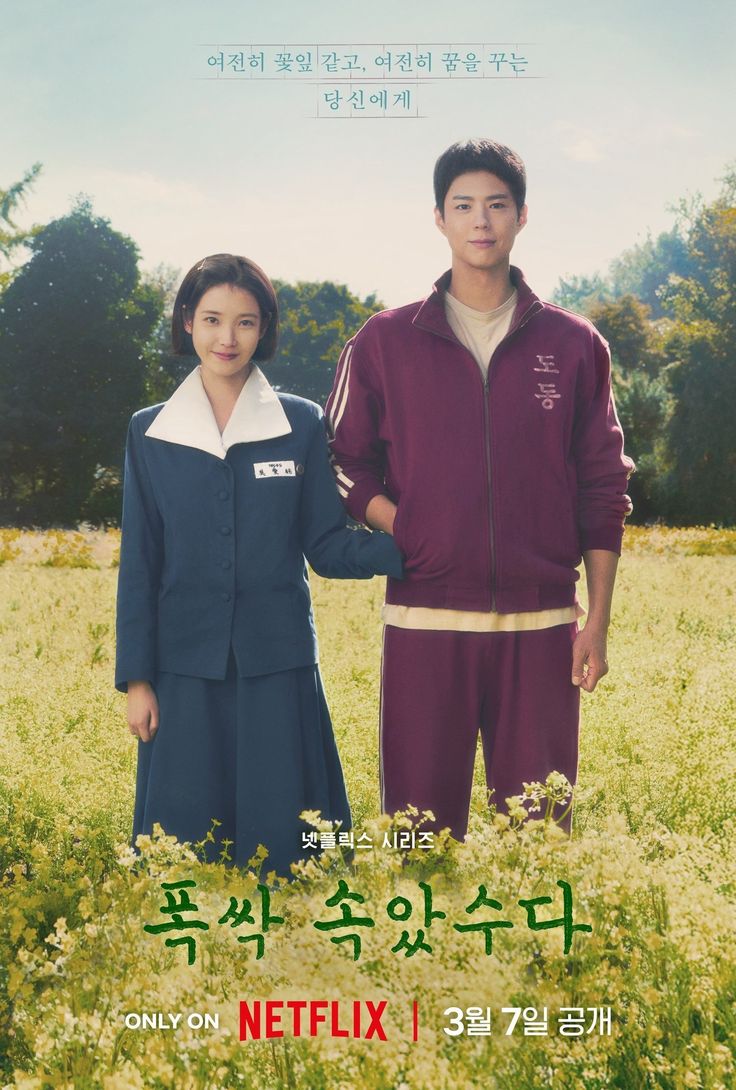
When Life Gives You Tangerines: A Beautiful Lesson in Life, Love, and Suffering Well
A drama that breaks your heart, stitches it back together, and whispers, “You’ll be okay.”
Korean Drama Name: 폭싹 속았수다 (You’ve worked hard)
Where To Watch: Netflix ← *Click for direct link*
Average Rating: 9.3/10 (Mydramalist)
My Rating: 8.5/10
One Sentence Description: a beautiful story about the hardships of life and the hope waiting on the other side.
Trailer:
Disclaimer: This review is 100% my opinion — I’m not here to hate, just to share my thoughts! Also, SPOILERS AHEAD, so proceed with caution if you haven’t watched yet. Watch it, come back and let’s see if you agree. Let’s keep the discussion respectful and fun! 💕
CONTENT WARNING:I hope you’ve already seen this show and know what the deal is. But in case you don’t, I felt like I should add in a little warning. This show has mentions of a child death. And since this is a review, I do also talk about this (in relation to the show only). Please be aware of that before you continue and be mindful of it. Stay safe ❤️
Simple Description
When Life Gives You Tangerines follows the life of a young girl who keeps getting hit with everything the world can throw at her. From losing her dream of becoming a writer to losing her third child, the drama shows a woman who suffers deeply but still finds pockets of joy. Through all of it, she becomes determined to give her daughter a completely different story.
⚠️Length Note: This post includes a detailed (and long) story breakdown. Want to skip straight to the review? Jump to the Review
The drama opens with a story inside a story. We meet 70‑year‑old Ae Sun, who takes us back to her childhood. She talks about her mother, a Haenyeo who lost her husband and eventually remarried. In 1961 on Jeju Island, Ae Sun lives with her father’s family — they’re well off and can afford her education, but they treat her terribly. She keeps begging to live with her mother instead. After winning second place in a poetry competition, Ae Sun leaves her poem with her mother and heads back to her uncle’s house. Her mother finally gets a moment to breathe, reads the poem, and is so moved that she storms into the uncle’s house and takes Ae Sun home.
For a while, life is peaceful. But everything flips when Ae Sun’s mother falls ill from years of diving. Around this time, we meet Gwan Sik who’s a quiet, steady boy her age who looks after her and brings her food. One evening, Ae Sun’s mother feels her death coming and tells Ae Sun to beg to return to her uncle’s house, saying it would be better than becoming a housekeeper in her stepfather’s home. Soon after, she passes away. Thankfully, Gwan Sik stays by Ae Sun’s side.
Time moves on, and Ae Sun ignores her mother’s warning. She moves into her stepfather’s house anyway. She tries to leave, but her father convinces her to stay by promising to send her to the mainland to study Korean Literature. Ae Sun agrees and starts selling cabbages at the marketplace while reading at the same time — though let’s be real, Gwan Sik ends up doing most of the selling.
More time passes, and Ae Sun and Gwan Sik grow into teens. We meet Gwan Sik’s grandmother, who is absolutely determined to keep them from getting married. One day, while they’re walking home, Ae Sun goes on and on about how she would never marry Gwan Sik, so his grandmother can relax. But Gwan Sik still confesses his feelings, Ae Sun clearly likes him too, and they share an awkward but cute little kiss.
We jump briefly to the future and learn that Ae Sun’s daughter has been narrating the story this whole time. Then we’re taken back again, where Ae Sun finds her stepfather with a new woman. The woman refuses to raise Ae Sun, so Ae Sun moves back in with her uncle. As she leaves, she discovers her stepfather never had money and lied about sending her to the mainland. Heartbroken, she runs to Gwan Sik and breaks down. He proposes, but Ae Sun isn’t into it — she’s always dreamed of marrying someone from the mainland so she could leave Jeju and never look back.
After everything falls apart, Ae Sun and Gwan Sik decide they’re done with Jeju and done with waiting for life to magically get better. They steal jewelry from their homes, pack their things, and sneak off to the mainland like two determined little runaways. They make it to Busan and try to sell the jewelry, but of course that flops immediately. Thankfully, the owner of a nightstay takes pity on them and lets them stay the night, even giving them free food and alcohol.
The next morning, Ae Sun and Gwan Sik wake up to find all their belongings gone. They confront the owners, who snap right back, saying they knew the two were runaways from the start and would call the police if they didn’t leave. Just like that, Ae Sun and Gwan Sik are stranded on the streets with nothing. Ae Sun, being Ae Sun, refuses to accept defeat and comes up with a plan.
That night, they warn another woman staying at the nightstay to keep her light on. It works — the owners can’t rob her. Once the owners go to sleep, Ae Sun and Gwan Sik sneak in to steal their money back. They almost pull it off until Ae Sun spots the owner’s daughter wearing the hairclip Gwan Sik gave her. That tiny detail ruins everything. The whole family wakes up, Ae Sun and Gwan Sik bolt, and they barely escape. They end up getting caught by the police anyway, where they learn Gwan Sik’s mother has come all the way to Busan looking for them. Soon after, all three return to Jeju.
Back home, Gwan Sik learns he’s been suspended from school, while Ae Sun has been fully expelled. Gwan Sik goes straight to Ae Sun’s grandmother, who gives him a harsh truth about the era: when a boy runs away, it’s “brave.” When a girl runs away, it’s “shameful.” Hearing that, Gwan Sik declares he’ll marry Ae Sun. The next day, he asks Ae Sun’s uncle for her hand but Ae Sun herself says no.
Because of that, she ends up on a blind date with a 30‑year‑old man looking for a second wife to raise his kids. He even offers to pay for her college tuition. It’s tempting, because she desperately wants to study, but she remembers her mother never wanted her to become someone’s housekeeper. Still, Ae Sun decides to go through with the marriage. When Gwan Sik finds out, he rushes to stop her. He begs her not to do it and even puts a ring on her finger. Ae Sun throws it away and tells him the only way she’ll ever be happy is if he stops standing in the way of her freedom.
Gwan Sik walks away heartbroken, while Ae Sun stays behind searching for the ring. The next day, she’s picking out a wedding dress, and Gwan Sik is heading to the mainland for an athletics competition. We learn that Gwan Sik’s mother told Ae Sun that if she married him, he’d have to give up his future as an athlete. Suddenly, Ae Sun’s harsh words make sense. On the flip side, we find out Gwan Sik only pursued sports to win medals and provide for Ae Sun and now that she’s marrying someone else, he doesn’t care about the sport at all.
Ae Sun realises her mistake too late. The boat has already left. She runs to the harbour, sobbing and screaming his name as it sails away. Luckily, Gwan Sik hears her and jumps into the sea, swimming all the way back to shore. The villagers cheer, while Gwan Sik’s grandmother scolds her daughter for ever letting him get into swimming in the first place.
Soon after all the chaos, Ae Sun and Gwan Sik finally get married. A few years pass, and we see Ae Sun as a young mom, raising her daughter while dealing with her in‑laws’ nonsense. She eventually mends her relationship with her stepfather’s wife, who gives her a little tricycle for her daughter, Geum Myeong. But Gwan Sik’s grandmother refuses to let Geum Myeong ride it because she believes girls shouldn’t be doing things like that. Ae Sun begs Gwan Sik to step in as she’s terrified her daughter will end up stuck in the kitchen the same way she was. She wants Geum Myeong to have the freedom she never got.
The next day, Gwan Sik buys another tricycle and makes sure Geum Myeong learns how to ride it. Then we jump to 1996, the present timeline. Geum Myeong is now an adult with her own struggles. She meets her fiancé’s mother, who comes from an influential family and immediately looks down on her background. The woman insists Geum Myeong quit her job after marriage. Knowing how hard her mother fought for her independence, Geum Myeong refuses.
Back in the past, Ae Sun and Gwan Sik are expecting their second child when Ae Sun discovers Gwan Sik’s family is trying to make Geum Myeong a Haenyeo. Remembering how sick her mother became from that work, Ae Sun explodes. The argument gets so heated that her mother‑in‑law slaps her right as Gwan Sik walks in. Fed up with how Ae Sun is treated, he takes her and Geum Myeong and leaves the house for good.
The couple moves into a tiny rented room with a kitchen. Days pass, and Gwan Sik comes home with bruises and a broken finger. Ae Sun visits Sang Gil, the man she almost married, because he’s been employing Gwan Sik. She finds out Sang Gil has been abusing him. She rushes to find Gwan Sik, catches Sang Gil mistreating him, and kicks Sang Gil in the shin with all her strength. She grabs Gwan Sik’s hand and tells Sang Gil he won’t be working for him anymore.
But the victory doesn’t last long. Gwan Sik struggles to find work because Sang Gil has influence all over the island. Nobody wants to hire him. The family starts running low on everything. Thankfully, Ae Sun’s grandmother visits with a bank book, jewelry, and small treasures. We learn she once accompanied Ae Sun’s mother to get her photo taken, and it was there that Ae Sun’s mother asked her to look after Ae Sun. With the money, Ae Sun and Gwan Sik buy a boat. Right as they celebrate, Ae Sun goes into labour and gives birth to their second child — a son.
Soon after, Gwan Sik buys the house where Ae Sun’s mother once lived with her stepfather. Ae Sun practically jumps for joy because she finally has a home of her own. She eventually gives birth to a third child, another son, and even becomes deputy president, assisting Sang Gil, who’s now president. Together, they crack down on people who engage in casual dance.
Years pass, and Ae Sun’s youngest is now a toddler while Geum Myeong is in school. One day, a typhoon starts forming in the distance, and Ae Sun learns that Geum Myeong got hurt riding her bike. She rushes out to find her, and in the chaos, her sons run off. When she returns and realises they’re missing, the whole town joins the search. The news reaches Gwan Sik, who drops everything and runs out to help. They eventually find the older son, but the youngest is still nowhere. When they finally find him near the seawall… he’s lifeless. He drowned. Ae Sun shuts down completely, and Gwan Sik — usually the rock of the family — breaks.
The family mourns for three days, shattered beyond words. Ae Sun eventually gathers the strength to go outside and finds her eldest son blaming himself for his brother’s death. At the same time, Gwan Sik finds Geum Myeong doing the same. Both kids are drowning in guilt. Ae Sun and Gwan Sik return to work, carrying grief that doesn’t fade. Ae Sun admits she blames herself, but Gwan Sik tells her no one is at fault and they need to keep going for their remaining children. Years later, Ae Sun discovers Gwan Sik has been quietly blaming himself all along.
Time moves forward, and Geum Myeong passes all her exams and prepares to attend college in Seoul. Ae Sun and Gwan Sik accompany her and meet Park Yeong Beom, her future fiancé. Back in Jeju, we see that while Geum Myeong is a scholar, her brother is… not. The election for village chief arrives, and Ae Sun wins becoming the first female village chief.
More time passes, and Geum Myeong is offered a chance to study abroad in Japan. She turns it down because she can’t afford it. Meanwhile, Gwan Sik heads to Seoul to receive an award and decides to visit Ae Sun while he’s there. He even meets Yeong Beom, who returned from the military for a few days just to see her. Ae Sun and Gwan Sik have dinner, where she vents about being poor and not being able to do what she wants because of it. Gwan Sik leaves, and Yeong Beom soon heads back to the military.
Back in Jeju, Ae Sun and the haenyeos attend a poetry competition for students, and one of the haenyeos secretly submits Ae Sun’s poem. Meanwhile, Geum Myeong’s teacher offers to fund her trip to Japan and tells Ae Sun. Realizing how much her daughter wants this, Ae Sun and Gwan Sik decide to sell their home to pay for it. The family moves to Seoul, and Geum Myeong leaves for Japan. Back in Jeju, we learn Ae Sun’s poem actually won the competition.
Time passes again, and Geum Myeong rents a room in Seoul. She immediately has to prove her loyalty to her landlord’s daughter by hiding her boyfriend in the room — which fails, but honestly, the effort was cute. Ae Sun can’t catch a break either when she finds Eun Myeong hiding a girl in his cupboard. That’s when we meet Bu Hyeon Suk, Sang Gil’s daughter, who’s dating Eun Myeong.
After Geum Myeong returns from Japan, she still struggles to find a job. That is, until she meets Park Cheong Seop, her landlord’s daughter’s boyfriend. We learn he’s an artist working at a theatre, and he helps her land a job at the ticket counter. Eventually Yeong Beom comes back from his military service, and Geum Myeong is over the moon. But that happiness doesn’t last long. Yeong Beom suggests she leave the “poor neighbourhood” she’s been living in. Instead of agreeing, Geum Myeong tells him to leave. And Cheong Seop, who overhears the whole thing, just quietly smiles.
Later, Geum Myeong stops by Cheong Seop’s office to drop off his lunch and ends up having to hide in the back while he and his girlfriend come in arguing. Her hiding spot doesn’t last and she gets discovered by both of them, and honestly, awkward doesn’t even begin to cover it.
Things get worse when Geum Myeong runs into Yeong Beom’s mother at his apartment. It goes horribly. His mother berates her, looks down on her, and treats her terribly. Yeong Beom just stands there and lets it happen. When Geum Myeong confronts him later, she tells him she shouldn’t be treated that way when she’s just as accomplished as he is. He doesn’t help, doesn’t reassure her, and she admits she can’t keep living like this.
The next day, Geum Myeong meets Cheong Seop’s mother, who secretly gives her a movie ticket. She watches her first ever film before the three of them — Cheong Seop, his mother, and Geum Myeong — head to her little shop. They share a meal, and Cheong Seop helps carry Geum Myeong’s books back to her room. The contrast between Cheong Seop and Yeong Beom’s mothers is painfully obvious.
Time moves on. Eun Myeong leaves for his mandatory military service, and Cheong Seop follows soon after. While they’re gone, Geum Myeong and Yeong Beom’s families meet for a meal, and Ae Sun watches firsthand how Geum Myeong is expected to behave — serving everyone like it’s her job. Every interaction between the families is miserable until Geum Myeong finally snaps. She breaks off the engagement. Yeong Beom actually fights back at his mother, saying she’s ruined his life. In a fast‑forwarded clip, we see him unhappily married to someone else, and his mother just as unhappy with her new daughter‑in‑law — which is exactly what she gets.
Back in the present, months later, Yeong Beom and Geum Myeong officially break up for good.
Time passes, and Geum Myeong eventually heals. Eun Myeong returns home… with a pregnant Hyeon Suk. Meanwhile in Seoul, Geum Myeong boards a bus just as Cheong Seop gets off. He notices her and runs after the bus, but he misses it and misses her.
Time moves on, and it’s now 1997. Hyeon Suk gives birth to a son. Eun Myeong, frustrated that he can’t provide for his child the way he wants, lashes out at his father for not being wealthy. Ae Sun steps in to defend Gwan Sik, reminding her son how hard his father works. It’s a sad, heavy moment. Around this time, South Korea faces a national financial crisis, leaving many unemployed. Geum Myeong is one of them and struggles to find work. She ends up returning to the theatre she once worked at and watches a movie before the building closes down. As she leaves, Cheong Seop arrives, realises he just missed her, and refuses to let that happen again. He chases after the bus and this time, he makes it.
They meet up for drinks, and a relationship begins. This time, everything feels right. Everyone gets along, and even Gwan Sik — who always puts up a tough front — approves of Cheong Seop. A year later, Geum Myeong and Cheong Seop got married. Yeong Beom shows up but watches from afar before driving out of her life for good. The wedding is beautiful, with everyone sobbing — especially Geum Myeong and her father.
Soon after, Eun Myeong gets into trouble when his business partner runs off with all their money. Eun Myeong ends up in jail, where he finally lets out all the resentment he’s been carrying. He explains how he’s always felt like a secondary priority compared to his sister, and how his reckless chase for wealth was his attempt to gain control over his life. Ae Sun and Gwan Sik work nonstop to pay his bail, which forces Gwan Sik to sell his boat. The family falls back into financial hardship, leaving Ae Sun to sell squids at the marketplace.
As the year 2000 approaches, Geum Myeong starts a business with Sang Gil’s wife, Ae Sun picks up poetry again, and Gwan Sik makes a bold decision to buy a shop in the middle of nowhere after hearing promises of redevelopment and a new golf course. Since they had to put their house up as collateral, Geum Myeong shows up with borrowed money to save it. Soon after, a huge argument erupts between Ae Sun and Geum Myeong as Geum Myeong vents about all the expectations placed on her. She leaves, and not long after, Ae Sun and Gwan Sik learn she’s pregnant.
We jump to Geum Myeong’s delivery, which leads to serious complications. Cheong Seop calls her parents and tells the doctors that if things take a turn for the worse, they should save his wife. Geum Myeong passes out but survives, along with her baby daughter. Things finally start looking up with Gwan Sik’s restaurant becomes a massive success, and Eun Myeong’s runaway business partner is caught and arrested.
Time goes on, and Geum Myeong uses some of her money to get her parents a full-body examination. While Gwan Sik is under anesthesia, Ae Sun learns the truth: he’s been carrying deep guilt over their son’s death all these years. The next day, Ae Sun continues writing her poems after visiting her son’s grave. Then Gwan Sik’s test results come back and he’s been diagnosed with blood cancer. They just can’t catch a break.
Gwan Sik returns home and spends his remaining days with his family. Geum Myeong eventually appears on TV as the founder of a new online education platform. Gwan Sik is admitted to the hospital and passes away while gazing at Ae Sun’s smiling face — his last request.
What follows is a long grieving period for Ae Sun, who turns to poetry to survive it. Many years pass, and she finally completes her book. The story closes with Geum Myeong buying her parents’ old home for Ae Sun, and Ae Sun publishing her book with her editor looking exactly like her mother.
We say goodbye with Ae Sun once again feeling the joys of life and her book becoming a tribute to her cherished memories with Gwan Sik.
The End.

The Review
The Good
Drama of the Year
I think we can all agree that this was one of the best dramas of 2025, hands down. It was beautifully filmed, beautifully written, and I can confidently say this is the kind of drama that stays with you LONG after the final credits roll. Maybe even forever.
I’m also really glad this drama was given the full 16 episodes it needed to tell its story. Nowadays, dramas love squeezing everything into 12 episodes with barely enough time to say what they want to say. When Life Gives You Tangerines demanded time and it used every minute to tell a story worth hearing.
I talk about this below, but I love that it doesn’t shy away from the ugliness of life. It shows you the ugly parts and the ugly path to healing, but it also shows you the beauty waiting on the other side. This was such a good drama, and I hope everyone gets the chance to watch it. It feels like it was made for everyone — anyone who’s lived, loved, lost, or tried again.
A Beginner’s Guide to Suffering Well
I think my favourite part about this drama was how warmly it was told. It felt like a grandmother sitting you down and telling you the story of her life. With love, care, and a whole lot of life lessons.
Just about every single episode was teaching you a little lesson on how to suffer well. Ae Sun and Gwan Sik were barely ever able to catch a break, and they went through some of the worst things a person could ever go through. And yet, they died happy and with no (or rather very little) regrets. If you’ve read my review on Doona! (review here!) Even If This Love Disappears Tomorrow (review here!) where I praised their lessons or my reviews on True Beauty (review here!), Love Untangled (review here!), Beauty Inside (review here!), It’s Okay to Not Be Okay (review here!), Doctor Slump (review here!) and many others (check them out here!) where they had the right idea but wrong execution, you would know that I love a drama that teaches you something. When you really think about everything the drama was trying to teach us, there were so many little lessons tucked inside it:
- Stand up for what you want.
- Choose love.
- Life goes on.
- Choose yourself and learn to walk away.
- You can suffer and still find the little joys.
- Life always gets better.
- Time heals.
- Heartbreak doesn’t last forever.
- Life ends well.
I could, of course, keep going, but each of those lessons is beautiful because they’re true. The drama never hesitated to show you the brutal truth about life. It wasn’t a fairytale, and it never pretended that if you were a good person, nothing bad would happen to you. Sometimes life is just hard. But it showed the beauty in continuing anyway.
And after everything Ae Sun and Gwan Sik went through, by the end of it, they were truly happy. They had lived. They had loved. They had suffered. They had lost things and found things and kept choosing to move forward anyway. And maybe that’s the most comforting lesson of all: one day, you’ll look back and realise you made it too.
And you will. I promise you will.
A Name That Sees You
If you’ve read my reviews on Moon in The Day (review here!), Even If This Love Disappears Tonight (review here!), and Youth of May (review here!), then you know how much I love a name that means something. ‘폭싹 속았수다’ essentially carries the meaning of “You’ve worked hard” or “You’ve been through so much,” a phrase used on Jeju to acknowledge someone after all they’ve endured. And I just love that.
After everything Ae Sun and Gwan Sik had been through, I honestly couldn’t think of a better name for this show. Because when you get to the end of a long life, I think what most of us desperately want is to know that we did well. That, despite everything we were given, we made something of it. That someone saw how hard we tried. It’s such a small thing, but there’s something incredibly beautiful about being told, I see you. I know you’ve worked hard. I know life wasn’t always kind to you, but look at you. You made it here.
And honestly, even if I hated this show, it would’ve at least gotten a 6/10 on the name alone. Even the English title, When Life Gives You Tangerines, is a beautifully fitting version of the familiar “when life gives you lemons” idea, swapping lemons for Jeju’s famous tangerines. But I think it works on an even deeper level because this story really is about what life gives you and what you choose to do with it.
Actors Who Don’t Play
If you’ve read my review on The Perfect Crown (review here!) or any of my recommendations (check them here!), then you’d know I absolutely LOVE IU. She’s my all-time favourite actress, and she never fails to completely become the character she plays. Ae Sun and Geum Myeong were both played by IU, and yet it was incredibly easy to see just how different they were. They never molded into the same person, and that’s not an easy thing for every actor to pull off. If this was your first time watching IU act, trust me, all her shows are that good.
And, of course, we have Park Bo Gum, probably the most likeable actor I’ve ever had the pleasure of watching. He has such a bright smile that you can’t help but love every character he plays, and Gwan Sik was absolutely no exception. Gwan Sik set the standard. If my husband isn’t like Gwan Sik, then I simply don’t want it. Park Bo Gum became his character in a way that made you feel every emotion right there alongside him. And honestly, I think the biggest reason for that is because Park Bo Gum already has the personality to be a real‑life Gwan Sik. It must’ve been easy to play him since he most likely was just channeling his future self as a father and husband.
And then we have the rest of the cast. I say this all the time — like in my reviews of Night in Paradise (review here!) and Goblin (review here!) — but it genuinely felt like we were watching a documentary where everything was real and someone had just placed hidden cameras around these people’s lives. That’s how believable everyone felt. Nobody seemed like they were “acting” their way through the story. They just were these people. I really can’t stress this enough: this cast was perfection.
No Villain, Just Life
I feel like I keep mentioning this, but I just really loved that they didn’t force a villain into the story. Sang Gil was probably the closest thing we had to one, but even he wasn’t some cartoonishly evil character. He was just the result of a greedy, arrogant man making selfish choices and hurting people along the way. Which, in this world, is incredibly accurate for many people.
And honestly, that’s what made this drama so heartbreaking. Everything that happened could happen in real life. There was no fantasy element protecting us from the pain. We weren’t watching some fictional family get thrown into ridiculous situations that would almost never happen to us. We were watching a family who just… lived life. They endured its cruelties and kept going anyway.
I’m really glad they were able to tell a story like this, where sometimes life just keeps throwing punches at you and you have to learn how to take them (or swerve). Not every hardship needs a villain behind it. Sometimes life is simply unfair. Sometimes people make terrible choices. Sometimes good people get hurt for no reason at all. And sometimes, all you can do is get back up and keep living.
That was what this story was about: life. And I’m so glad they trusted that idea enough to let Ae Sun and Gwan Sik’s lives simply play out as they would. No unnecessary villain, no forced drama, no need to make everything bigger than it was. Just two people living through all the beautiful and terrible things life had waiting for them.
Geum Myeong and the Cost of Being Gold
As I mentioned before, I love that this drama didn’t shy away from the many different realities of being a parent and being a child. I especially loved the way they portrayed Geum Myeong’s role in the family. That scene where she finally yelled at Ae Sun about always having to be number one and carrying everything on her shoulders was such a beautiful scene. Obviously, not the yelling part but the message behind it.
Maybe I’m the only one, but as the younger daughter who’s always been treated like the oldest, I felt that scene in my bones. Watching WLGYT, I couldn’t help but relate to Eun Myeong’s middle‑child energy and the heavy weight Geum Myeong had to carry… I’m fine — It’s why I’m funny 🥲.
Seeing Geum Myeong finally yell about everything being on her shoulders was refreshing because it highlighted a very real problem that children can carry. That’s probably why we always see those TikToks like “Your card declines at therapy, so your therapist tells you your parents’ dreams and how you can’t save them,” and we collectively all sob. Because there’s something deeper underneath that joke. There comes a pressure in being someone worth all the sacrifices. We want to show our parents that we were worth whatever dreams they may have had to give up. That we were worth the life they chose with us. That all the things they sacrificed weren’t for nothing.
And in that aspect, I related to Geum Myeong wholeheartedly. Seeing her sob on the airplane, and seeing the weight she carried every time her parents made sacrifices for her future, healed something in me. It’s funny because we can know we aren’t the only people in the world who feel a certain way, but sometimes it takes seeing someone else experience it before something inside you finally goes, “So I’m not crazy. Other people feel this too.”
So as the designated older sister, it felt good to be seen. To have that part of yourself acknowledged without having to explain it first. And maybe that’s what Geum Myeong needed too.
It’s just good to be seen.
Geum Myeong the Hypocrite?
I read a comment the other day saying Geum Myeong was a hypocrite. They said she told Cheong Seop that if her father didn’t like him, their relationship was essentially over, and yet she broke up with Yeong Beom because he wouldn’t choose her over his mother. And if you thought the same thing, I just want to take a second to explain why I think these situations were very different.
First, let’s look at Yeong Beom’s mother. I think the biggest difference was that his mother was simply controlling. She was domineering and was only really satisfied when she got what she wanted. She treated Geum Myeong horribly because of her background and even treated her parents with disdain. But the real problem was Yeong Beom. He let it happen. He let his mother treat Geum Myeong horribly, and he did very little to stop it. He never really put his foot down, and he never really comforted Geum Myeong when she was left dealing with the aftermath.
Then we have Geum Myeong’s father, who only wanted the best man for her. Not for the sake of their family name or reputation, but for her. Gwan Sik was already an amazing father and husband, and Geum Myeong knew that. Wanting a man who takes after your amazing father isn’t hypocritical. It’s knowing what love is supposed to look like and understanding how you could and should be treated. Wanting your good father to accept the man you’re going to marry isn’t hypocritical either. If anything, it’s understanding that good men can recognise good men. And look at the result. Geum Myeong spent the rest of her life being loved and taken care of, while Yeong Beom ended up in a loveless marriage with his mother just as miserable.
I can understand why people are quick to find flaws in characters. As a reviewer, I’m definitely guilty of that. But sometimes it’s important to take a step back, look at the bigger picture, and ask what the situation is actually trying to tell us. Because if anything, Geum Myeong’s story taught me not to force a man to be “the one” just because I’m scared to let go or terrified that I’ll be single forever. There is always someone better suited for you. Always. There are good men in the world. You just have to be patient enough to find them.
The Beauty of Time
I mentioned this above, but I really want to use this section as more of a message backed by the evidence of the show rather than rehashing everything we’ve already talked about a million times.
Life is hard. Life can punch you and punch you and punch you, and still expect you to keep going anyway. We saw with Ae Sun and Gwan Sik that they almost never got a break. Ae Sun lost her chance to be a writer and ended up stuck on an island she desperately wanted to leave. She married the love of her life but had to endure the abuse of her in‑laws while trying to shield her daughter from the same fate. And Gwan Sik didn’t catch a break either. He couldn’t help Ae Sun accomplish her dreams of writing or leaving Jeju Island, and they struggled to make ends meet. As the breadwinner and the quiet pillar of the family that he was, that must not have been easy. Then he had to deal with an abusive boss who hated him for marrying Ae Sun, lost that job, and essentially got blacklisted. And then came the horrific scene we’re all still not over — the loss of their third child, and having to keep going for the sake of their other children. Those were some serious punches.
But more than anything, look where they eventually ended up. Gwan Sik started a successful restaurant. He got to see his daughter get married, end up on TV, and meet his grandchildren. And even though his life ended sooner than he expected, it ended knowing that he had been a good man who made Ae Sun and his family—his whole world—happy.
And Ae Sun? She got to raise Geum Myeong into someone she never had the chance to become herself. She eventually moved to the mainland like she always wanted. She was truly loved. And yes, she lost Gwan Sik earlier than she ever expected, but she also became the writer she always dreamed of becoming. She published a book of poetry about her life with Gwan Sik, turning all those years of love, pain, sacrifice, and memories into something that would live on.
Life has a horrible way of making you think, “This is it. This is all it’s ever going to be. It doesn’t get better. It doesn’t get easier.”
But it does. Maybe not in the way you expected. Maybe not according to the plan you had for yourself. Sometimes life takes you somewhere completely different from where you thought you were going. But that doesn’t mean you’ve reached the end of your story. Ae Sun didn’t become a writer when she thought she would. She didn’t leave Jeju when she wanted to. Gwan Sik didn’t get the long life he deserved. Their lives weren’t perfect, and they certainly weren’t easy. But somehow, they still ended up with something beautiful.
Life was created to have a happy ending, even if the beginning and middle parts are messy. Life keeps going, and time heals. Time heals everything. And what a beautiful thing it is that we have the time to heal, to change, to love, to make mistakes, to start over, and to live whatever life is still waiting for us.

The Bad
Just… Life
I know I complimented this drama for its portrayal of life, and I won’t take that back, but dramas like this just aren’t really my cup of tea. I think I mentioned this in my review of True Beauty (review here!), but I always struggle with dramas that simply meander through life without a clear ending in sight. Even though I loved the message and the realness of it all, I wasn’t hooked on this drama from beginning to end. There were quite a few moments when I was just… bored.
And like I said, this is a drama about life, so obviously that’s what it’s going to be about. But that was also what I struggled with the most. There were times when I really wanted to know where the story was going, only to realise that there wasn’t necessarily somewhere specific it needed to go. It was just life happening. Beautiful, painful, ordinary life.
I also didn’t finish this as quickly as I wanted to because I caught myself taking more than one break, and at one point, I just wanted the drama to end. Don’t hate me. I still loved it! I can appreciate what this drama was trying to do and still admit that watching someone live their entire life isn’t always the most gripping television. Sometimes “life” pacing is just slow pacing, and that’s okay to admit.
The Son We All Forgot
I recently saw an edit about the second son, Eun Myeong, and it was highlighting how neglected he felt and how he always seemed to come second to Geum Myeong. And honestly? I have to agree. I watched this drama when it first came out last year, and when I finally decided to write a review on it, I completely forgot they even had another son. I saw some comments saying that the drama never really put Ae Sun or Gwan Sik in a bad light, so even in the scene where Eun Myeong is in jail talking about how neglected he felt, the story still framed the couple as the victims. And I have mixed feelings about that too.
I think I agree to a certain extent simply because of how much of a background character Eun Myeong was. Other than a few scenes here and there of him getting into trouble and his relationship with Hyeon Suk, there really wasn’t much else about him. And I understand that this is primarily Ae Sun and Geum Myeong’s story, but Eun Myeong was still a part of Ae Sun’s story. He was her son. So why was he barely in it?
So much of the family’s attention went toward Geum Myeong and making sure she had every opportunity to prosper, while Eun Myeong was left to figure things out largely on his own. I wish we got a few scenes or flashbacks showing how Eun Myeong was taken care of and loved — something to remind us that sometimes we forget how loved we really were. His only happy memory with Gwan Sik was when they went out to eat for his birthday after his brother died. That was it. This reminds me of It’s Okay Not to Be Okay (review here!) and how the male lead often felt like the designated caretaker rather than his mother’s son. I wish we saw more moments of care, more moments of connection, and maybe even a sit‑down where his parents explained themselves. Instead, they sold everything to get him out of jail, and the “ignored child” issue got pushed away like Gwan Sik’s boat.
This drama was so good at showing real‑life issues and how you heal from them. I wish they had done that for Eun Myeong too — for children who related to him.
Geum Myeong Was Hard to Root For
I had such mixed feelings about Geum Myeong and the way she treated her parents. On one hand, this drama really knew how to show the reality of relationships and family. People aren’t perfect, and even loving families can hurt each other. On the other hand, I kept watching Geum Myeong and thinking, I would never treat my parents like that.
Don’t get me wrong, we’ve all had moments when we’ve said things we didn’t mean, or things we did mean but didn’t mean to say quite that way, and ended up hurting our parents’ feelings. That’s normal. But with Geum Myeong, it never felt like she truly appreciated them to their faces, especially once she got to college and beyond. She understood their sacrifices. She understood what they had done for her. We heard her acknowledge it through narration, but we rarely saw her actually express that gratitude to them or let it change the way she treated them.
And yes, she eventually admitted that she hadn’t treated her parents well and was upset with herself for taking everything they did for granted, but acknowledging something and changing nothing does… well, nothing. Now, Geum Myeong wasn’t a bad person. It just sucked watching her treat her parents that way when there are so many people who would give anything to have parents like that. Like me. Maybe like you.
I’ve always had my own issues with my father and how he’s never really provided for me and has left me hanging more than once, so watching Geum Myeong treat Gwan Sik, a man who gave absolutely everything he had to his family, hit a little deeper than it probably should have. Even when I think about people who constantly treat their parents like that, the examples that usually come to mind are people who were spoiled, or people whose parents had failed them in some pretty significant way. It’s not often that you see someone raised by genuinely loving parents, who also clearly love each other (which, even that, is rare), grow up feeling like they’re never satisfied with what they’ve been given.
Geum Myeong had something a lot of us would do anything to have, and I just wish she had appreciated it more while they were still there to hear it, instead of mostly acknowledging it through a voice-over.
The Guest Role of Park Bo Gum
I don’t know if everyone noticed this, but why did Park Bo Gum basically have a guest role in the second half of his own drama? I genuinely thought he was going to be the main male character, but he basically had the same amount of screen time as Kim Seon Ho as Cheong Seop. I think part of this may have been because IU was the one constant throughout the story (which I loved!), while the drama followed Ae Sun and Geum Myeong through their lives, but I still wish we had gotten a few more moments with young Gwan Sik in the later episodes.
And honestly, this could’ve been another place where the drama gave us more of Eun Myeong and Gwan Sik. A few flashbacks of them together, showing their relationship before everything fell apart, would’ve helped both storylines. It would’ve given Eun Myeong more emotional weight while also letting us see more of Gwan Sik as a father to a son who often felt forgotten.
The show was still good, and I understand why Park Bo Gum wasn’t around as much after a certain point but I just remember getting to episode 10 and thinking:
“Wait… where’s Bo Gum? Please don’t play with me right now. Come back. Come back to me.”

What I Would Do
Nothing… That’s Just Life
Honestly? Nothing.
I think I’ve only done this once before in my review of Flower of Evil (review here!), but I genuinely don’t have anything I would change about this story. And I think that says a lot, especially because I usually have a whole list of things I’d fix.
With When Life Gives You Tangerines, it felt like we were watching an actual life unfold. People made mistakes, things happened that they couldn’t control, some dreams came true while others didn’t, and sometimes life just… sucked. Trying to change the way their lives went would almost feel like I was invalidating everything they had to go through to get to the end.
I wouldn’t want Ae Sun to have an easier life just for the sake of giving her an easier story. I wouldn’t want Gwan Sik to avoid every hardship. I wouldn’t want their children to grow up without making mistakes. If I did, it would take away the realness this drama had spent 16 episodes showing. I get that if we could, we’d all ensure we had the best life ever with no suffering, but that’s not reality. And this was too real of a show for me to change it. Those things were part of their lives, and those hardships are what made the moments of happiness mean so much more.
I would’ve liked a bit more of a redemption arc between Eun Myeong and his parents, but other than that… life sucks sometimes, and that’s that.

Final Thoughts
In the end, this drama was a masterpiece. Like I said above, I love a drama that has something to say, and When Life Gives You Tangerines was nothing short of a life lesson. Like I said in The Good, this drama felt like a warm hug, a warm drink, and a grandmother sitting across from you, telling you her life story as if it happened yesterday. There was so much to love, but I think it all boils down to one thing: it made me feel seen. In one way or another, I saw some part of my own life in this story. And this drama had a clever, sometimes cruel way of opening all your old wounds and scars, looking directly at them, and lovingly saying, “I see them. I see you.”
From the very beginning, people were sobbing (yes, I’m people), and most of us didn’t stop even after the final credits rolled. There’s something incredibly comforting about watching someone go through hell and still make it to the other side with a smile and a poetry book. Not because the pain suddenly became worth it, but because they made it through. They lived long enough to see that life had more waiting for them.
And I hope that’s what this drama gives you too. I hope it gives you the courage to keep living. To look at your life, even when it hurts, and say, “I’m sticking around. I want to see what all this was for.”
I know this is just a drama, but it’s also, in some form, someone’s life. Maybe your life. Maybe mine. Maybe the life of someone you love. And because it reflects life in some way, the happy ending is also a reflection of what’s to come. So as it stands, this drama leaves you with a beautiful message, a wrung‑out heart, and hopefully a little more hope than before.
And perhaps that’s what 폭싹 속았수다 really means. Not simply “thank you for your hard work,” but “you worked so hard.” After everything life gave them — every loss, every sacrifice, every little victory — they kept going. And maybe sometimes that’s all life asks of us. To keep going. To love where we can. To make something beautiful out of whatever we’re given. And when we finally reach the end, to look back and say:
You’ve worked so hard.

And that’s a wrap! Honestly the google doc where I created this drama review has been sitting there for months and I was expecting it to sit there way longer. I was not expecting to be writing this review so soon but I’m honestly glad that I did. I genuinely enjoyed the whole process of writing this drama and I sincerely hope that you not only got something from the drama but also from what I had written about it.
I’ve been watching a lot of movies recently and I’ve had quite a few opinions of quite a few of them so I think for the next couple of weeks, I’ll be reviewing movies. I hope that’s okay. I actually think taking a break on dramas after this masterpiece is the perfect time to do so. I’ve also realised something tragic: I’m writing reviews quicker than I’m writing them. And to make things even worse, I have a lot of dramas that would be perfect to review… but they were so boring/so bad that I couldn’t even finish them. I didn’t realise that finishing a bad drama so that I could write a review on it would be so hard, yet here we are. Don’t worry, there are so thousands of dramas out there so I’ll never run out of things to talk about.
Anyways, this is getting kind of long so I hoped you enjoyed this week’s review and I hope to see you next week! 💕


Find Your Next Watch!


Main Cast
IU as Oh Ae Sun and Yang Geum Myeong
Park Bo Gum as Yang Gwan Sik
Moon So Ri as Oh Ae Sun (Older)
Park Hae Joon as Yang Gwan Sik (older)
Choi Dae Hoon as Bu Sang Gil
Kang You Seok as Yang Eun Myeong
Lee Soo Kyung as Bu Hyeon Suk
Lee Jun Young as Park Yeong Beom
Kim Seon Ho as Park Cheong Seop
Themes/ Genres
Suffering and resilience ~ Motherhood and sacrifice ~ Poverty, class, and social inequality ~ Love, loyalty, and chosen family ~ Grief, healing, and endurance ~ Dreams lost and dreams reclaimed ~ Generational trauma and hope
Melodrama ~ Historical drama ~ Family drama ~ Coming‑of‑age
Mentioned Posts
-

Doona! Review: A Toxic Relationship Wrapped in a Cinematic Distraction
-

Even If This Love Disappears Tonight Review: A Beautiful Romance That Needed More Time
-

The Problem with True Beauty: When Romance Overpowers the Message
-

Love Untangled Review — When Hair Insecurity Becomes a Plot Device Instead of a Journey
-

The Beauty Inside (2015) Review: When Star Power Replaces Storytelling
-

It’s Okay to Not Be Okay Review: When Mental Health Became a Side Plot and Toxic Love Took Centre Stage
-

Doctor Slump: I Wanted Depth, But Got Drunk Doctors and Rom-Com Chaos Instead
-

Moon in the Day Review: A Tragic Love That Transcends Lifetimes
-

Youth of May Review: A Spring Romance in a Story That Forgot Everything Else
-

The Perfect Crown Review – A Royal Romance That Lost Its Way
-

Night in Paradise Breakdown: A Mobster Film That Refuses Redemption and Embraces the Inevitable
-

Goblin: The Lonely and Great God — Why This Fantasy Romance Classic Still Reigns as a K‑Drama Masterpiece
-

Flower of Evil Made Me Feel Things… Then Dragged Them Out for 16 Episodes